



- Published on: 2026-11-06 18:17:18
Transitioning to a Pro Trading Account for Your Strategy

A Pro Account isn’t automatically better for every trading strategy. Transitioning to a pro trading account makes sense when its terms fit how you trade, but another account may suit your goals and approach better. Choose based on strategic fit, not the account label.
It’s natural to assume a professional tier means a stronger setup. But the right choice depends on what and how often you trade, and which account features matter to your method.
This guide explains how to assess whether a Pro Account fits your strategy, what to weigh before switching, and when another account type may be a better match. Use the framework to make a focused, informed decision.
Key Takeaways
- Decide whether a Pro Account fits your trading approach, even if you focus on a single currency pair; account tier alone doesn’t determine suitability.
- Understand how deposit requirements and account activation relate before planning a move, and allow for market-data changes during the transition.
- Match account features to your strategy, trading frequency, and priorities rather than assuming one account type works for everyone.
- Learn what can change when moving from an evaluation Test to a PRO account, and which account-opening and verification steps shape the process.
- Explore how Social Trading and Copy Trading can complement your approach, alongside Rookie, Micro, and Pro Account options.
Should I switch to a Pro Account if I only trade one pair?
Trading one pair doesn’t automatically make a Pro Account the better choice. Focus on whether its terms fit your trading frequency, costs, risk controls, and account requirements. For example, an EUR/USD trader may benefit from a different setup than someone whose strategy depends on several markets. The number of pairs alone isn’t decisive.
Automatic activation depends on the brokerage’s stated deposit threshold and onboarding conditions. There isn’t one deposit amount that applies to every broker or account type. Before planning a switch, identify the required deposit, when it must be received, and whether identity checks or account documents must also be complete. A deposit alone may not finish onboarding.
Trader onboarding typically includes account registration, identity details, and the brokerage’s terms for the selected account. Treat each as a separate step: complete the application, provide the requested information, then review the account conditions before funding. This sequence clarifies which conditions govern activation, available instruments, and account rules.
A weekly trading requirement matters only if the account terms make activity a condition of continued eligibility. Check how the brokerage defines a qualifying trade, the measurement period, and what happens after an inactive week. Returning to standard PRO+ also depends on its stated eligibility and transition rules. Don’t assume a deposit or single trade restores that status.
Professional status can affect leverage, margin, and buying power under the account’s terms. Leverage determines how much market exposure a deposit supports; margin is the collateral required to maintain that exposure. Greater buying power can magnify gains and losses, so compare permitted leverage with your planned position size.
Investor protections may change when an account is classified as professional. The protections involved depend on the applicable jurisdiction and brokerage classification. Review the terms for changes to safeguards, disclosures, and complaint processes. Don’t assume that protections attached to a retail account carry over unchanged.
Before transitioning to a pro trading account, weigh concentrated exposure, leverage, margin calls, and the broker’s eligibility rules. Trading one pair can simplify your market focus, but it also concentrates your strategy in that pair. A spread change, volatility shift, or execution issue can affect every position tied to it.
Use a practical decision test: compare the account’s deposit and onboarding conditions, weekly activity terms, leverage, and return-to-PRO+ rules with your actual trading plan. If one pair already meets your goals under your current account, switching solely for the Pro label offers no clear strategic advantage.
Upgrade and market-data transition timing
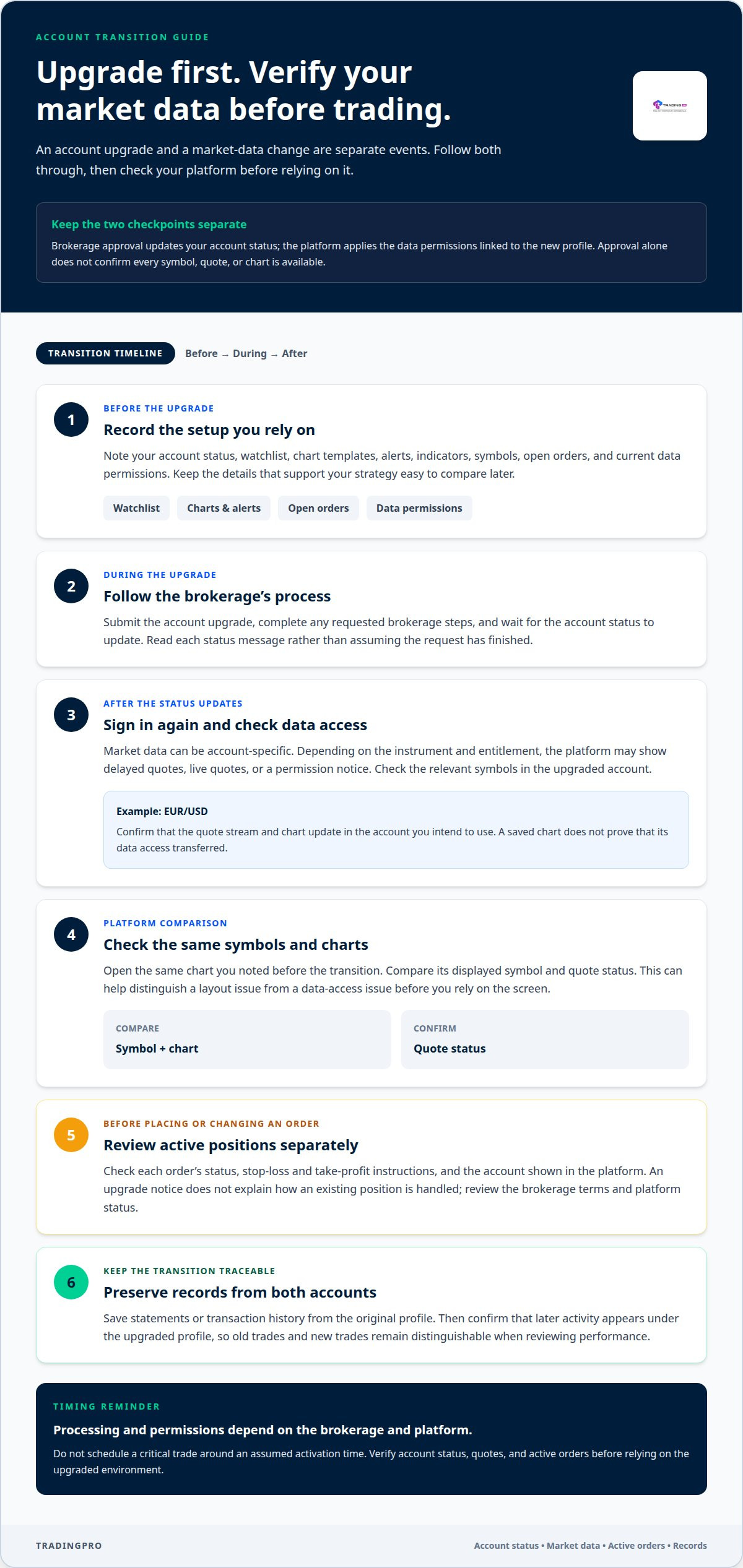
An account upgrade and a market-data change are separate events. The brokerage processes the account request, while the trading platform applies the data permissions linked to the new profile. Plan for both before changing your workflow. An approval notice alone doesn’t confirm that every symbol, quote, and chart is available in the upgraded environment.
Start by identifying the sequence. Submit the account upgrade, complete any requested brokerage steps, and wait for the account status to update. Then sign in again and check the relevant market-data access. Timing depends on the brokerage’s processing and the platform’s permissions, so don’t schedule a critical trade around an assumed activation time.
Market data can be account-specific. Depending on the instrument and data entitlement, a platform may display delayed quotes, live quotes, or a permission notice. For example, if your strategy follows EUR/USD, confirm that its quote stream and chart update in the account you intend to use. A saved chart doesn’t prove that its data access has transferred.
Before switching, record the setup that supports your strategy. Note your watchlist, chart templates, alerts, and any indicators tied to specific symbols. Afterward, open the same EUR/USD chart and compare its displayed symbol and quote status. This quick check can distinguish a layout issue from an access issue before you rely on the screen.
Review open positions separately. Check order status, stop-loss and take-profit instructions, and the account shown in the platform. An upgrade notice doesn’t explain how an existing position is handled. Review the brokerage’s account terms and the platform status to understand the transition before placing a new order or changing an active one.
Keep your profit records aligned with the correct account. Save statements or transaction history from the original profile, then confirm that later activity appears under the upgraded profile. This gives you a clear record of the switch and helps distinguish old trades from new ones when reviewing performance.
- Before: note the account status, symbols, open orders, and data permissions.
- During: follow the brokerage’s upgrade sequence and read each status message.
- After: sign in again, verify quotes, and review active orders before trading.
Use this transition check as part of your trading plan, not as a substitute for it. If you’re ready to begin account setup, use the secure account registration form and review the account details before you trade.
Choosing an account for different trading strategies
Choose an account based on how your strategy trades, not the title attached to it. A scalper who enters and exits quickly may prioritize execution conditions and transaction costs. A swing trader holding EUR/USD through longer moves may weigh financing terms and overnight position rules more heavily. Match the account’s actual conditions to your strategy’s demands.
For frequent trading, calculate how spreads and commissions affect your expected activity. That figure is a comparison point, not a universal charge. Review both the commission structure and spread, then consider how each affects your planned entries and exits.
A scalping approach can be sensitive to small differences in execution costs because it may involve repeated trades. For example, someone making several EUR/USD entries should assess the combined spread and commission, not just the cost of one position. Also consider whether the account’s trading conditions suit the strategy’s timing and order types.
A swing strategy has different pressure points. If you hold a position through market sessions, overnight terms and margin rules may matter more than a narrow intraday spread. Compare your planned holding period with the account’s stated conditions. A strategy that depends on keeping positions open needs terms that support that approach.
For a one-pair method, such as trading only EUR/USD, focus on that instrument’s costs, available data, and the account rules for open positions. Trading one pair doesn’t automatically require a professional tier. The deciding question is whether the account fits your method, not whether its name sounds more advanced.
Use this comparison to structure your decision:
- Scalping: weigh spreads, commissions, execution, and frequent order handling.
- Day trading: assess intraday costs, order controls, and your planned position size.
- Swing trading: examine overnight terms, margin, and rules for holding positions.
- Single-pair trading: compare conditions for the pair you actually trade, such as EUR/USD.
Test the account against a representative trade from your plan. Record the instrument, entry and exit approach, likely holding period, and applicable costs. This makes differences visible without assuming one account suits every trader. If the terms don’t support your strategy’s core requirements, a higher tier alone won’t solve the mismatch.
Review the comparison whenever your method changes. A trader moving from occasional swing positions to frequent intraday entries may need to reassess costs and account conditions. Keep your strategy, account terms, and risk limits aligned before switching.
Moving from the evaluation Test to a PRO account
Passing an evaluation Test marks a change in account stage, not simply a new label. The Test measures trading against stated conditions; the PRO account operates under its own terms. Treat the transition as a review point, and compare the evaluation rules with the account rules before placing your next trade.
Start with the Test result and its recorded status. Confirm which criteria were met, whether any positions remain open, and whether the account has reached its final evaluation state. For example, a profitable result may still require formal completion of the Test before the next account stage begins. Keep the result notice and trading record together.
Next, distinguish evaluation limits from the rules governing the PRO account. Review the permitted instruments, position limits, drawdown method, and rules for holding trades. A Test’s loss limit doesn’t automatically define the next account’s risk limit. If the evaluation used EUR/USD, verify that the new account’s terms apply to the same instrument and strategy.
Pay close attention to how equity and drawdown are measured. An end-of-day drawdown uses a different measurement point from a limit monitored during active trading. That distinction affects how you plan entries, exits, and overnight exposure. Write down the applicable calculation before trading; don’t rely on memory of a Test limit.
Then confirm the account structure and profit rules. Determine whether profits remain in the account, become eligible for withdrawal, or follow a split arrangement. Check the calculation basis, any threshold, and when a withdrawal can be requested. A Test balance and a PRO account balance may serve different purposes, so keep them as separate records.
Use a transition checklist to keep the change controlled:
- Complete: confirm the Test’s final status and save its result.
- Compare: review the PRO account’s instruments, risk limits, and drawdown calculation.
- Reconcile: identify how the starting balance and profits are treated.
- Prepare: update position sizing and risk limits to match the new terms.
- Begin: place a trade only after the platform displays the intended account.
For example, a trader whose Test strategy used small EUR/USD positions should recalculate position size under the PRO account’s rules. The same lot size can carry different risk if the account’s drawdown method or available margin changes. Keep your first trades consistent with the written plan.
Finally, keep the Test record, new account terms, and subsequent statements together. These documents help distinguish evaluation performance from PRO account results. A clear record also makes it easier to assess whether the strategy still fits the account after the transition.
Opening and verifying a Pro account
Opening a Pro Account starts with the application, but verification and account selection matter just as much. Keep your account details consistent from the first form through the platform login. For example, a mismatch between the name on an application and the identity information provided can require correction before the account is ready to use.
Begin by selecting the intended account type and completing each application field accurately. Use your personal details as they appear on the identity information you provide. Review your contact details before submitting, since a mistyped email address can disrupt account notices or access steps.
Verification generally confirms the information associated with the account. Follow the application prompts and provide the requested identity and account information through the designated process. Don’t submit unrelated files or alter a document to fit a prompt. If a submission is rejected, use the stated reason to correct that specific issue before trying again.
Keep the stages distinct. Registration creates an application; verification reviews its details; account activation allows access to the trading environment. Completing one stage doesn’t automatically finish the next. Check the displayed account status to see where you are, then follow the next instruction on screen.
Before funding or placing an order, review the account terms and confirm that the correct profile is open. Check that the account name, trading platform, and selected instruments match your plan. For example, if you intend to trade EUR/USD, locate that symbol in the active account before preparing an order.
Use this ordered checklist to reduce avoidable errors:
- Select: choose the account type that matches your intended trading approach.
- Complete: enter accurate personal and account information.
- Submit: provide the verification details requested in the application.
- Review: read the account terms and confirm the displayed account status.
- Test access: open the trading platform and locate your intended instrument before trading.
Protect your login credentials during setup. Use the account’s sign-in process, avoid sharing passwords, and sign out on a shared device. If you use a phone and desktop, confirm both sessions show the same account profile before managing an order.
After activation, save the application confirmation and account terms with your trading records. These give you a clear reference if you later need to review the account type, verification status, or settings. Start your Pro account registration by completing the application accurately and following its verification prompts.
TradingPRO: Social Trading / Copy Trading
TradingPRO offers Social Trading / Copy Trading for traders who want to replicate other traders’ strategies. It can complement a Pro Account if you’re exploring approaches beyond your own single-pair method, but copying trades doesn’t remove market risk or replace your own account decisions.
Choose an account structure that fits your experience and trading approach. A Rookie Account or Micro Account may suit a different starting point than a Pro Account. Consider how copied strategies fit your risk limits, preferred instruments, and plans for monitoring positions. Stay responsible for understanding your trading activity and its potential losses.
To explore whether Social Trading / Copy Trading or an account option fits your strategy, contact TradingPRO.
Set Your Next Trading Standard
The decision to transition to a pro trading account should support the trader you’re becoming, not just the trades you place today. Define what you want your account to enable next, then choose a structure that fits your strategy, risk discipline, and preferred level of involvement. Make the choice part of your trading plan and revisit it as your approach develops.
TradingPRO offers Rookie Account, Micro Account, and Pro Account options. Choose a starting point that aligns with your current objectives and how you intend to trade. Build deliberately, stay focused on your process, and let each decision earn its place in your plan.
Explore account registration and take your next step with a clear strategy. Your progress starts with a choice you understand and can stand behind.
Frequently Asked Questions
Is a Pro Account better for all strategies?
No. A Pro Account isn’t automatically the best fit for every strategy; suitability depends on the account terms and your trading method. A trader focused on one currency pair may value predictable costs and position controls more than a professional label. Someone placing frequent trades may weigh per-trade costs differently. Compare the account’s conditions with your holding periods, order frequency, and risk limits before changing tiers.
What Is a Pro Account in Forex and CFD Trading?
A Pro Account is a brokerage account tier for trading instruments such as forex and CFDs under the brokerage’s stated conditions. The term isn’t a universal technical standard: features depend on the brokerage and applicable client classification. For a practical comparison, review instruments, margin rules, costs, execution conditions, and account protections. The label alone doesn’t establish access, pricing, or professional status under local rules.
What matters more: spread, commission, or execution?
None matters in isolation; assess their combined effect on your trades. The spread is the difference between an instrument’s buying and selling prices, while commission is a separate trading charge when applicable. Execution affects the price at which an order fills. For example, compare the total cost and expected fill quality for the same instrument and order size, rather than choosing by the spread alone.
Who Is Considered as Pro Trader?
“Pro trader” has no single definition across brokerages or jurisdictions. Trading descriptions often associate the profile with trading more than 100 lots per month and adding funds above $10,000. Those figures are examples, not universal qualification criteria. A brokerage may assess account eligibility separately from trading activity, so describing yourself as professional doesn’t itself change your account status or classification.
What is a pro trading account and how does it differ from a standard retail account?
A professional trading account is an account classified or structured for professional trading under the brokerage’s terms. Compared with a retail account, its trading conditions and protections may differ. Professional classification can affect leverage availability and investor safeguards, while the exact effects depend on local rules and account terms. Don’t assume the “pro” label means the same conditions across brokers or jurisdictions.
How do I apply to upgrade to a professional trading account?
Submit the brokerage’s account or classification request, provide the requested information, and review the updated terms before trading. If you already have an account, distinguish whether you’re requesting a tier change or professional client classification; they may involve different processes. Keep the confirmation and note any changes to margin, protections, and account conditions so your trading plan reflects the account you actually hold.
What documents or proof of trading experience and assets are required?
The application’s verification and classification criteria determine what proof is required. It may request identity information, evidence related to trading history or assets, or both. No single document establishes qualification for every account. Submit current, readable records in the requested format, and keep the details consistent with your application. Trading experience or account funding alone doesn’t necessarily change your account classification.
What fees, commissions, and minimum deposits apply to pro trading accounts?
Fees, commissions, and minimum deposits depend on the brokerage and account terms; there’s no single schedule for every Pro Account. Trading costs may include spreads and commissions, while funding thresholds are set by the relevant account conditions. Compare the combined costs for your instrument and trading frequency, then review the account’s funding terms before transferring money. Don’t judge suitability by one charge alone.


