




- Published on: 2026-11-01 10:17:30
Managing a Multi-Strategy Portfolio Through Active Allocation

A portfolio built around several strategies can still concentrate risk in one place. Managing a multi-strategy portfolio means combining approaches and actively adjusting their allocations as markets change. Diversification can spread exposure, but strategies may move together in extreme markets, so it does not eliminate the risk of loss.
More strategies do not automatically make a portfolio more balanced. What matters is how their risks interact, how exposures are monitored, and whether allocations respond to market conditions. This guide explains what a multi-strategy approach involves, how active allocation shapes the portfolio, and why risk controls, liquidity, and coordination matter. It also covers how multi-asset management capabilities can connect analysis, exposure monitoring, and trade execution, creating a clearer operational framework for portfolio decisions.
Key Takeaways
- See how equities, fixed income, and cash can serve different roles in a diversified portfolio, while recognizing that spreading investments doesn’t remove loss risk.
- Use equal-risk contribution as a starting framework, then assess whether strategy groups create unintended concentration.
- Account for liquidity constraints, changing opportunities, and strategies that may move together during extreme markets.
- Connect allocation decisions with exposure monitoring, portfolio-level risk evaluation, and trade execution across asset classes.
- Explore how drawdown controls and ongoing review can help keep a multi-strategy portfolio aligned with its risk goals.
What is multi-asset portfolio management?
Multi-asset portfolio management coordinates investments across asset classes, regions, and sectors. A manager may combine equities, fixed income, and cash, then adjust exposure as market and economic conditions change.
Diversifying Across Asset Classes
Diversification across asset classes spreads investments among holdings with different sources of return, such as equities, fixed income, and cash. This matters because one market driver may affect each holding differently. For example, equities can rise or fall with company and market conditions, while fixed income responds to interest rates and credit factors.
A multi-asset team may take a top-down approach, assessing economic developments before allocating across regions, sectors, and asset classes. This differs from bottom-up equity research, which may focus on individual companies’ financial statements. For example, a manager assessing a macroeconomic shift may consider its potential effects on equity and fixed-income exposures before changing allocations.
Diversification and Absolute-Return Objectives
An absolute-return objective seeks a positive return against a defined benchmark, rather than simply measuring performance against an equity index. For diversifying strategies, one stated target is cash plus 4.0% to 6.0%, net of fees. This illustrates how an objective can frame a strategy’s role without making its outcome certain.
Use that objective to assess the portfolio’s purpose, not as a promise of performance. A cash-plus target asks whether strategies can pursue returns beyond cash, while diversification considers how those strategies interact. A portfolio can hold several strategies and still concentrate risk if they respond similarly to market events.
Compare each strategy’s expected role with its actual exposures and sources of return. For example, equity long-short seeks gains from both undervalued and overvalued stocks, while fixed-income arbitrage focuses on relative pricing within bond markets. Labels alone do not establish diversification. Evaluate what could drive gains or losses, then consider how those drivers fit the portfolio’s objective.
Diversification and Portfolio Efficiency
Portfolio efficiency means combining investments to pursue a target return while managing overall risk. Diversification can support that aim when holdings have different return drivers, but it does not remove the risk of investment losses. The distinction matters: diversification describes how broadly a portfolio is spread, while multi-asset management actively decides what to hold and how allocations should change.
For example, a portfolio could own equities, bonds, and cash but leave their weights unchanged as market conditions shift. Active multi-asset management adds research and allocation decisions across asset classes, regions, and sectors. Managers may use passive or active external managers, including mutual funds, hedge funds, and ETFs, to gain equity exposure.
Measure efficiency at the portfolio level rather than judging each investment in isolation. A strong individual return may add little value if it duplicates existing exposure. Conversely, a holding with a different return driver may help balance the overall mix. Review positions, shared sensitivities, and each holding’s contribution to the objective. Adjust allocations when those relationships change.
What Is a Multi-Strategy Approach?
A multi-strategy approach combines distinct investment methods, then allocates risk among them. Its design accounts for how strategies behave individually and together.
Equal-Risk Contribution as a Starting Point
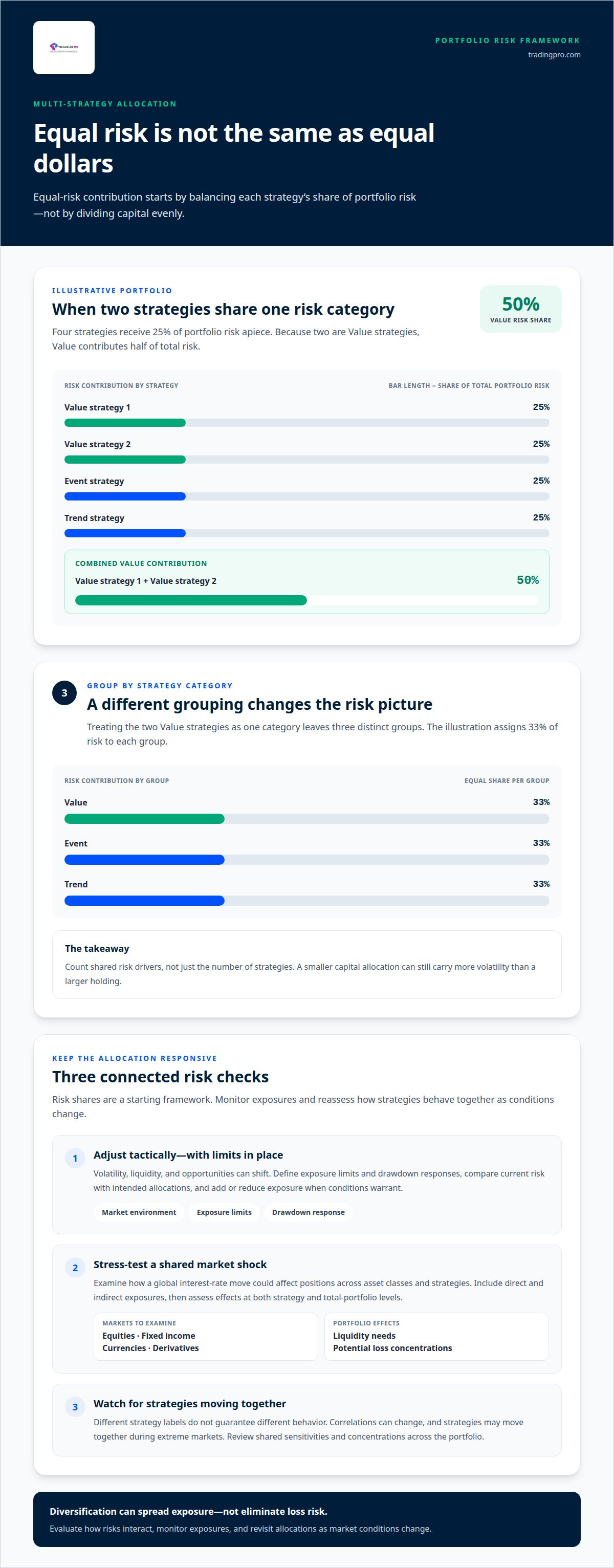
Equal-risk contribution assigns each strategy or strategy group a comparable share of portfolio risk, rather than equal dollars. It matters because a smaller capital allocation can still carry more volatility than a larger holding. In an illustrative portfolio with two Value strategies, an event strategy, and a trend strategy, assigning 25% of risk to each leaves Value carrying 50% of total portfolio risk. Grouping those strategies into three distinct categories instead assigns 33% of risk to each group.
Tactical Allocation and Risk Controls
Tactical allocation adjusts strategy weights as the market environment changes. This matters because the same mix can behave differently as volatility, liquidity, and opportunities shift. Risk controls define exposure limits and responses to drawdowns before positions expand. Managers can compare current risk with intended allocations, then reduce or add exposure when conditions warrant. This makes adjustments deliberate rather than a reaction to one losing trade.
Cross-Asset Risk and Stress Testing
Cross-asset stress testing examines how a portfolio might respond to a shared shock across markets. Test a global interest-rate move against equities, fixed income, currencies, and derivatives held across strategies. Review direct holdings and indirect exposures, since separate positions can depend on the same market driver. Then compare effects at both the strategy and total-portfolio levels, including liquidity needs and potential concentrations of loss. This reveals where one shock could affect several positions at once.
Managing Cross-Strategy Correlation Risk
Cross-strategy correlation measures whether distinct strategies tend to move together; the danger is assuming those relationships stay fixed. During extreme markets, strategies that usually differ may become correlated, weakening diversification under pressure. Use history as context, not as a forecast: the S&P 500 and HFRI Macro had 0.30 correlation over 1/1/1991 - 6/30/2019.
Buy-side teams assess portfolio exposures for investors, while sell-side desks manage exposures created by facilitating trades. Compare these perspectives when reviewing a position: a trade that looks contained on one desk may add to a broader portfolio concentration. Social Trading / Copy Trading lets users replicate traders’ strategies, but following a strategy doesn’t replace assessing its exposures. If you want to explore strategy replication, create a TradingPRO account and consider how copied positions fit your own risk framework.
Challenges of constructing a multi-strategy portfolio
Portfolio construction means balancing strategy exposures, trading capacity, liquidity, and expected returns. Evaluate performance by comparing net returns with the portfolio’s objective, then examine volatility, drawdowns, and each strategy’s contribution over the same period.
Long-Only and Long-Short Construction
Long-only portfolios hold positions expected to rise, while long-short portfolios combine long and short positions. This choice matters because each structure creates different market exposures and requires different risk controls. An equity long-short strategy can buy stocks considered undervalued and sell those considered overvalued, making stock selection central to its results.
Construction also depends on how strategies combine. A portfolio might pair equity long-short with relative-value and event-driven strategies, each with distinct return drivers. Compare their underlying positions, not just their labels. Two strategies in different asset classes can still share exposure to the same market event, while strategies in one asset class may respond differently.
Capacity and Liquidity Constraints
Capacity is the amount a strategy can deploy before additional capital makes trading harder or changes its opportunity set. It matters because rapid inflows can crowd trades and strain liquidity. As more participants entered arbitrage markets, opportunities declined and liquidity became a challenge for fast-growing hedge funds; some expanded into new investment areas in response.
Liquidity also affects how quickly an investor can withdraw or reposition capital. Multi-strategy hedge funds often impose monthly to quarterly liquidity constraints, with notice periods of 30 to 90 days. Align those terms with the portfolio’s cash needs. A strategy’s expected returns should be considered alongside whether its withdrawal schedule fits planned obligations.
Evaluating Portfolio Performance
Performance evaluation compares what a portfolio delivered with its stated objective and the risks taken to pursue it. This matters because a strong return alone can conceal rising volatility, a deep drawdown, or reliance on one strategy. Review net performance, risk, and liquidity together, using a consistent measurement period and method across the strategies being compared.
Attribute portfolio results to their sources. For example, separate gains from equity long-short stock selection from returns generated by event-driven positions. Then assess whether strategy weights or market exposures explain changes in results. This helps distinguish a repeatable contribution from a temporary benefit of market conditions.
Finally, compare realized outcomes with the portfolio’s intended role. Assess a strategy intended to diversify by how it behaved alongside other holdings, especially during market stress. Review its losses, recovery pattern, and effect on total portfolio volatility. The goal is to understand its contribution and trade-offs, not to rank it by return alone.
Multi-asset portfolio management capabilities
Effective management connects research, allocation, exposure monitoring, and execution across assets. Managing a multi-strategy portfolio also means linking these capabilities so decisions reflect the full portfolio, not isolated positions.
Management Tools
A multi-asset management system brings positions, exposures, risk, and performance into a connected view. This matters because portfolio managers need to see how separate holdings combine, not just how each account performs. For example, monitoring equity, fixed-income, and derivatives positions together can reveal overlapping exposures that separate reports might obscure.
Track real-time profit and loss at both portfolio and strategy level, then compare each result with its risk contribution. A sudden gain in one strategy can mask deterioration elsewhere. Reviewing both views helps distinguish broad portfolio strength from reliance on a single source of return. These tools make managing a multi-strategy portfolio more precise by connecting strategy-level activity with total portfolio risk.
Quantitative analysts can build top-down forecasting models, while strategists assess global trends and sectors. A team might use that analysis to update its model portfolio, then give allocation guidance to portfolio managers. This structure links research to decisions without confusing a model portfolio with direct investment positions.
Portfolio Benchmarks
A portfolio benchmark is a reference point for assessing performance against an intended objective or investment profile. This matters because a broad equity index may not reflect the risks or return sources of a portfolio holding several strategies. Choose comparisons that match the portfolio’s mandate and explain the role each reference plays.
For example, the HFRI Fund Weighted Composite and HFRI Equity Hedge indices represent different hedge fund strategy exposures. Comparing a multi-strategy portfolio with either index can provide context, but the comparison should account for differences in holdings, leverage, liquidity, and strategy mix. A benchmark is a measuring tool, not a substitute for portfolio analysis.
Pair benchmark comparisons with portfolio-level measures. Review returns alongside volatility, drawdowns, and each strategy’s contribution over matching periods. If a portfolio targets diversifying returns, compare its behavior with relevant market exposures as well as its stated objective. This helps identify whether results reflect allocation decisions, broad market movements, or a strategy’s specific investment profile.
Keep the benchmark framework consistent as the portfolio changes. When a manager adds a strategy or shifts the asset mix, document how that change affects the comparison. A clear record helps investors distinguish a genuine change in performance from a change in the yardstick.
What are common risk management methods for a multi-strategy portfolio?
Common methods combine risk budgets, exposure limits, stress tests, liquidity planning, and drawdown controls. Apply them across the full portfolio and to each strategy, because a loss in one sleeve can coincide with pressure elsewhere.
Set Risk Budgets and Exposure Limits
A risk budget sets how much portfolio risk each strategy may contribute. Pair it with limits on exposure, leverage, or concentration, then review any breaches against the portfolio’s objectives. For example, if equity long-short positions and a trend strategy both depend heavily on equity markets, their combined exposure matters more than either allocation viewed alone.
Risk limits should reflect each strategy’s role and the assets it trades. A market-neutral approach and a directional global macro strategy do not have identical exposure profiles. Compare position-level, strategy-level, and portfolio-level risk before changing allocations. This layered view can reveal concentrations that a capital-weighted allocation alone may miss.
Stress-Test Market Shocks
Stress testing estimates how holdings could respond to adverse market scenarios. Model a sharp equity decline alongside changing interest rates, wider credit spreads, or reduced liquidity. Then assess which strategies could lose value together and whether the resulting portfolio drawdown fits its risk limits.
Historical correlations provide context, but relationships between strategies can change in extreme markets. Scenario tests should therefore include shocks that recent market behavior may not represent well. Review direct positions and indirect exposures, such as derivatives in one strategy that may respond to the same underlying market move as its equity holdings.
Control Drawdowns and Leverage
Drawdown controls define how a manager responds when portfolio value falls from a previous peak. Set review triggers and specify whether the response involves reducing positions, adjusting strategy weights, or reassessing assumptions. This helps prevent a difficult period from turning into unmanaged exposure across several strategies.
Leverage and derivatives need particular attention. Trading futures, commodities, options, derivatives, and other financial instruments can result in losing the full account balance. Trading derivatives or using leverage can also result in losses greater than the initial deposit. Track the potential loss on each position and its contribution to total portfolio exposure.
Match Liquidity to Risk Capacity
Liquidity planning connects redemption terms with the portfolio’s obligations. For hedge funds, notice periods can range from 30 to 90 days, while liquidity constraints may be monthly to quarterly. A portfolio that must meet near-term cash needs should account for these terms before allocating capital, not after a withdrawal request arises.
Use regular reviews to connect limits, stress scenarios, drawdowns, and liquidity needs. For example, a rising drawdown combined with falling market liquidity may call for a faster reassessment than either signal alone. To put your trading plans into practice, create a TradingPRO account.
TradingPRO: Rookie Account
TradingPRO’s Rookie Account is a natural starting point for readers exploring individual trading after learning how portfolio strategies and risks interact. Multi-strategy portfolio management involves allocation and risk decisions across a combined portfolio; a trading account serves a different purpose by supporting an individual’s own trading activity.
Choose an account tier that aligns with your experience and trading approach. Alongside the Rookie Account, TradingPRO offers Micro, Pro, and Scalp accounts. These account options provide a practical next step for readers moving from understanding market concepts to considering their own trading approach, while keeping personal risk decisions in focus.
Visit tradingpro.com to explore TradingPRO’s account options.
Put Your Risk Framework Into Practice
Active allocation is an ongoing discipline, not a one-time portfolio design. As market conditions shift, keep a clear record of why each position belongs, what could change its role, and how much risk it contributes. This decision process can also sharpen individual trading: define the exposure you intend to take, the conditions that would change your view, and the loss level you can accept before entering a position.
Managing a multi-strategy portfolio and trading through an individual account are different activities. Apply the same focus on risk and deliberate decisions, but do not assume a diversified portfolio framework translates directly into a personal trading plan. TradingPRO’s account options provide a place to pursue your own trading approach, with responsibility for decisions remaining yours.
Choose a clear next step and build from your own goals and risk tolerance. Explore TradingPRO account options and take your next step with confidence.
Frequently Asked Questions
What is a multi-strategy investment portfolio?
A multi-strategy portfolio combines distinct investment approaches within one framework, with each approach seeking returns through different market behaviors or instruments. A portfolio might pair equity long-short positions with event-driven investments and trend strategies. The manager considers how those approaches interact rather than assessing each in isolation. The structure can use internal teams, external managers, or both, depending on who selects and oversees each strategy.
How do you set asset allocation across multiple investment strategies?
Managing a multi-strategy portfolio starts with defining the portfolio’s objective and each strategy’s intended role. Then assess risk contribution, exposures, liquidity, and how strategies may respond to shared market events. For example, two strategies with different labels may both depend on equity volatility. Set an initial allocation based on those relationships, test how the mix behaves under different conditions, and revise it when assumptions or portfolio needs change.
How can you diversify strategies by asset class, market, and investment style?
Map each strategy by the assets it trades, the markets it accesses, and the method it uses to seek returns. For example, strategies in different regions may still share exposure to the same interest-rate move. Compare directional approaches with relative-value methods, then identify common drivers across instruments and markets. This can reveal hidden concentrations and help determine whether a proposed strategy adds a distinct source of risk and return.
How do you measure correlation and diversification benefits between strategies?
Compare strategy returns over matching periods and assess how closely they move together. Review the relationship across different market environments, since correlation can change under stress. For example, strategies that moved independently in calm conditions may fall together during a sharp sell-off. Correlation describes co-movement, not the size of potential losses, so pair it with drawdown analysis and scenario tests to assess whether diversification meaningfully changes portfolio risk.
How should portfolio managers allocate capital and rebalance across strategies?
Managing a multi-strategy portfolio requires translating each strategy’s risk role into a capital allocation, then monitoring actual exposures against the intended mix. Rebalance when weights drift, liquidity needs change, or a strategy’s risk profile shifts. Before trading, assess whether the adjustment restores the portfolio’s plan or merely reacts to recent results. Record the reason for each change so later reviews can evaluate the decision process.
What are the risks of strategy overlap, leverage, liquidity, and model failure?
Strategy overlap can create concentrated exposure even when approaches appear different. Leverage can amplify losses, while limited liquidity can restrict how quickly positions can be reduced or exited. Model failure can occur when market behavior or input data changes enough to weaken a strategy’s assumptions. For example, a signal based on historical price relationships may become less useful after those relationships shift. Review positions, leverage, exit constraints, and model assumptions together.


