




- Published on: 2026-11-23 18:01:42
How to Survive Your First Month of Live Market Trading

Estimates of day-trader success rates range from 1% to 15%, so a profitable first month alone doesn’t prove you’re on track for consistent results. To learn how to survive your first month of live market trading, focus on a repeatable process: understand your platform, follow a defined strategy, manage risk, and review each trade rather than chasing quick wins.
It’s natural to want tools and indicators that make decisions feel clearer. They work best, though, when you understand what they measure and how they fit your plan. A trading journal, considered feedback, and a supportive community can help you identify patterns without treating one win or loss as a verdict on your ability.
This guide explains how to prepare for live trading, use market tools with purpose, keep a useful journal, and learn from mentors and trading communities. You’ll also see why consistent profitability takes more than a month, and how to make your first month a disciplined start.
Key Takeaways
- Choose mentors and trading communities that encourage thoughtful review and explain their reasoning, not just their results.
- Measure progress through disciplined practice and repeatable decisions, rather than expecting a quick path to consistent profitability.
- Use a trading journal to capture your plan, decisions, and outcomes, then look for patterns during regular reviews.
- Learn what your indicators and platform tools show before relying on them to support a trade decision.
- Build confidence with practice and risk controls before moving from simulated trading to live positions.
Finding a suitable mentor and trading community
Trading can feel isolating, but feedback makes blind spots easier to spot. One brokerage-data analysis reported that 40% of traders quit after one month, while 7% remained active after five years. Those figures underline why support should strengthen your process, not promise quick profits.
Choose a mentor who explains decisions, risk, and mistakes plainly. Ask them to walk through a completed trade: the setup, the point that invalidated the idea, the exit, and what they learned. A useful mentor distinguishes a sound decision from a lucky outcome. Be wary of anyone promising guaranteed returns or urging you to copy trades without explaining the risks.
A trading community can provide structure, peer review, and a place to compare observations. Look for members who discuss their reasoning and acknowledge losses, not only winning screenshots. In one described proprietary trading firm, about 30 traders worked on the floor, with another five to 10 people learning and trying to qualify. That example shows the value of a learning environment, but not a guarantee of success.
Use a simple three-step filter to assess a mentor or group:
- Check whether advice includes a clear strategy and defined risk.
- Compare claims with documented trade examples, including losing trades.
- Notice whether questions are welcomed or replaced with pressure to act.
Paper trading helps you learn order entry and practise a trading plan without risking real money. Live trading adds financial pressure, so simulated confidence can’t reproduce every emotional response. Transition with small, controlled exposure.
A common professional risk benchmark is no more than 1% of capital per trade. Treat it as a ceiling to study, not a promise that losses will stay within that amount under every market condition.
In US live trading, commissions, spreads, and slippage can reduce a trade’s net result, while taxes can affect what remains after trading. Commissions apply to transactions, spreads are the gap between buying and selling prices, and slippage means execution differs from the expected price. Tax treatment depends on your trading activity and circumstances.
Set a daily loss limit before trading by deciding the maximum loss your plan can tolerate. Once you reach it, manage open positions according to your plan, stop entering trades, and review your decisions after the session.
Size each position according to the amount you’re prepared to lose and the distance between your entry and stop. If the stop is farther away, reduce the position size. Never widen the stop simply to avoid taking a planned loss.
Pause live trading if you repeatedly ignore stops, increase position size to recover losses, or feel unable to step away from the screen. If trading causes serious financial or emotional distress, seek qualified professional support before resuming.
How long it takes to become consistently profitable
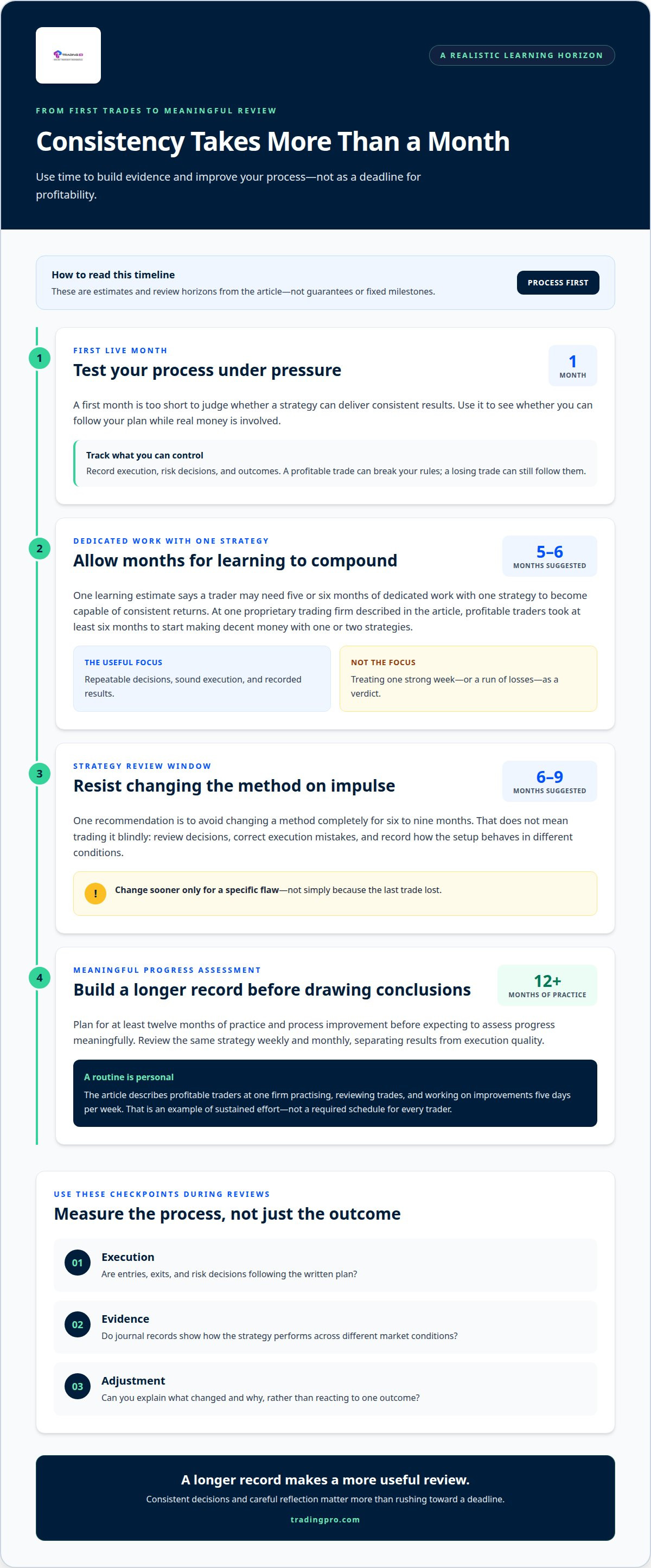
A first month is too short to judge whether a strategy can produce consistent results. Outcomes vary with the method, market conditions, execution, and your ability to follow a plan. Focus on repeatable decisions and recorded results, not one strong week or a run of losses.
One learning estimate suggests a trader may need five or six months of dedicated work with one strategy to become capable of consistent returns. At a proprietary trading firm described in the research, profitable traders took at least six months to start making decent money with one or two strategies. These examples point to a process measured in months, not days.
Give a method enough time to produce useful evidence. One recommendation is to avoid changing it completely for six to nine months. That doesn’t mean trading it blindly: review your decisions, correct execution mistakes, and record how the setup behaves in different conditions. Change the method sooner only when you identify a specific flaw, not simply because the last trade lost.
A practical evaluation can use three checkpoints:
- Execution: Are entries, exits, and risk decisions following the written plan?
- Evidence: Do journal records show how the strategy performs across different market conditions?
- Adjustment: Can you explain what changed and why, rather than reacting to one outcome?
Plan for at least twelve months of practice and process improvement before expecting to assess your progress meaningfully. Review the same strategy weekly and monthly, separating results from execution quality. A profitable trade can still break your rules, and a losing trade can still follow them. This distinction helps prevent short-term outcomes from driving constant strategy changes.
Consistency also depends on realistic practice. The profitable traders in the firm example practised, reviewed trades, and worked on improvements five days per week. That describes sustained effort, not a required schedule for every trader. Choose a routine you can maintain, then use each review to identify one clear improvement for the next session.
Use your first month of live trading to test whether you can follow your process under real financial pressure. Don’t treat it as a deadline for profitability. If you’re still refining entries or risk decisions, continued practice and careful review will provide more useful evidence than switching methods after a brief losing period.
Another useful benchmark is survival at break-even: the page states that a trader who can trade around break-even without losing money is doing better than 99% of traders. Treat that as a sign of process control, not proof that the approach is ready to scale. Staying near break-even while following the plan can still reveal whether losses come from execution, risk decisions, or the strategy itself.
Use reviews to decide whether to keep the method, correct a defined weakness, or pause live exposure while you practise. Assess decision quality and the evidence you’ve gathered, rather than rewarding a short burst of gains. If the method remains unclear, write down what observation would justify a change before making one. This makes patience active, gives each review a specific purpose, and stops every result from becoming a verdict.
Keeping and reviewing a trading journal
Build a journal around decisions, not just profit and loss. For every trade, record the setup, planned entry, exit conditions, position size, and reason for taking it. After closing, add the result and note whether you followed your rules. This separates a well-executed losing trade from a profitable trade that broke your plan.
Keep entries clear enough to review later. A short note such as “entered after the planned signal; exited at the stop” is more useful than a vague comment like “bad trade.” Record the market conditions you noticed, the tool or indicator that informed your decision, and any changes you made while the position was open. These details help reveal repeated choices.
To create and follow a simple plan during your first month, write down your setup, entry trigger, exit rule, and risk limit before trading. Apply the same plan to each eligible trade, then record any deviation and its reason in your journal.
A practical journal entry can include:
- Before entry: The setup, trigger, planned exit, and reason the trade fits your strategy.
- During the trade: Any adjustment, including what market information prompted it.
- After exit: The outcome, whether you followed the plan, and one lesson for review.
Review entries weekly to spot execution patterns, then monthly to assess the strategy more broadly. Focus on one or two strategies so comparisons remain meaningful. If you use different setups, label each clearly; otherwise, results from one method may hide another’s weaknesses.
Look for repeated behaviours, not one memorable loss. For example, if several entries show that you moved an exit rule after a trade went against you, treat that as a process issue. If trades followed the plan but results varied, record the distinction instead of rewriting the strategy immediately.
Common beginner mistakes include entering without a defined setup, changing rules after a loss, and taking trades to recover money. Reduce these errors by writing your plan before the session and recording every deviation as it happens.
At each review, choose one improvement to test in your next session. You might wait for the stated entry signal, avoid an unplanned adjustment, or record why you skipped a setup. Use your next journal entries to see whether the change improved execution. Focused reviews turn daily notes into practical feedback instead of a record you never use.
Use each review to assess whether your approach is becoming more consistent instead of reacting to an isolated outcome. Keep weekly reviews focused on individual decisions, and use monthly reviews to consider broader adjustments. When testing an improvement, note which strategy it concerns so the observation remains useful. Stay focused on one or two strategies as you review trades weekly and monthly and work to improve your results.
Learning trading tools and indicators
Start with the platform features your strategy needs: a price chart, order ticket, watchlist, and trade history. Learn where each setting is before a live session. For example, locate the order type, quantity field, and exit controls before entering a position. Familiarity reduces avoidable mistakes, but it doesn’t remove market risk.
Indicators process market data; they don’t predict outcomes. A moving average smooths past prices, while the relative strength index measures recent price momentum. Use an indicator to answer a defined question, such as whether price is above or below its recent average. Several overlapping indicators can make a chart harder to interpret without adding useful evidence.
Build your learning around one chart setup. First, identify what the indicator measures and which data it uses. Next, observe how it behaves in different market conditions. Then record what it showed before and after each potential entry. A moving average, for instance, can help describe direction, but may react slowly after a sharp price change.
Market orders, limit orders, and stop orders serve different purposes. A market order seeks execution at available prices. A limit order sets the maximum buying price or minimum selling price, and may not fill. A stop order activates when its trigger price is reached and typically becomes a market order; execution can differ from the trigger price.
Practise order entry in a simulated environment before using live funds. Try entering and cancelling a limit order, then observe what happens if the price doesn’t reach it. Review how a stop behaves around its trigger. These exercises show the difference between an order’s instruction and its actual execution.
- Charting: Learn to change timeframes and identify the price data displayed.
- Indicators: Tie each indicator to one question in your written strategy.
- Orders: Understand the conditions that can fill, trigger, or leave an order unfilled.
- Review: Compare the planned entry with the executed price and the market movement.
Keep your display focused. If your plan uses a trend indicator and a price level, make those visible first. Remove signals that don’t affect a decision. A clean chart makes it easier to see whether a setup qualifies, rather than searching for a reason to trade.
For example, if price crosses above a moving average but your entry rule also requires a pullback, don’t enter on the cross alone. Record whether the pullback occurred and how the order was executed. This turns a chart signal into a repeatable decision instead of an impulse.
Explore a trading tools hub as part of your platform learning, then focus on the features that support your own plan.
What should a beginner do before placing their first live trade?
Spend your first few months practising on a demo account or using backtesting software. This gives you time to learn order entry and observe how your strategy responds to market conditions. Paper trading uses simulated money, so you can rehearse decisions without risking real funds.
Use practice to test a specific plan, not to chase perfect results. Define the setup, entry signal, exit conditions, and position size before each simulated trade. Then record whether you followed those rules. Studying 1,000 charts can build familiarity, but a live setup may still behave differently from anything you’ve reviewed.
Learning how to survive your first month of live market trading starts with understanding order types. A market order seeks execution at available prices. A limit order sets a price boundary but may not fill. A stop order activates at its trigger and can execute at a different price. Practise placing, changing, and cancelling each type in simulation.
Set your risk boundaries before funding a live position. Choose an amount you can afford to lose, decide where the trade idea is invalidated, and size the position around that exit. Don’t use money needed for rent, bills, or essential expenses. Keep trading funds separate from your everyday budget.
Margin requires extra care. FINRA warns that day trading on margin can expose you to losses beyond your initial investment. In the United States, FINRA requires pattern day traders to maintain at least $25,000 in a margin account. That rule applies to US pattern day traders, not every trading approach or country.
Use this readiness check before your first live order:
- Plan: You can state the setup and the condition that cancels it.
- Platform: You know how to enter, review, and close an order.
- Risk: You’ve set position size and a daily stopping point in advance.
- Mindset: You can accept a planned loss without immediately trying to recover it.
A clear readiness check can help you decide how to survive your first month of live market trading without rushing into a position. If an item is missing, return to simulation and practise that specific skill. For example, rehearse order entry if you’re unsure which ticket settings control quantity or order type. Move to live trading when the process is clear, not because a calendar says it’s time.
Ready to take the next step after building your plan and understanding the risks? Create your trading account.
TradingPRO: Social Trading / Copy Trading
TradingPRO offers Social Trading / Copy Trading for traders who want to follow and replicate other traders’ strategies. It can help you observe different approaches while you build your understanding of entries, exits, and risk.
Use copy trading as a learning aid, not a replacement for a plan. Review the strategy you follow, consider how its decisions fit your goals, and keep its risks in mind. Copying another trader’s positions doesn’t remove the possibility of losses or guarantee consistent profitability.
If you’re ready to explore this approach, contact TradingPRO to discuss Social Trading / Copy Trading.
Make your next trading decision deliberate
Your next step is to turn what you’ve learned into a standard you can apply consistently. Decide what conditions must be present before you trade, what would make you stand aside, and how you’ll assess your decisions afterward. This framework gives each session a purpose beyond chasing a particular outcome.
Thinking about how to survive your first month of live market trading means treating it as the start of a longer learning process. Keep your expectations grounded, protect your ability to continue, and let evidence guide adjustments to your approach. For traders looking to expand their analytical foundation into advanced valuation and market analysis, Financial Modelling University offers structured training to develop professional financial skills.
TradingPRO offers Rookie Account, Micro Account, and Pro Account options. Consider which account aligns with your current trading goals and approach, then take your next step with care.
Contact TradingPRO to discuss your trading goals. Build your process one considered decision at a time, and keep moving forward with confidence.
Frequently Asked Questions
What Is the Success Rate of Day Traders?
Estimates of day-trader success rates range from 1% to 15%. The range depends partly on how success is defined, such as whether it means making money over a short period or sustaining profits over time. A beginner should treat an early gain as one result, not proof of a durable edge. Track performance across trades and compare it with the strategy’s rules.
What about traders who make money right away?
Early profits can happen, but they don’t prove that a trader has a repeatable method. For example, a position might gain from a favourable market move even if the entry ignored the plan. Review the decision alongside the outcome: Was the setup valid? Was the exit planned? Consistent execution offers more useful evidence than celebrating or increasing a position after one win.
How to use a trading journal to review trades and improve?
Use each journal entry to test one specific question about your decisions. For example, mark trades taken in a particular market condition, then compare how closely each followed your rules. During review, group similar setups and note recurring differences in execution. Choose one adjustment to observe in later trades instead of changing several parts of your approach at once. This makes your journal a tool for focused learning.


