




- Published on: 2026-11-14 09:05:07
How to Assess Following Market Analysis Reports and Their Price

A market report is useful when it helps you make a better decision. Market analysis examines an industry, target customers, competitors, and market conditions to assess whether a business idea is likely to succeed. Following market analysis reports can reveal the evidence behind an opportunity, but their value depends on how closely the coverage fits your decision.
A report should do more than describe a market. You need to know what it covers, how current and credible its evidence is, and whether it points to a practical next step. This guide explains why market analysis matters, how internal and external analysis differ, and what to look for in live coverage. It also outlines the factors that shape report pricing, so you can assess scope and relevance before committing budget.
Key Takeaways
- Connect market opportunity, demand, risk, and competition to the decision you need to make.
- Separate internal performance from external market forces to see where the real constraints and opportunities lie.
- Assess whether live coverage and forecasts match your decision timeframe and information needs.
- Judge report pricing against its scope, depth, and relevance rather than the price alone.
- Strengthen your conclusions by comparing report findings with government statistics, industry research, and customer evidence.
Market analysis purpose and benefits
Use a report according to its license terms, including rules for access, sharing, quotation, and reuse. Legal requirements vary by jurisdiction and license, so buying access does not automatically grant redistribution rights. Common risks include outdated data, narrow samples, weak assumptions, and conclusions that overlook competition or changing demand.
- Start with the decision you need to make. Define whether you’re assessing a new business concept, entering a market, or seeking funding. A report should connect its findings to that specific decision, rather than offer broad industry facts without a clear use. For a proposed location, focus on local demand, customer profiles, competitor activity, and operating conditions. This keeps the analysis tied to an action, such as proceeding, revising the concept, or investigating a risk further.
- Trace each conclusion to its evidence. Identify the sources behind claims about demand, market size, customer behavior, and competitors. Separate observed data from forecasts and assumptions. If a report predicts growth, look for the drivers it names and the conditions that could change them. Market research analysts convert data and findings into tables, graphs, and written reports, according to the U.S. Bureau of Labor Statistics. Clear presentation helps, but the underlying sources determine whether a conclusion is useful.
- Connect opportunity with risk and competition. A large or growing market does not prove that a specific business can win customers. Assess who already serves the audience, what customers need, and what could limit demand. For example, a report may show interest in a product category while also revealing strong competitors or a customer group your concept cannot reach. Use both sides of the finding to shape investment decisions, not just the most optimistic projection.
- Test whether the report supports the next step. Match its evidence to the decision’s scale and timing. A business considering a new location needs findings relevant to that geography, while an investor discussion may require clear market context and supporting data. Check whether the report explains its scope, methods, and assumptions. If key evidence is missing, treat the conclusion as a prompt for further research, not as a complete basis for committing time or money.
- Turn findings into an action plan. Record the opportunity, the main risk, the evidence supporting each, and the decision each finding informs. Then assign a practical next step, such as gathering customer feedback or refining a forecast. A custom market analysis can help assess whether a business concept is attractive before committing resources. Keep the conclusion balanced: use the evidence to guide a decision, while recognizing that incomplete analysis can lead to poor investment choices.
Internal and external market analysis
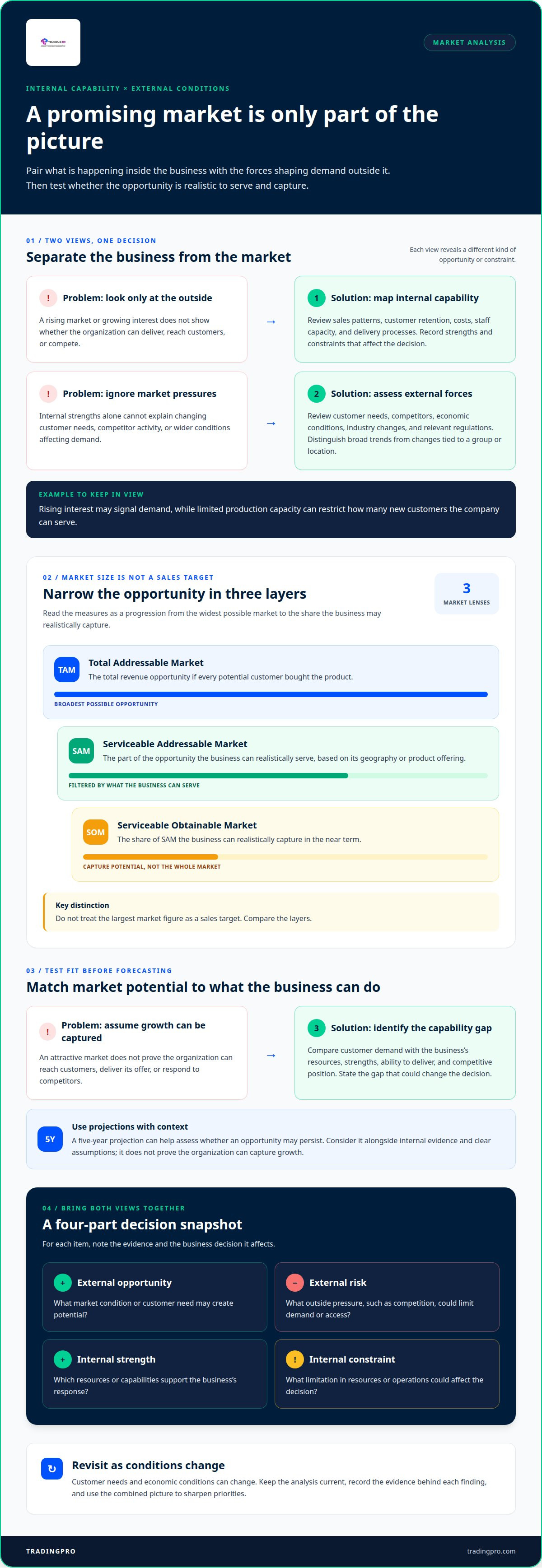
- Map the business before assessing its market. Internal analysis examines how the organization operates and what resources it can bring to a decision. Review sales patterns, customer retention, costs, staff capacity, and delivery processes. For example, a company may identify rising interest but lack enough production capacity to serve new customers. Record each strength and constraint, then connect it to the decisions the business must make. This prevents external trends from overshadowing practical limits inside the organization.
- Assess the outside forces shaping demand. External analysis examines how the wider market affects the business. Review customer needs, competitor activity, economic conditions, industry changes, and relevant regulations. Separate trends that affect the whole market from changes limited to a specific customer group or location. For example, a shift in purchasing habits may create demand while a strong competitor makes customer acquisition harder. Use evidence from each area to identify opportunities and pressures.
- Estimate the market in layers. Total Addressable Market, or TAM, represents the total revenue opportunity if every potential customer bought the product. Serviceable Addressable Market, or SAM, narrows that opportunity to customers the business can realistically serve based on its geography or product offering. Serviceable Obtainable Market, or SOM, is the share of SAM the business can realistically capture in the near term. Compare these measures instead of treating the largest market figure as a sales target.
- Test market potential against internal capability. A market can look attractive without matching the organization’s strengths, resources, or competitive position. Compare customer demand with the business’s ability to reach customers, deliver its offer, and respond to competitors. A five-year projection can help assess whether an opportunity may persist, but it does not prove the organization can capture growth. Use the projection alongside internal evidence and clear assumptions. Identify the capability gap that could change the decision.
- Combine both views and revisit the analysis. Build a simple framework with four entries: external opportunity, external risk, internal strength, and internal constraint. For each entry, note the evidence and the business decision it affects. This structure can expose gaps in an existing evaluation and sharpen priorities. Revisit the analysis regularly as customer needs and economic conditions change. If your market review also informs trading decisions, you can start a trading account.
Keep your review current as economic conditions, customer needs, and competitor activity change. A market analysis may include five-year projections to assess a business concept’s potential, but those projections should be considered alongside internal evidence and clear assumptions. Market attractiveness alone does not show whether an organization can compete successfully or capture growth. Use the findings to identify which capabilities or evidence need closer attention before committing resources.
Conducting a market analysis with a market research firm is recommended as one of the first steps before starting a business or opening a new location. Organizations can use a structured framework to identify gaps in their existing market evaluation and improve decision quality. Check that each conclusion connects an external opportunity or risk with an internal strength or constraint, and revisit conclusions that lack evidence. This keeps the assessment focused on whether the concept or location fits what the organization can realistically do.
Live market analysis and coverage
- Define the decision timeframe. Choose the period your decision depends on before reviewing live coverage. A sales forecast may focus on the next three months, while another decision may need a longer view. Match the report’s forecast period to your planning cycle. For example, a near-term inventory decision needs timely demand signals, not only a broad annual outlook. Separate historical results from projections so recent performance doesn’t look like a guaranteed future outcome.
- Specify which market the coverage tracks. Confirm the report’s industry, geography, customer group, and product category align with your question. A national trend may conceal different conditions in one region—in residential real estate, for example, localized groups like The Kombrink Team track community-level metrics rather than broad national figures. A report about an entire industry may also miss demand for a specific product segment. Write down the boundaries you need, then compare them with the report’s stated scope. This shows which findings can inform your decision and which fall outside its coverage.
- Check what “live” means for the report. Look for the latest observation date, publication date, and stated update process. These dates describe different things: data may be collected before publication. A report dated this month can still rely on older customer research. For each key chart, identify the period covered and the source. When following market analysis reports, pay particular attention to leading indicators that change quickly, since older observations may no longer reflect current conditions.
- Inspect the indicators behind each forecast. Identify the inputs used to project sales or demand, such as customer activity, pricing, or competitor changes. Read the assumptions beside the forecast, not just its headline. For example, a sales projection may depend on demand remaining steady or distribution expanding. Record the conditions that could strengthen or weaken the projection. This turns a forecast into a planning tool you can reassess as new evidence appears.
- Compare coverage across sources. Use market research alongside company records, customer feedback, and relevant industry data. Check whether these sources point in the same direction or reveal a mismatch. If a report signals rising interest but customer conversations show little intent to buy, investigate the difference before acting. Note whether each source measures actual behavior, stated preferences, or estimates. A disciplined approach to following market analysis reports treats conflicting evidence as a prompt for closer analysis.
- Set a review trigger and record the result. Decide which new evidence would cause you to revisit the forecast, such as a clear change in customer demand or competitor activity. Keep a short log with the report date, key assumptions, expected outcome, and later observations. Compare outcomes with the original forecast when new coverage arrives. This record helps reveal what the analysis captured, what changed, and which decisions need adjustment.
Market analysis definition and scope
- Set the report’s boundaries. Define the industry, geography, customer groups, and products the analysis covers. A report about U.S. demand, for example, may not answer a question about one city or a different country. State the decision first, then match the scope to it. This makes gaps visible before you rely on a market total or growth forecast.
- Include market size, growth, and forecast data. A useful report identifies the market’s current size, explains the period and method behind its growth rate, and presents forecasts tied to clear assumptions. Forecasts may cover the next six months or a year, depending on the decision. Compare the relevant segments and geography, and check whether figures describe revenue, units sold, or another measure.
- Separate market research from full market analysis. Market research gathers information about customers, their needs, and their behavior. Market analysis uses that research alongside industry conditions, competitors, and relevant regulations to assess the broader opportunity. For example, customer interviews may reveal interest in a product, while competitor analysis shows how existing offers address that demand. Keep these evidence types distinct in the report.
- Check how the report defines its market. Market size depends on which customers, products, and locations are counted. TAM, SAM, and SOM describe different levels of market opportunity, so compare like with like. A global industry estimate cannot stand in for a reachable local segment. Look for clear definitions, exclusions, and units beside each figure. These details help prevent inflated comparisons between unlike markets.
- Read forecasts as scenarios, not isolated totals. Find the assumptions behind expected growth, including demand, pricing, and market conditions. Check whether the report distinguishes past performance from future projections. A forecast should explain the time period it covers and the factors that could affect revenue. If a report gives a headline figure without showing its basis, its usefulness for planning is limited.
- Match the scope to the decision. For a product launch, prioritize target customers, competing offers, demand, and the relevant sales outlook. For a location decision, focus on local market conditions rather than broad global totals. A funding discussion may require market size and growth evidence with transparent definitions. Use the scope that answers the question at hand, and note where evidence does not extend to your specific case.
Sales forecasts may cover periods such as a year. Relate the forecast horizon to the decision at hand, and state what the estimate is intended to inform. A defined period helps readers interpret projected sales alongside the market’s scope, assumptions, and evidence, rather than treating the estimate as a standalone measure.
How do I evaluate the accuracy and credibility of a market report?
Test a report’s key claims against independent evidence before relying on them for a business decision. Compare the sources, methods, dates, and assumptions, then note where the evidence agrees or conflicts. A polished chart can clarify a finding, but it cannot replace the evidence behind it.
- Trace important claims to original sources. Check whether market size, customer demand, and competitor claims identify their underlying data. Compare relevant findings with government statistics, industry reports, and customer research. For example, a report’s estimate of customer interest becomes more useful when customer interviews or survey findings support the same direction. Record differences instead of selecting only the evidence that supports your preferred decision.
- Examine how the information was collected. Look for the research method, the population studied, and the geographic or product scope. A survey of one customer group may not represent an entire market. Check whether interviews, surveys, company data, or public statistics support each claim. If the report combines several methods, identify which source supports each conclusion. This helps separate measured behavior from opinions or estimates.
- Check dates and definitions across the report. Confirm when the data was collected, not only when the report was published. Then compare how it defines terms such as customer, market, and revenue. If one chart measures product sales while another estimates total industry revenue, they cannot be compared directly. Note the period, unit, geography, and segment for each important figure before drawing conclusions.
- Separate evidence from interpretation. Mark which statements describe observed results and which offer explanations or forecasts. A report might show declining sales, then attribute the change to customer preferences. The sales figure is an observation; the explanation needs separate support. Look for alternative causes, such as pricing or distribution changes, and see whether the report addresses them. This prevents an interpretation from being treated as established fact.
- Test projections and AI-generated insights. Identify the assumptions behind each forecast, then compare them with government statistics, industry reports, and customer evidence. AI tools can support analysis, but their outputs may be inaccurate or outdated. Verify AI-generated claims against reliable sources before using them. If an automated summary states that demand is rising, locate the underlying data and confirm its date, scope, and measurement.
- Document confidence and act proportionately. Create a short evidence log with each major claim, its source, the date, and any conflicting finding. Label conclusions as well-supported, uncertain, or dependent on an assumption. For example, use a narrow customer sample to guide further research, not as proof of nationwide demand. Keep your decision tied to evidence strength. Open a trading account to apply a disciplined approach to market decisions.
TradingPRO
TradingPRO offers Rookie, Micro, Pro, and Scalp Accounts for traders looking to put market views into practice. A market analysis report can inform your thinking, but trading decisions still depend on how you interpret its findings and manage your approach. Choose an account type that aligns with your trading style, whether you’re building familiarity or looking for an environment tailored to a particular approach.
Use reports to frame questions, monitor trends, and assess possible scenarios, not as instructions to buy or sell. When you’re ready to connect your market perspective with trading, explore TradingPRO’s account options and choose the one that best fits your goals. Contact TradingPRO to take the next step.
Turn your next market insight into a deliberate move
A report is a starting point, not a trading instruction. Make your next step specific: identify the market view you want to explore, decide what could change your thinking, and keep your decision grounded in evidence. Following market analysis reports can sharpen that process when you treat new findings as prompts to reassess, not automatic signals to act.
TradingPRO offers Rookie, Micro, and Pro Accounts for different trading approaches. Choose the account option that fits how you want to engage with the market, and keep your research and decision-making disciplined. Explore account options and take your next step with TradingPRO. Build your approach with care and move forward with confidence.
Frequently Asked Questions
What is market analysis, and why does it matter?
Market analysis evaluates evidence about a business opportunity so decision-makers can assess its potential and risks. It matters because a promising market trend may not translate into demand for a particular offer. Before expanding a product line, for example, a business can use market findings to identify customer segments, competing alternatives, and barriers to entry. That context turns broad interest into more informed planning.
What is a market analysis report, and what does it include?
A market analysis report organizes evidence to help readers understand a particular market and make a decision. It may cover customers and competitors, industry conditions, market size, forecasts, and the methods or sources behind its conclusions. For a product launch, check whether the report’s customer group and geography match the launch plan. Then identify which findings support action and which need further investigation.
Where can I find free and paid market research reports?
Free market evidence is available from government statistics, public company filings, trade associations, and customer research. Market research publishers and industry analysts offer paid reports, often with deeper coverage of a specific sector or geography. Combine sources rather than relying on a single document. For example, compare an industry report’s demand estimate with government data and direct customer feedback to spot mismatched definitions or unsupported conclusions.
How much do market analysis reports cost?
Prices vary by subject, coverage, and report scope. Compare what each report covers, the evidence it uses, and its relevance to your decision. These are report prices, not prices for TradingPRO accounts.


