





Safe Haven Currencies
When markets panic, capital moves fast. Knowing where it goes, and why, separates preparation from reaction.
Authorship
Written by

Forex Market Analyst , an ICT Chartered Graduate with 18 years of live trading experience in forex, gold, and crypto.
Reviewed by

Forex market analyst and educator with a strong focus on technical analysis and trader psychology.
Key Takeaways
-
Safe haven currencies are those that attract capital during periods of global uncertainty, financial stress, or geopolitical crisis. The three primary safe havens in forex are the Swiss franc, the Japanese yen, and the US dollar, each for different structural reasons.
-
The Swiss franc and the Japanese yen respond to different types of crisis through different mechanisms. The franc benefits from genuine safe haven capital flows into Swiss assets. The yen benefits primarily from the unwinding of carry trades. Knowing which mechanism is active in the current crisis type determines which safe haven to watch.
-
The US dollar is a conditional safe haven. It typically benefits in extreme global shocks but can weaken when the crisis originates within the United States itself or when investors prefer more nimble hedges in moderate risk off episodes.
What Are Safe Haven Currencies?
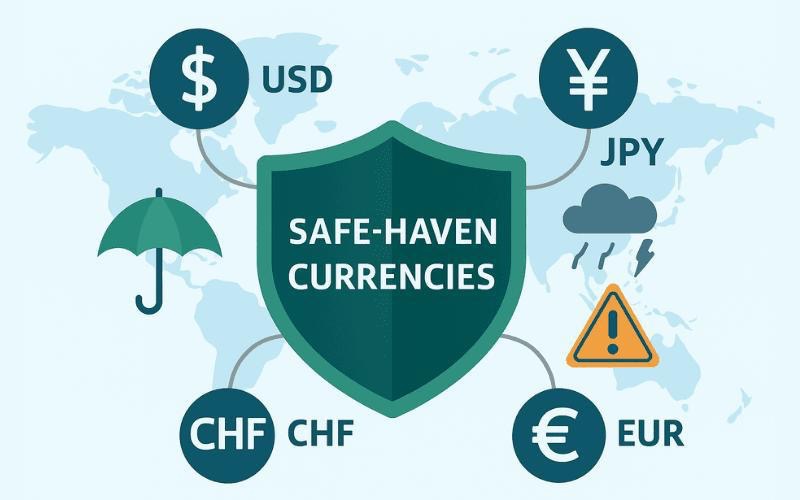
Financial markets are driven by confidence. When investors feel optimistic, they seek higher returns by investing in equities, commodities, and growth-focused assets. But when uncertainty increases, priorities change. Investors become less concerned about making money and more concerned about protecting it. That shift in priorities creates demand for assets considered stable and reliable during periods of economic or political stress. In forex, those assets are safe haven currencies.
If you are new to the forces that drive currency prices, start with What Moves the Market before continuing.
Safe haven currencies are currencies that attract capital during periods of global uncertainty, financial stress, and geopolitical crisis. They are defined not by high interest rates or strong economic data but by stability, liquidity, and the structural confidence that global investors have in them as stores of value when other assets are falling. The three most widely recognised are the Swiss franc, the Japanese yen, and the US dollar. Each holds safe haven status for different reasons, responds to different types of crisis through different mechanisms, and can behave very differently from the others in the same event.
How Does It Work?
What triggers safe haven flows
Several types of event commonly move capital toward safety. Economic recessions and the concern about slowing growth and falling earnings push investors toward preservation. Financial crises, including banking stress and credit events, trigger rapid moves out of risk assets. Geopolitical conflicts, particularly those affecting energy supply, trade routes, or major economies, create uncertainty that safe haven currencies absorb. Sharp stock market declines compress risk appetite quickly and produce reflexive safe haven buying. Unexpected global events, from pandemics to major political developments, can trigger the same dynamic whenever the scale of the shock exceeds what investors had priced in.
The Swiss franc
Switzerland's safe haven status is built on four structural pillars: persistent political neutrality spanning over a century of major global conflicts, a current account surplus that consistently runs above 5% of GDP, deep and well-regulated financial institutions, and fiscal discipline that produces low government debt relative to most developed economies. When global stress rises, capital flows into Swiss assets, Swiss government bonds, Swiss bank deposits, and the franc itself. EUR/CHF is the most traded expression of this: when European or global stress rises, capital leaves European assets and enters Swiss ones, pushing the pair lower.
Historical data confirms the consistency of this pattern. The franc appreciated nearly 30% against the euro during the 2008 financial crisis. A research study analysing major geopolitical conflicts from 1990 through 2025 found the franc appreciated against the dollar in 100% of cases analysed. One important caveat applies: the Swiss National Bank actively intervenes to limit excessive franc appreciation because a very strong franc damages Swiss export competitiveness. At extreme levels, SNB selling can produce sharp short-term reversals even during genuine safe haven episodes.
The Japanese yen
The yen's safe haven mechanism is structurally different from the franc's. Japan is the world's largest creditor nation and the yen has served for decades as a primary carry trade funding currency: investors borrow in yen at low rates and invest those funds in higher-yielding assets globally. When risk appetite deteriorates and those carry trades are unwound, investors must buy yen to repay their loans. This creates mechanical demand for yen that is not driven by investors seeking Japanese safety specifically but by the requirement to return borrowed capital.
The yen's safe haven response is therefore most reliable in episodes of broad financial stress, rising volatility, and carry trade unwinding. In geopolitical events that do not trigger carry unwind, such as a regional conflict that drives oil prices higher without creating broad financial stress, the yen may not respond as expected and can even weaken if the shock raises Japan's energy import costs more than it benefits the safe haven bid.
The US dollar
The dollar occupies a unique and conditional position. As the world's reserve currency, it commands global demand that no other currency matches. US Treasuries are the most liquid safe asset in the world, and buying them requires buying dollars. In extreme global shocks, this reserve currency demand strengthens the dollar. However, in moderate risk off episodes, investors increasingly use the franc and yen as more immediate hedges while treating US Treasuries as the backstop for systemic extremes. When the crisis originates in the United States itself, the dollar may weaken alongside risk-sensitive assets rather than strengthening as a safe haven.
How the type of crisis determines which safe haven responds
Financial system stress, such as banking crises or credit events, tends to trigger carry trade unwinding and benefits the yen most directly. Geopolitical stress, particularly regional conflicts that do not directly threaten Japan or the US, tends to benefit the franc most clearly. US-specific or dollar-specific stress may weaken the dollar as investors rotate into francs, yen, or gold. Applying the right safe haven framework to the right crisis type produces more accurate directional reads than treating all three as interchangeable.
Safe haven does not mean risk free
A common misconception is that safe haven currencies are completely safe. No currency is. Safe haven status means investors tend to prefer these currencies during uncertainty. They can still decline in value, experience significant volatility, and react sharply to domestic economic conditions. The franc can be sold aggressively by SNB intervention. The yen can weaken in a geopolitical shock that does not trigger carry unwinding. The dollar can fall when the crisis is US-specific. Safe haven currencies are relatively preferred under stress, not guaranteed to rise.
Gold as a related asset
Gold is not a currency but it behaves as a safe haven asset alongside the franc, yen, and dollar. It has no yield, no central bank, and no political risk, making it a pure capital preservation vehicle. When risk sentiment deteriorates, gold tends to rise alongside safe haven currencies. Watching gold alongside USD/JPY and EUR/CHF gives a more complete picture of where crisis capital is flowing and which safe haven mechanism is driving the episode.
Example
The October 2025 safe haven episode illustrated the franc's structural safe haven properties across a period of compounding, simultaneous stressors. All data is confirmed by published Swiss trade analysis (smzh.ch, October 21, 2025) and independent market analysis (Medium, November 8, 2025).
|
Safe Haven Event |
Detail |
|
April 2025 |
CHF surged approximately 9% vs USD in the month (trade shock, broad risk off) |
|
October 21, 2025 |
EUR/CHF approached 0.92 (lowest since 2015 SNB floor removal) |
|
Context (October 2025) |
Simultaneous stress: US-China trade tensions, French and Japanese political uncertainty, US regional banking concerns |
|
Swiss export data (21 Oct) |
Seasonally adjusted exports rose 3.4% in September (fundamental support for CHF) |
|
October 30, 2025 |
CHF/JPY hit record 192.25 yen (franc's strongest level against yen; +10.3% annual gain) |
|
Yen comparison |
USD/JPY fell approximately 8% from April highs across H1 2025; yen also strengthened but episodically |
|
EBC Financial Group (Oct 2025) |
CHF and JPY outperformed USD in moderate risk off episodes; USD works better in extreme stress |
The October 2025 period demonstrated what happens when multiple stress sources compound simultaneously. US-China trade tensions, European political uncertainty, and US banking concerns all created risk off pressure at the same time without a single acute crisis event as the trigger. In this environment of prolonged moderate stress, the franc outperformed: EUR/CHF fell to 0.92, the lowest since the 2015 SNB floor removal, while CHF/JPY hit a record high as capital treated Switzerland as its primary defensive anchor.
The yen also strengthened in this period, but through a different mechanism. USD/JPY fell around 8% from April highs through the first half of 2025, primarily reflecting carry trade sensitivity to rising volatility rather than genuine safe haven buying of Japanese assets. The franc's October move was more sustained and structurally driven. The yen's moves in 2025 were more episodic and tied to specific volatility spikes. Two safe havens, responding to different mechanisms in the same broad environment, produced similar directional moves for different reasons.
Why It Matters
Safe haven flows can move currencies faster and further than any scheduled data release. When a crisis event strikes, EUR/CHF can fall 200 pips in minutes as capital rushes into Swiss assets. USD/JPY can surge or collapse equally quickly depending on whether the crisis triggers carry unwinding or safe haven dollar demand. A trader holding a position on the wrong side of a safe haven flow faces an abrupt, sentiment-driven loss that no chart pattern or economic data analysis would have predicted.
Understanding which safe haven responds to which crisis type also allows for more precise positioning during risk off episodes. A financial system shock calls for watching USD/JPY for carry unwind. A regional geopolitical shock calls for watching EUR/CHF. A domestic US policy shock calls for watching gold and CHF independently of the dollar. Applying the right framework to the right crisis produces more accurate directional reads than treating all three as always behaving the same way.
Safe haven flows also reverse. When the crisis resolves, the same currencies that surged during stress tend to weaken as capital rotates back into growth-sensitive assets. A position entered during peak crisis stress carries significant reversal risk when tension eases. For a deeper look at how to manage entry timing and stop placement around safe haven episodes and their reversals, read Risk Management alongside this topic.
Common Mistakes
|
Mistake |
Why It Matters |
|
|
Mistake 1 |
Treating USD, JPY, and CHF as interchangeable safe havens |
Each responds to a different type of crisis through a different mechanism. The yen's carry trade unwind dynamic works in financial stress but not necessarily in geopolitical shocks. The franc's genuine capital flow mechanism works across most crisis types but is subject to SNB intervention at extreme levels. The dollar is the ultimate backstop in systemic extremes but not always the first responder in moderate stress. Applying the wrong safe haven to the wrong crisis type leads to misdirected positions. |
|
Mistake 2 |
Ignoring SNB intervention risk when trading CHF strength |
The Swiss National Bank actively intervenes to prevent excessive franc appreciation because a very strong franc damages Swiss exports. At extreme levels, SNB selling can produce sharp short-term reversals in CHF even during genuine safe haven episodes. Monitoring the SNB's recent commentary and the speed of CHF appreciation helps assess when intervention risk is elevated. |
|
Mistake 3 |
Holding safe haven positions after the crisis resolves |
Safe haven currencies appreciate during crisis and depreciate as conditions normalise. A position held well past the resolution of the triggering event will give back a significant portion of its gains as risk appetite returns and the flows reverse. Safe haven trades have a natural exit when the fear that drove them fades. |
Quick Summary
- Safe haven currencies are those that attract capital during global uncertainty, financial stress, and geopolitical crisis. The three primary safe havens in forex are the Swiss franc, the Japanese yen, and the US dollar. Each benefits from a different structural mechanism and responds most reliably to a different type of crisis.
- The franc benefits from genuine safe haven capital flows driven by Switzerland's political neutrality, fiscal discipline, and institutional credibility. The yen benefits primarily from carry trade unwinding in financial stress. The dollar is the reserve currency of last resort in extreme shocks but often underperforms franc and yen in moderate risk off episodes.
- Safe haven currencies are not risk free. They can still decline, experience volatility, and react to domestic conditions. Safe haven flows also reverse when the crisis resolves. The same currencies that surged during stress tend to weaken as risk appetite recovers and capital rotates back into growth-sensitive assets.
Next Steps
You now understand the currencies that protect capital during global uncertainty and why each works differently. The next step is pulling everything in this series together into a structured approach to trading.
What Is a Trading Strategy - Learn how to combine technical analysis, fundamental analysis, risk sentiment, and currency strength into a coherent framework for identifying and executing trades with a defined edge.
What Moves the Market - Revisit the broader forces that drive price and see how safe haven currencies connect to the full picture of fundamental analysis.
Take Action
The next time a major geopolitical event or economic shock occurs, observe four assets simultaneously: the US Dollar Index, USD/JPY, EUR/CHF, and gold. Ask whether money is flowing toward safety or toward risk, and note which of the three safe havens is moving most and which is moving least. Then open EUR/CHF on a daily chart and look back over the past 12 months, identifying the periods where the pair fell most sharply and noting what type of stress was driving each move. Compare those episodes with USD/JPY over the same period and look for any divergence where one surged while the other stalled. That comparison, done once, teaches more about conditional safe haven behaviour than any abstract explanation can. Practice identifying safe haven flow episodes and their reversals on a demo account before using them to inform live trading decisions.


