



- Published on: 2026-07-19 10:13:52
Trading Stock Indices for Beginners: The 2026 Masterclass

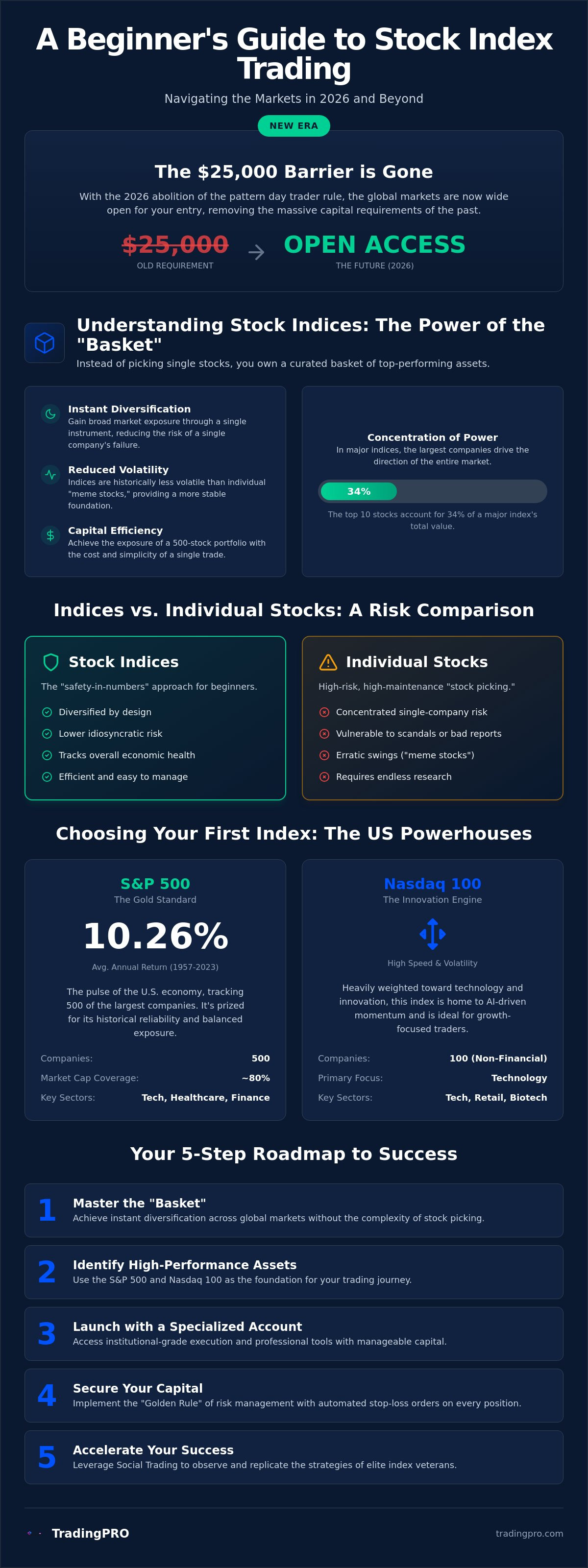
The $25,000 barrier to active trading is officially dead. With the 2026 abolition of the pattern day trader rule, the global markets are now wide open for your entry. You've likely felt that trading stock indices for beginners was a gated community reserved for the elite, hidden behind walls of technical jargon and massive capital requirements. It's natural to fear volatility or feel paralyzed by the complexity of margin accounts. We know the stakes are high, and the desire to protect your hard-earned capital is your top priority.
This masterclass is your definitive roadmap to market dominance. You'll master the fundamentals of index trading and learn how to leverage institutional-grade tools to build a diversified portfolio from scratch. We provide the precision and speed necessary to navigate today's fast-paced landscape with total confidence. We'll show you exactly how to protect your deposit while accessing the same sophisticated resources used by global professionals. Your first trade isn't just a goal; it's the start of your new high-performance legacy. Prepare to trade with the authority of a market leader.
Key Takeaways
- Master the power of the "basket" to achieve instant diversification across global markets without the complexity of individual stock picking.
- Identify high-performance assets like the S&P 500 and Nasdaq 100 as the foundation for trading stock indices for beginners in 2026.
- Launch your journey with a specialized Rookie Account to access institutional-grade execution speed and professional infrastructure with manageable capital.
- Secure your capital by implementing the "Golden Rule" of risk management and utilizing automated stop-loss orders on every position.
- Accelerate your success by leveraging Social Trading to observe and replicate the real-time strategies of elite index veterans.
Understanding Stock Indices: The Power of the "Basket"
Owning the top 500 companies in America with a single click is no longer a dream for the elite. It's the core reality of trading stock indices for beginners. Instead of gambling on a single CEO's temperament or a localized supply chain glitch, you back an entire economic sector. An index is a curated basket of assets designed to filter out individual company noise and focus on collective momentum. This is the ultimate "safety-in-numbers" play for those entering the market in 2026.
Beginners often face a high barrier to entry when trying to build a diversified portfolio. Buying 100 individual stocks requires massive capital and endless research. Indices solve this instantly. You gain broad exposure through a single instrument. This approach provides a stable foundation, as indices are historically less volatile than the erratic swings of "meme stocks." You aren't just trading; you're investing in the proven winners of the global economy. Diversification is your first line of defense against market uncertainty.
Size drives direction in this landscape. In 2026, the top ten constituent stocks in major indices account for 34% of the index's total value. These heavy hitters dictate the market's pulse. When the titans of industry move, the entire index responds with precision. This concentration of power creates a predictable environment where institutional-grade analysis meets retail opportunity. You follow the money where it's concentrated most.
The Mechanics of Index Movement
An index is a statistical measure of change in a representative group of individual securities. To master your strategy, you must first grasp what is a stock market index and how it functions as a barometer for economic health. Most modern indices use market-capitalization weighting. This means a price shift in a trillion-dollar company like Apple has a significantly larger impact on the S&P 500 than a shift in a smaller firm. You're following the path of maximum capital. Recognizing Bull markets versus Bear markets allows you to align your trades with the overall momentum of global economies.
Indices vs. Individual Stocks
Trading an index eliminates idiosyncratic risk. If a single company in your index faces a scandal or bankruptcy, the remaining firms absorb the shock. Your capital remains protected by the strength of the group. This is the ultimate risk management tool for new traders. It's also a matter of pure efficiency. Managing a 50-stock portfolio is a logistical nightmare. Trading one index gives you the same exposure with a fraction of the effort. You save on execution costs and time. This macro view empowers you to trade the world's most powerful companies with the confidence of a seasoned authority. You aren't just picking stocks; you're commanding a portfolio.
Choosing Your First Index: From Wall Street to Global Markets
Success begins with selection. You need a battlefield that matches your ambition and provides the liquidity necessary for precise execution. While the global stock market indices sector is projected to reach $127 trillion in 2026, the most effective entry points remain the established giants of the West. Trading stock indices for beginners requires a focus on markets with high volume and predictable price action. You start where the capital is most concentrated.
The "Big Three" in the United States represent the primary engines of global wealth. Beyond North America, European powerhouses like the DAX in Germany and the FTSE 100 in the UK offer unique exposure to industrial and financial sectors. For those seeking aggressive growth, emerging markets provide high-octane opportunities, though they require a more sophisticated approach to volatility. Your choice of index defines your trading persona.
The S&P 500: The Gold Standard
The S&P 500 is the undisputed pulse of the U.S. economy. It tracks 500 of the largest publicly traded companies, covering approximately 80% of available market capitalization. This index is prized for its historical reliability; from 1957 through 2023, it saw an average yearly return of 10.26%. For many, learning how to invest in an S&P 500 index fund is the first step toward institutional-grade portfolio management. In 2026, it remains the safest haven for those who value stability over speculative swings. It provides a balanced exposure across technology, healthcare, and finance.
The Nasdaq 100: The Innovation Engine
If you crave speed and volatility, the Nasdaq 100 is your instrument. This index is heavily weighted toward technology, retail, and biotechnology, excluding the financial sector entirely. It's the primary home of AI-driven market momentum. In 2026, the Nasdaq remains highly sensitive to interest rate shifts and tech earnings cycles. It attracts traders who prioritize faster price movements and are comfortable with higher intraday swings. It's the high-performance choice for the modern, tech-forward investor.
- S&P 500: Broad market stability and long-term reliability.
- Nasdaq 100: Tech-heavy, high-volatility, and innovation-focused.
- Dow Jones: A price-weighted look at 30 "Blue Chip" industrial leaders.
- DAX & FTSE 100: Critical gateways to European industrial and financial strength.
Don't wait for the perfect moment to enter these markets. The 2026 landscape rewards the proactive. You can secure your place in the global market by opening your account today and aligning your strategy with the world's most powerful economic indicators. Precision starts with the right platform and the right index.
How to Trade Indices: A Step-by-Step Execution Guide
The era of the $25,000 minimum equity requirement is dead. In 2026, the market belongs to the proactive trader who understands that trading stock indices for beginners is about infrastructure, not just capital. You no longer need a massive bankroll to access global indices. You need a partner that provides institutional-grade tools to a retail audience. This guide strips away the complexity and gives you a clear, high-performance path to your first execution.
Execution is where strategy meets reality. To win, you must follow a disciplined process that prioritizes speed and precision. Here is your four-step roadmap to market entry:
- Step 1: Select a Broker with Specialized Rookie Infrastructure. Your platform must offer the execution speed of a global leader. Avoid brokers that hide behind laggy interfaces or high commission structures.
- Step 2: Open a Rookie Account. This is your safe-haven entry point. It's specifically designed for those who want to start with manageable capital while still accessing the same indices as the pros.
- Step 3: Analyze the Market Using the Trade Hub. Don't trade on gut feelings. Use professional-grade analysis tools to identify trends, support levels, and potential breakout points.
- Step 4: Execute Your First Trade. Decide your direction. You can go Long (Buy) if you expect the index to rise, or Short (Sell) if you anticipate a market correction.
Setting Up Your Trading Environment
Your journey begins with a Secure Registration of your profile. This is the gateway to your future success. You'll face a choice between a Demo account and a live Rookie account. While a Demo account offers a risk-free environment to learn the interface, a live account provides the psychological "skin in the game" necessary for real growth. Funding your account in 2026 is frictionless. Low-minimum deposits empower you to start with as little as $10 or $100, allowing you to scale your ambition at your own pace.
Executing the Trade
Precision control is non-negotiable. Use Market Orders when you need immediate entry at the current price, or Limit Orders to dictate the exact price you're willing to pay. In the world of trading stock indices for beginners, the concept of "Lots" is your best friend. Micro-lots (0.01) allow you to trade indices with surgical precision, keeping your risk exposure tight. Finally, leverage provides the institutional power to amplify your market exposure. When used responsibly, it allows you to control larger positions and maximize your potential in a fast-moving landscape.
Risk Management: Protecting Your Rookie Capital
Survival in the markets isn't about luck. It's about precision. Every elite trader starts with a defense-first mindset. Effective risk management is the cornerstone of trading stock indices for beginners. You must treat your capital like a high-performance engine. If you redline it too long, it will blow. Protection isn't a passive concept; it's a proactive strategy that separates the professionals from the gamblers.
Adopt the Golden Rule immediately. Never risk more than 1-2% of your total account balance on any single trade. If your account has $1,000, your maximum loss per trade is $10 to $20. This ensures that a single losing streak won't end your career. Use Stop-Loss Orders as your automatic emergency brake. They execute instantly when the market hits your predefined exit point, preventing a minor dip from becoming a catastrophic crash. This level of automation is essential in the fast-moving 2026 landscape.
Understand your margin requirements with total clarity. Margin is a powerful tool, but it's a double-edged sword that demands respect. In 2026, disciplined sizing is the only way to avoid the dreaded "Margin Call." If the market moves against you and your equity drops too low, the broker will close your positions to protect their capital. Stay disciplined. Manage the high of a win and the sting of a loss with the same level of professional detachment. Your goal is consistent execution, not emotional highs.
The Mathematics of Survival
Calculating your position size is your first task after opening a Rookie Account. Base every lot size on your current balance, not your expected profit. A stop-loss is a non-negotiable tool for protecting capital against sudden market reversals. In 2026, Negative Balance Protection is a standard safety feature you should demand. It ensures you never lose more than your initial deposit, creating a safe-haven environment even during extreme volatility. This is the institutional stability you need to grow.
Common Beginner Pitfalls
Over-leveraging remains the #1 reason new traders fail. They see the potential for massive gains and ignore the risk of total liquidation. Don't fall into this trap. Emotional trading is equally dangerous. You must trade the plan, not the feeling. If the market becomes irrational, stay rational. Check out our Forex Trading for Beginners Guide for a deeper dive into the psychology of risk. Mastering your mind is just as important as mastering the charts.
Ready to trade with institutional-grade protection? Register your secure profile and start your journey with the right infrastructure today.
Scaling Up: Social Trading and Professional Infrastructure
Why trade alone in a landscape that rewards collective intelligence? The 2026 market environment has evolved beyond the isolated terminal. Success in trading stock indices for beginners now leverages the power of social connectivity. You can bypass the years of trial and error by replicating the strategies of index veterans. This isn't just about following a trend; it's about aligning your capital with proven, high-performance minds. You gain an immediate competitive edge by standing on the shoulders of market leaders.
Social Trading transforms the market into a collaborative arena where expertise is transparent. You observe real-time interactions, analyze historical performance, and interact with a global community of specialists. If you prefer a hands-off approach, Copy Trading allows you to automate your success by mirroring elite index traders. Your account executes the same moves as the pros, providing a frictionless path to growth while you continue to master the fundamentals. It's the ultimate shortcut to institutional-grade results.
The Power of the Social Feed
Filtering for excellence is your primary objective. Use the social feed to identify traders who specialize in specific indices like the Nasdaq 100 or the DAX. You must understand the distinction between Social and Copy Trading to choose the method that fits your lifestyle. Social trading offers a mentor-driven environment where you retain manual control, while copy trading provides a automated, "set-and-forget" solution. Use this community as a high-performance mentor to refine your own market intuition.
Your Path to Professionalism
Growth requires a transition from entry-level tactics to professional-grade execution. Once you've mastered the Rookie infrastructure, it's time to increase your capital and complexity. Ambitious traders eventually move from a Rookie setup to ScalpX. This specialized environment is built for high-frequency index strategies, offering the razor-thin spreads and lightning-fast execution needed to catch volatile index breakouts. You'll access the same infrastructure used by the world's most aggressive firms.
- Observe: Watch how veterans react to interest rate shifts and tech earnings.
- Replicate: Use copy trading to mirror the risk management of elite performers.
- Scale: Move to professional accounts as your confidence and capital grow.
- Dominate: Utilize institutional execution speeds to maximize every market move.
The roadmap is clear. You've learned the mechanics, the indices, and the risk protocols. Now, it's time to execute with the authority of a global leader. Don't let hesitation hold you back from the 127 trillion dollar index market. Start your journey today with TradingPRO and claim your place in the future of finance. Precision, speed, and community are waiting for you.
Command Your Financial Future
The global financial landscape has shifted. You've mastered the fundamentals of the "basket" and learned how to navigate the world's most powerful economies with surgical precision. Trading stock indices for beginners is no longer a restricted territory. It is a high-performance arena where the right infrastructure defines your success. By prioritizing strict risk management and leveraging the collective intelligence of a social ecosystem, you've built a foundation for long-term growth.
Now is the time to transition from observation to execution. TradingPRO provides the multi-tiered accounts you need to scale, ranging from the entry-level Rookie Account to the high-frequency Scalp Account. You'll benefit from institutional-grade execution speed and a comprehensive Social Trading ecosystem designed to accelerate your progress. Don't let the momentum of 2026 pass you by.
Join the Elite: Register Your TradingPRO Rookie Account Now. Your future in the markets starts today. Step into the arena with confidence and command your financial destiny.
Frequently Asked Questions
Is index trading better than stock trading for beginners?
Yes, index trading is often superior because it provides instant diversification. When trading stock indices for beginners, you back an entire economic sector rather than a single company. This approach eliminates the "idiosyncratic risk" of one firm’s failure ruining your position. It is a macro-driven strategy that prioritizes institutional-grade stability over the erratic swings of individual shares.
How much money do I need to start trading indices in 2026?
You can launch your journey with as little as $10 to $100. The 2026 abolition of the $25,000 pattern day trader rule has completely democratized market access. By utilizing a Rookie Account or Micro Account, you can control meaningful positions with manageable capital. You no longer need a massive bankroll to execute trades with the same precision as global professionals.
Can I trade indices on a mobile phone?
Absolutely. Modern infrastructure ensures you command your portfolio from any device without sacrificing speed. High-performance trading apps provide real-time access to global indices, social feeds, and risk management tools. You can monitor market breakouts and execute orders with institutional-grade speed while on the move. Your phone becomes a powerful gateway to the world's most liquid markets.
What is the most profitable index to trade for a rookie?
The S&P 500 is the gold standard for reliability, boasting an average yearly return of 10.26% from 1957 through 2023. It offers a balanced exposure that suits most new traders. However, the Nasdaq 100 is often the choice for those seeking high-octane growth driven by AI and tech innovation. Profitability depends on your ability to align your strategy with current market momentum.
How does leverage work when trading the S&P 500?
Leverage grants you the power to control a large market position with a fraction of the total value as a deposit. For example, 1:10 leverage allows a $100 deposit to command a $1,000 position in the index. It amplifies your potential gains significantly. You must use this tool responsibly within your risk management plan to ensure it empowers your growth rather than accelerating losses.
What happens if the market crashes while I have an open index position?
Your automated stop-loss order serves as your primary shield. It triggers an immediate exit at your predefined price, preventing a market dip from becoming a capital catastrophe. In 2026, Negative Balance Protection is a non-negotiable standard that ensures you never lose more than your initial deposit. These safety protocols provide a safe-haven environment even during extreme global volatility.
Do I own the actual shares when I trade an index CFD?
No, you are speculating on the price movement of the index rather than owning physical share certificates. This flexibility is a core advantage of trading stock indices for beginners. It allows you to profit from both rising and falling markets without the logistical burden of share ownership. You gain the price exposure of the world's top companies with much lower execution costs.
How do I choose between the Nasdaq and the Dow Jones?
Choose the Nasdaq if you want exposure to high-growth tech, biotech, and AI-driven sectors. It is the innovation engine of the market and offers faster price action. Select the Dow Jones if you prefer the stability of 30 "Blue Chip" industrial leaders. Your decision should reflect whether you prioritize aggressive momentum or the institutional gravitas of established corporate giants.


