




- Published on: 2026-10-31 10:34:56
Top Trading Books to Read for Risk and Better Decisions

The best starting point depends on what you need to strengthen: The Daily Trading Coach offers 101 short lessons, while Trading in the Zone focuses on the psychological side of trading. The top trading books to read can sharpen your approach, but no book replaces a clear, tested trading system.
It makes sense to look for books that explain risk management for day trading. Stops, position decisions, and emotional discipline all matter, but they work best as parts of a consistent process, not as isolated tips. This guide matches books to the skills they address, including day trading, risk controls, stop losses, and decision-making. You’ll also see how to apply what you learn to build a coherent trading system, rather than collecting ideas without a plan.
Key Takeaways
- Choose beginner-friendly books for the skill you want to build, from trading psychology to practical day-trading habits.
- Use probabilistic thinking to assess decisions by process and risk, not by the outcome of a single trade.
- Turn useful ideas from books into clear rules within a coherent trading system, including how you approach stop losses.
- Match options and futures reading to the distinct mechanics and risks of each market.
- Compare forex and cryptocurrency books by the concepts they explain, then apply what you learn with a deliberate, consistent approach.
1. What is the best day trading book for beginners?
For a beginner building trading psychology and discipline, The Daily Trading Coach by Dr. Brett Steenbarger is a practical starting point. Its 101 short lessons give readers focused prompts for examining habits and improving decisions. For risk management, pair it with William O’Neil’s How to Make Money in Stocks, which advocates an 8 percent hard stop.
Classic trading books offer different lessons from financial speculation. Market Wizards: Interviews with Top Traders was published in 1989, Trading in the Zone in 2000, and Jack D. Schwager’s Stock Market Wizards in 2001. Benjamin Graham began teaching his investment theory at Columbia University in 1928, linking trading literature to a longer history of market analysis.
Start with the challenge you want a book to address. If you react emotionally to losing trades, read Mark Douglas’s Trading in the Zone for its focus on mindset and consistent execution. If you need a structured way to reflect, Steenbarger’s lessons offer a method for examining decisions one at a time. If your priority is risk control, O’Neil’s stop-loss approach gives you a concrete rule to study, though it isn’t a universal fit for every strategy.
Financial speculation is also a study of behavior under uncertainty. Reminiscences of a Stock Operator remains a classic account of trading psychology, with lessons about patience, conviction, and the pressure to follow market movements. Read it as a record of decisions and biases, not as a ready-made day-trading system. A memorable market story can clarify a mistake, but it can’t define your entry, exit, or position rules for you.
Turn each chapter into a practical exercise. Before a session, write down the setup you plan to trade and the condition that would invalidate it. Afterward, compare your actions with that plan. For example, if you moved a stop farther away after a trade began losing, note the decision and your reason. This makes discipline observable instead of treating it as a vague personal quality.
Use books to distinguish a sound process from a lucky outcome. One profitable trade doesn’t prove a decision was strong, and one loss doesn’t prove it was poor. Review whether the setup matched your plan, whether you defined risk beforehand, and whether you followed your exit criteria. Steenbarger’s short lessons support repeatable review, while Douglas’s focus on psychology helps you examine reactions to wins and losses.
Read actively, rather than moving through a book without a purpose. Choose one idea from a chapter, turn it into a written rule, then review examples from your own trading. Keep ideas that clarify your process and discard rules that conflict with your strategy. That turns the top trading books to read into working references and keeps your decisions grounded in a coherent system.
2. Probabilistic thinking and decision-making
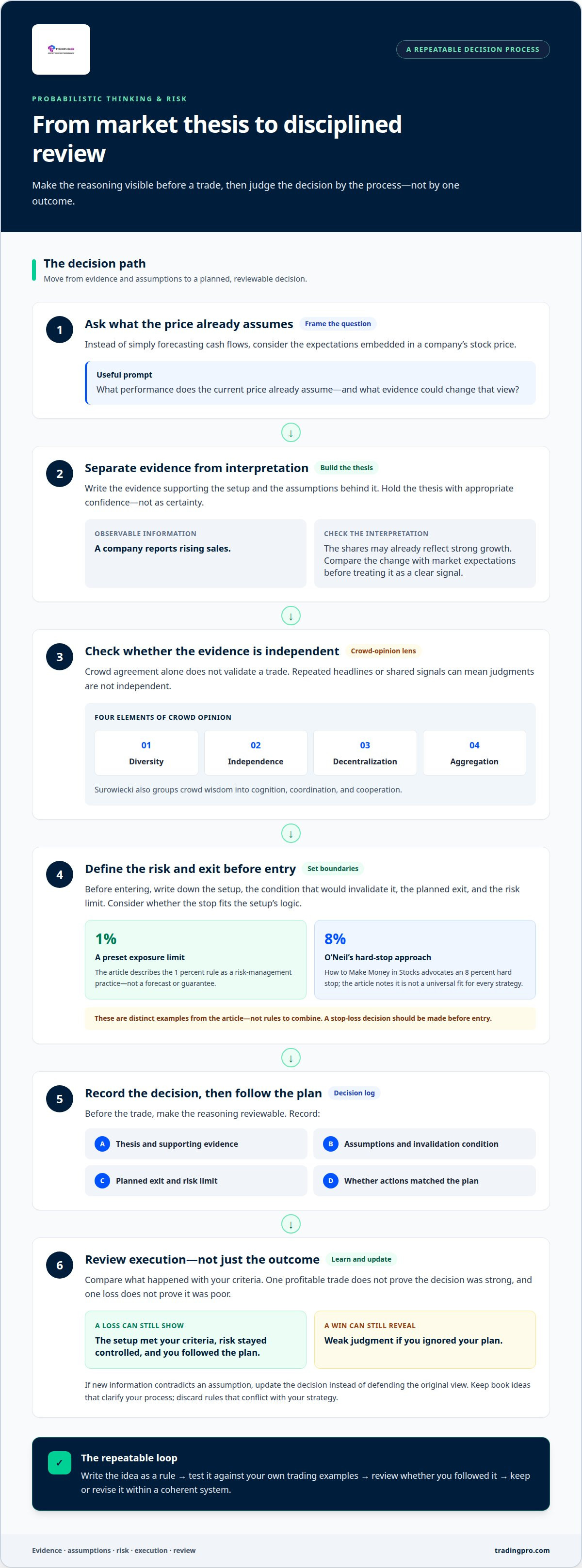
A trading decision is best judged by its process, not by the result of one trade. Michael J. Mauboussin recommends estimating the expectations embedded in a company’s stock price instead of simply forecasting its cash flows. That shift raises a sharper question: what performance does the current price already assume, and what evidence could change that view?
Mauboussin’s approach is useful because a forecast can sound convincing while overlooking the expectations already built into a price. Separate observable information from your interpretation. For example, a company may report rising sales, but its shares may already reflect strong growth. Compare the reported change with market expectations before treating the news as a clear signal.
Probabilistic thinking means holding a thesis with appropriate confidence, not treating it as certain. Write down the evidence supporting a setup, the assumptions behind it, and the event that would weaken it. If new information contradicts an assumption, update your decision instead of defending your original view. This keeps conviction responsive to evidence.
James Surowiecki identifies four elements of crowd opinion: diversity of opinion, independence, decentralization, and aggregation. These help explain why a collection of views can sometimes reveal information no single observer holds. But crowd agreement alone doesn’t validate a trade. If traders repeat the same headline or follow the same signal, their judgments may not be independent.
Surowiecki groups crowd wisdom into three types: cognition, coordination, and cooperation. For traders, cognition concerns how a group reaches an answer; coordination concerns how people align their actions; cooperation concerns how they work toward shared outcomes. Use these ideas to distinguish broad, independent evidence from a crowded position built on the same assumption.
Bring probability into your process with a brief decision log. Before entering a trade, record the thesis, supporting evidence, invalidation condition, and planned exit. After closing, assess whether you followed those rules. For example, a losing trade may still reflect sound execution if the setup met your criteria and risk stayed controlled. A winning trade can expose weak judgment if you ignored your plan.
A practical risk-management practice is the 1 percent rule. Treat it as a preset limit for controlling exposure, not as a forecast or a guarantee of a favorable outcome. Pair it with a stop-loss decision made before entry, then consider whether the stop fits the setup’s logic. The number matters less than applying the rule consistently across comparable decisions.
Use books on decision-making to build a repeatable method, then test each idea against your written rules. Keep the reasoning visible. If you’re ready to put a defined approach into practice, begin your trading registration with the plan and risk limits established first.
4. Using books alongside a coherent trading system
A trading book offers ideas, not a complete operating plan. Turn each useful concept into a rule that connects your market selection, setup, entry, position size, exit, and review. For example, a chapter about valuation can inform how you assess a company, while your system defines when that assessment becomes a trade.
In the United States, a popular trading book’s price depends on its edition, format, condition, and seller. Compare like-for-like editions: a new hardcover and a used paperback are different purchase options.
For fundamental analysis and valuation, Benjamin Graham’s The Intelligent Investor is a classic starting point. Value investing means buying stocks that trade below their intrinsic value. Graham’s Mr. Market allegory encourages attention to business performance instead of overemphasizing market value. Michael J. Mauboussin’s work adds another useful lens: estimate the expectations embedded in a stock price rather than simply forecasting cash flows.
Connect these ideas to a written process. Before acting on a company, record what its current price appears to expect, which business evidence supports your view, and what would change your assessment. Then define the trading conditions separately. A favorable valuation can inform a thesis, but it doesn’t establish a timely entry or define your exit.
Build a book-to-system workflow with a focused reading note. Capture one principle, translate it into an observable condition, and decide how you’ll review it. For instance, if Graham’s Mr. Market framing helps you resist reacting to price swings, write down which business changes matter to your thesis. This keeps an investment idea distinct from a short-term price move.
Next, use historical examples to stress-test the rule. Ask how your decision would work if earnings disappointed, expectations changed, or the market moved against your position. Don’t add a condition just because one example supports it. Look for clear reasoning you can apply consistently, and record exceptions instead of quietly rewriting the rule.
Keep a system document alongside your reading notes. Include the market or instrument you trade, setup criteria, the point that invalidates the idea, exit logic, and your review method. A book can suggest a framework, but your document should show how its parts fit together. That makes conflicting advice easier to spot before it shapes a live decision.
Review changes deliberately. If a book prompts you to adjust your method, note the old rule, the new rule, and the reason for the change. Evaluate the updated approach using consistent criteria, not one memorable outcome. This separates a useful improvement from an impulse. Choose books for the specific gap they address, then make each insight earn a place in your system.
4. What are the best books on options and futures trading?
For options, start with Sheldon Natenberg’s Option Volatility & Pricing. It explains how volatility and pricing relate to option strategies, making it a focused reference for readers learning options mechanics. Goodreads lists the book 136 times under its trading shelf. Use it to understand a strategy’s moving parts, not as a shortcut to choosing trades.
Pair that title with a clear study question. For a call option, identify how the underlying price, time, and volatility affect your reasoning. Then compare that view with the strategy’s payoff at different prices. This exercise helps distinguish a directional opinion from a position shaped by more than direction alone.
For futures, A Complete Guide to the Futures Market by Jack D. Schwager and Mark Etzkorn provides a broad starting point. Read it to understand market structure, contract mechanics, and trading approaches. Futures differ from options, so track how contract terms, price movements, and expiration affect the position you’re studying. Don’t assume an options framework transfers unchanged.
Make each book practical with a comparison sheet. For every example, note the market view, instrument, entry condition, exit logic, and main risk. An options strategy may respond to volatility as well as price direction. A futures position is tied to its contract and the underlying market movement. Understand these mechanics separately before judging a setup.
Options readers should map a strategy’s possible outcomes before weighing its appeal. Record what happens if the underlying price rises, falls, or stays near its current level. Then ask how changing volatility or time could alter the position. Natenberg’s book is useful here because it connects option pricing concepts with strategy analysis.
Futures readers can use Schwager and Etzkorn to build a different checklist. Identify the contract being discussed, the market condition behind the trade, and the event that would invalidate the idea. Then examine how entry and exit decisions fit that view. This keeps contract mechanics central instead of treating futures like ordinary stock positions.
Choose your first title based on the gap in your knowledge. If option pricing and volatility are unclear, begin with Natenberg. If futures contract structure needs attention, choose Schwager and Etzkorn. Keep a separate journal for each market, because an options example and a futures example may involve different risks. A focused reading plan turns both books into tools for informed decisions, not collections of strategies to copy.
5. What are the best books on forex and cryptocurrency trading?
For forex, choose books that explain currency drivers and trading decisions, not just chart patterns. Kathy Lien’s Day Trading and Swing Trading the Currency Market connects technical analysis with economic events and currency-market context. It suits readers who want to understand how a market view becomes a trade plan.
Brian Dolan and Mark Galant’s Currency Trading for Dummies offers an accessible introduction to forex terminology and mechanics. Use it to clarify concepts such as currency pairs, quote conventions, and the forces that can move exchange rates. Treat each explanation as a foundation, then apply it to a specific pair and trading approach.
For cryptocurrency, distinguish books about blockchain technology from books about investing in cryptoassets. Andreas M. Antonopoulos’s Mastering Bitcoin focuses on Bitcoin’s technical foundations. Chris Burniske and Jack Tatar’s Cryptoassets: The Innovative Investor’s Guide to Bitcoin and Beyond takes an investment-oriented approach to evaluating digital assets. The first builds technical understanding; the second helps frame an investment thesis.
Antony Lewis’s The Basics of Bitcoins and Blockchains is another accessible starting point for readers learning how cryptocurrency systems work. Technical knowledge matters because a token’s market price and its underlying network are separate subjects. Learn about the network first, then examine how a trading idea depends on liquidity, market sentiment, and the asset’s role.
Keep separate reading notes for forex and crypto. For a currency pair, record the economic event or market condition behind your thesis, the direction you expect, and what would invalidate that view. For a cryptoasset, add the project’s purpose and the assumptions behind its value. This makes it easier to distinguish a market hypothesis from a confident-sounding narrative.
Check the publication context before applying a book’s examples. Forex strategies may rely on market conditions that have changed, while cryptocurrency products and networks evolve quickly. A chapter can teach a durable concept, but a specific example may depend on its original market environment. Mark dated examples, then focus on the reasoning instead of copying the trade.
Don’t assume a book’s title proves its method suits your timeframe or risk tolerance. Compare its entry logic, exit rules, and treatment of losses with your own plan. For example, a swing-trading method may not fit someone seeking short-term currency trades. Choose a book for the market you intend to study, then test its ideas against consistent criteria.
After studying forex or crypto concepts, put your approach into practice with clear rules and deliberate review. Register to start your trading journey with a defined plan, rather than relying on a book alone.
TradingPRO: Rookie Account
TradingPRO’s Rookie Account is a natural next step when you’re ready to put ideas from trading books into practice. Use your reading to define the market you want to follow, the setup you’re studying, and the risk rules that guide each decision. A written plan helps keep your actions aligned with what you’ve learned instead of switching methods after every trade.
The Rookie Account gives traders an option as they begin applying a considered approach. As your style develops, TradingPRO also offers Micro, Pro, and Scalp Accounts. Focus on matching your account to your trading approach while keeping your system and decision-making rules clear.
Explore the Rookie Account as you move from reading to structured practice. Visit tradingpro.com to learn more.
Put Your Next Trading Decision Into Motion
The top trading books to read can shape your perspective, but progress comes from applying one idea with focus. Choose a principle that addresses a current challenge, then decide how you’ll use it before your next trading decision. Keep the test narrow: write down what you’ll observe, what would change your view, and what you’ll learn from the result.
Deliberate practice can help turn reading into a more intentional trading routine. Let your notes evolve as your understanding grows, but make changes for clear reasons instead of reacting to one outcome. Strong decision-making develops through attention, reflection, and steady refinement.
TradingPRO offers account options including Rookie, Micro, and Pro. If you’re ready to take the next step, register with TradingPRO and continue developing your approach with purpose.
Keep learning, stay disciplined, and move forward with confidence.
Frequently Asked Questions
Are there good books on risk management for day trading?
Yes. William O’Neil’s How to Make Money in Stocks is a useful starting point for studying exit discipline. To make the reading practical, choose a hypothetical setup and write down what could go wrong before entry. Consider a sudden price gap, a failed breakout, or an exit that doesn’t execute as expected. This turns risk reading into scenario planning, rather than a search for one rule that fits every trade.
Can you learn day trading from books alone?
No. Books can explain terminology, strategies, and common decision errors, but they can’t show how you respond to a changing market. Apply each lesson through chart review or simulated practice before relying on it in live trading. For example, mark where a setup would appear, identify what would invalidate it, and record whether your interpretation stays consistent. That practice reveals gaps a chapter can’t diagnose for you.
Is Market Wizards worth reading?
Yes, especially if you read it to compare approaches rather than copy trades. Jack D. Schwager’s interviews in Market Wizards show how trading methods can differ across individuals. As you read, note each trader’s market focus, decision process, and exit conditions. Then compare those choices with your own constraints. The book is most useful as a source of questions about method, not a template for duplicating another trader’s results.
Is Trading in the Zone worth reading?
Yes, if your main challenge is sticking to decisions under pressure. Mark Douglas’s Trading in the Zone focuses on the mental side of trading, not on finding chart entries. Use it to notice a specific reaction, such as hesitating after a losing trade or taking profit early out of fear. Record the trigger and your response. That gives you a concrete behavior to work on alongside your strategy.
What are the best books a trader can read?
The best choices depend on the skill you want to develop. For trader interviews, read Schwager’s Market Wizards; for psychological discipline, choose Douglas’s Trading in the Zone; for option concepts, study Natenberg’s Option Volatility & Pricing. Add titles selectively. A focused reading list is more useful than collecting books without a clear question, such as how to improve trade review or understand a particular market.
What is the best day trading book for beginners?
The Daily Trading Coach by Dr. Brett Steenbarger is a strong choice for beginners who want to develop self-review habits. After a trading session, choose one decision to examine: what information did you use, what did you do, and what would you change next time? Keep the review specific. This makes the book a practical companion to learning market mechanics, not a substitute for understanding them.
What are the best books on trading for beginners?
Begin with books that match your immediate learning need. Steenbarger’s The Daily Trading Coach supports reflective practice, while Graham’s The Intelligent Investor introduces a longer-term approach to evaluating businesses. For interviews with traders using varied approaches, consider Schwager’s Market Wizards. Read one title at a time and note concepts you can define and apply. That helps separate useful learning from unfamiliar jargon.
What are the top books on stock trading and technical analysis?
For stock trading, consider William O’Neil’s How to Make Money in Stocks and Jesse Livermore’s How to Trade in Stocks. For volume-focused chart study, Anna Coulling’s A Complete Guide to Volume Price Analysis offers a different angle. Choose based on the tool you want to understand, then review charts using that approach. Keep your observations separate from conclusions about a company’s underlying business.


