




- Published on: 2026-09-17 05:07:09
Sharpe Ratio for Copy Trading: Risk-Adjusted Success Guide

Did you know that 80% of retail copiers lose capital within a year because they chase raw returns while ignoring the hidden price of volatility? It's a brutal reality in 2026, where a trader yielding 5% annually barely beats the 3.97% risk-free rate offered by Treasury Bills. If you're tired of seeing your account blown by "star" traders who turn out to be high-leverage gamblers, you need a more sophisticated lens. Mastering the Sharpe ratio for copy trading is your first step toward institutional-grade risk management and long-term portfolio stability.
We agree that selecting a strategy provider shouldn't feel like a trip to the casino. You deserve a reliable framework that separates genuine skill from temporary luck. This guide promises to transform you into a precision-focused investor by providing the tools to distinguish elite providers from reckless outliers. We'll explore how to navigate the TradingPRO social feed, decode risk-adjusted metrics, and construct a diversified portfolio that suppresses variance. It's time to stop guessing and start leveraging data to secure your competitive advantage in a high-stakes environment.
Key Takeaways
- Move beyond the "Profit Illusion" by identifying Master Traders who generate high returns without exposing your capital to excessive volatility.
- Master the Sharpe ratio for copy trading to benchmark strategy providers against institutional standards, focusing on those with scores of 1.0 or higher for sustainable growth.
- Navigate the TradingPRO social feed with precision, filtering for elite providers who maintain stability and professional execution in high-stakes market conditions.
- Protect your portfolio by pairing Sharpe metrics with Maximum Drawdown analysis to expose hidden risks in seemingly "perfect" equity curves.
- Construct a resilient, multi-strategy portfolio by allocating funds across uncorrelated traders to optimize your total risk-adjusted performance.
Beyond Total Return: Why the Sharpe Ratio Is Your Secret Weapon
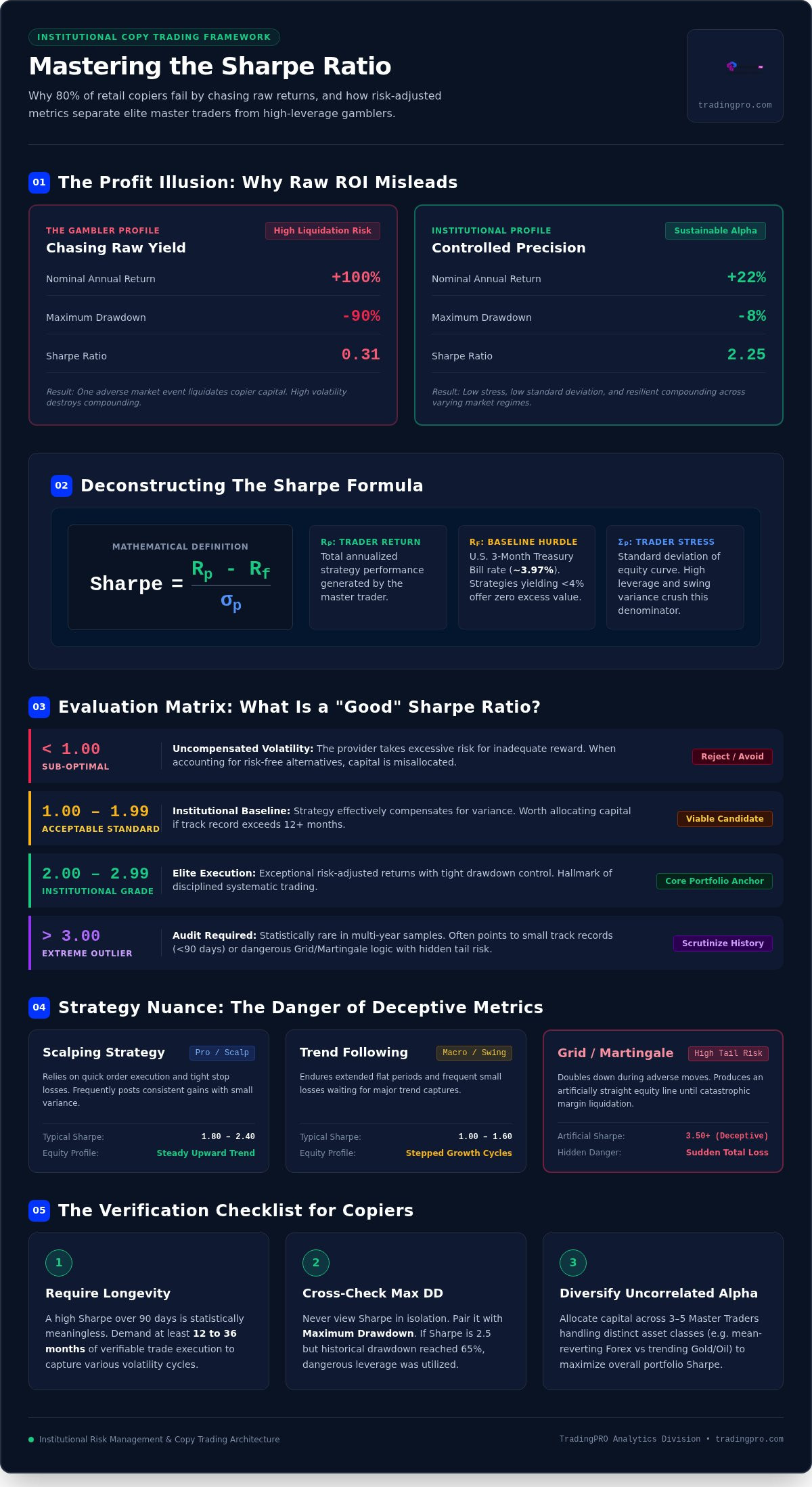
ROI is a trap. Amateurs look at the top-line percentage and ignore the carnage required to reach those numbers. In the high-stakes world of social trading, a 100% return is mathematically inferior to a 20% return if the former required a 90% drawdown. This is the "Profit Illusion." Elite investors value surgical precision over reckless gambling. Utilizing the Sharpe ratio for copy trading allows you to bypass the noise and focus on quality. TradingPRO prioritizes this level of transparency across its social feed, ensuring you see the institutional-grade metrics behind every master trader. Whether you are monitoring a Scalp account or a Pro account, the raw ROI is only half the story.
The Math Simplified: (Return - Risk-Free Rate) / Volatility
The calculation for the Sharpe ratio is your primary tool for clinical evaluation. It subtracts the risk-free rate from the trader's total return and divides that figure by the standard deviation. As of late 2026, the U.S. 3-Month Treasury Bill rate sits between 3.80% and 3.97%. This is your hurdle. If a strategy provider yields 5% annually, they've provided virtually zero excess value once cash alternatives are factored in. Standard deviation represents "trader stress." A massive return is a red flag if the volatility denominator is equally large. You want high-impact returns with low-impact variance. A higher numerator isn't always better if the cost is a roller coaster of equity swings.
Why Copy Traders Fail Without This Metric
Most copiers fail because they are blind to "Hidden Tail Risk." This is especially dangerous when using high-leverage accounts, where TradingPRO offers up to 1:2000 conditions. Without a risk-adjusted lens, you might copy a "lucky gambler" who is one market spike away from liquidation. The Sharpe ratio for copy trading acts as a definitive lie detector. It separates the consistent performers from those merely benefiting from a temporary trend. By focusing on this metric, you protect your capital from the 70% to 80% loss rate typical of retail copiers who chase raw ROI. The Sharpe ratio is the ultimate filter for professional strategy replication.
Interpreting the Numbers: What is a 'Good' Sharpe Ratio for Copy Trading?
Raw numbers don't lie, but they can mislead without context. When evaluating the Sharpe ratio for copy trading, you need hard benchmarks to separate the pros from the pretenders. A ratio of 1.0 is your entry point to quality. It indicates the trader is being adequately compensated for the volatility they endure. Scores between 2.0 and 2.99 represent institutional grade performance. Be skeptical of anything exceeding 3.0. While theoretically exceptional, in the retail space, these figures often signal a small sample size or a strategy that hasn't yet faced a "black swan" event. To understand the formal mechanics behind these figures, William F. Sharpe's analysis of the Sharpe ratio provides the foundational theory required for serious capital allocation.
Timeframes are the ultimate truth-teller. A high Sharpe ratio over 90 days is noise; a high Sharpe ratio over three years is a legacy. You must also account for asset class variance. Forex pairs often exhibit mean-reverting behavior, allowing for smoother equity curves and higher ratios. Commodities like Gold or Oil are trending and volatile, which naturally suppresses the Sharpe ratio even if the total payout is massive. High leverage is the enemy of sustainability. While TradingPRO allows significant flexibility, remember that excessive leverage spikes your standard deviation. This denominator growth will crush a Sharpe ratio faster than any losing trade. You can analyze these metrics in real-time by creating your profile today.
Sharpe Ratio Benchmarks by Strategy Type
Different strategies demand different expectations. Scalping strategies, often executed on a Scalp account, require high execution precision and frequently show high Sharpe ratios due to small, frequent wins. Trend followers might show lower ratios because they endure long periods of "flat" performance or minor drawdowns before catching a major move. The most dangerous profiles are Grid or Martingale traders. These strategies produce artificially "smooth" equity curves that keep the Sharpe ratio deceptively high. This is a trap. The ratio "lies" by ignoring the catastrophic tail risk that eventually leads to a total account wipeout.
The 'Sortino' Alternative: Why Downside Risk Matters More
The Sharpe ratio treats all volatility the same. It penalizes a trader for "good" volatility, like a sudden, massive profit spike. This is why elite copiers supplement their research with the Sortino Ratio. This metric isolates downside semivariance, focusing exclusively on "bad" volatility or drawdowns. When you vet a Master Trader on the TradingPRO feed, look for a high Sharpe paired with a strong Sortino. This combination confirms the trader isn't just lucky; they're actively protecting your capital during market stress. It's the difference between a gambler and a professional.
How to Use Sharpe Ratio on the TradingPRO Social Feed
TradingPRO transforms the social feed into a transparent, data-driven marketplace where discipline beats popularity every time. It's not about who has the most followers or the loudest profile. It's about who has the most disciplined execution. You should treat the feed like a professional scout looking for elite athletes. Instead of following the biggest ROI numbers, use the Sharpe ratio for copy trading to identify strategies that offer institutional stability. Leverage the TradingPRO Trade Hub to perform a deep-tissue scan of any strategy provider's history before you commit your capital. This level of scrutiny aligns with the ESMA supervisory guidance on copy trading, which emphasizes rigorous trader evaluation to protect your portfolio from unmanaged risk.
Step 1: Filtering the Master List
Access your social trading dashboard and move past the surface-level metrics. Use the integrated filter tool to set a minimum Sharpe Ratio of 1.5. This immediately eliminates the "lucky gamblers" who rely on massive, uncalculated swings to generate returns. Once filtered, analyze the equity curve alongside the ratio. You want to see a curve that moves upward with minimal jagged edges. A smooth curve paired with a high ratio suggests a Master Trader who manages their stop-losses with surgical precision. Don't settle for anything less than professional-grade consistency in the 2026 market environment.
Step 2: Cross-Referencing with Account Tiers
Strategy performance varies significantly based on the account type being utilized. Seeing a high Sharpe ratio for copy trading on a Scalp Account is an elite signal. It proves the Master Trader can maintain high execution speed and precision without letting volatility spiral out of control. Conversely, you should adjust your expectations for a Rookie Account, where providers might still be refining their edge. For a broader context on how these systems function, explore our analysis of Social Trading vs Copy Trading to ensure your chosen provider matches your specific financial goals.
Combine your Sharpe analysis with Maximum Drawdown (MDD) for a 360-degree view of potential risk. If a trader displays a Sharpe of 2.0 but an MDD of 50%, they're likely running a dangerous recovery strategy that could collapse at any moment. You're looking for the "Golden Ratio": a high Sharpe paired with a low MDD. This indicates a trader who wins often but loses small. In 2026, outlier performance is common during market anomalies. If a trader's stats look too good to be true over a 30-day window, they probably won't repeat that success. Consistency is the only metric that pays long-term dividends in this landscape.
The Limitations: When the Sharpe Ratio Can Mislead You
The Sharpe ratio is a precision tool, but even the best tools fail when used blindly. Most retail investors fall for the "Normal Distribution" fallacy. They assume market returns follow a predictable bell curve. They don't. In the volatile environment of 2026, "fat tails" and black swan events are the norm, not the exception. A strategy provider might show a flawless Sharpe ratio for copy trading while actually sitting on a powder keg of unmanaged risk. This is the "Turkey" problem. The turkey is fed every day and thinks life is perfect, right up until the day before Thanksgiving. A smooth equity curve often masks catastrophic tail risk that the Sharpe ratio simply cannot quantify.
Sample size is your first line of defense. A Sharpe ratio calculated over 10 or 20 trades is statistically irrelevant noise. You need a track record of at least 150 completed trades across varied market regimes to verify skill. If a Master Trader on the TradingPRO feed hasn't survived a full market cycle, their metrics are just a snapshot of a lucky streak. High-frequency strategies on a Scalp account might accumulate these trades quickly, but swing strategies require months of data for a valid assessment.
Regime Change: When Old Ratios Break
Strategies that dominated in 2025 often crumble under the shifting interest rates of late 2026. When the risk-free rate fluctuates between 3.80% and 3.97%, old excess return calculations become obsolete. You must demand "Rolling" Sharpe Ratios to identify recent performance decay. A trader's lifetime ratio might look stellar, but their 30-day rolling metric could reveal a strategy in terminal decline. Past performance metrics are a clinical snapshot of history, not a crystal ball for future profits.
The 'Lookback' Bias
Be wary of "Lookback" bias. Strategy providers frequently cherry-pick specific six-month windows to inflate their scores and hide previous blowouts. They use curve-fitted algorithms that look perfect on paper but disintegrate in live, frictionless markets. Diversification across 3 to 5 uncorrelated traders remains the ultimate hedge against metric failure. Don't bet your entire portfolio on a single number. Register your Pro account today to start building a resilient, multi-metric portfolio that survives the unexpected.
Action Plan: Building Your Institutional-Grade Copy Portfolio
Execution is where theory meets profit. You've identified the metrics; now you must deploy them. Building a resilient portfolio requires a clinical approach to capital allocation. Don't bet your financial future on a single provider. Instead, synthesize the Sharpe ratio for copy trading into a broader framework that prioritizes survival and steady growth. Treat your social trading experience like a multi-manager fund. This shift in perspective moves you from a passive follower to a sophisticated portfolio manager who values precision over hype.
Before you click "Copy," run through this final verification checklist to ensure your capital is protected:
- History: Does the trader have at least 150 completed trades over a minimum of 6 months?
- Risk Profile: Is the Sharpe ratio above 1.5 while the Maximum Drawdown remains under 20%?
- Account Fit: Does the Master Trader's strategy align with your chosen account tier, such as a Pro or Scalp account?
Constructing Your 'Mini-Hedge Fund'
Diversification is your only free lunch in the markets. Allocate your capital across 3 to 5 Master Traders who specialize in uncorrelated assets. Pair a Forex scalper with a Gold trend follower and an Indices specialist. This spread stabilizes your aggregate Sharpe ratio. When one market enters a regime of low volatility, another will provide the necessary momentum. If you're still building your base knowledge, our Forex Trading for Beginners Guide offers the foundational insights needed to understand these market dynamics. Set hard stop-losses for each strategy. If a trader hits a pre-defined drawdown limit, disconnect immediately. Precision execution leaves no room for sentiment or hesitation.
Continuous Monitoring in 2026
Your job doesn't end once the copy engine starts. Perform weekly portfolio reviews to track performance decay. If a Master Trader's rolling 30-day Sharpe ratio drops significantly below their lifetime average, investigate the cause. They might be struggling with a regime shift or failing to adapt to the 2026 risk-free hurdle. Rebalance your winners monthly. Take profits from high-performing strategies and reallocate to maintain your target risk-adjusted balance. Use a Rookie Account to test new high-Sharpe candidates with minimal capital before scaling them into your main fund. Secure your future and start copying elite traders today at TradingPRO.
Master Your Risk-Adjusted Future
You've successfully moved beyond the profit illusion. You now understand that raw ROI is a distraction without a sustainable Sharpe ratio for copy trading. By applying institutional benchmarks and diversifying across uncorrelated master accounts, you've transitioned from a retail observer to a disciplined portfolio manager. This framework ensures you distinguish between temporary luck and professional consistency in the 2026 market landscape. It's time to deploy these insights within a high-performance ecosystem designed for your success. TradingPRO delivers the precision tools and transparency required for global scale. Access over 100 Master Traders with verified Sharpe Ratios and benefit from elite execution speeds under 10ms. With guaranteed Negative Balance Protection, your capital remains shielded while you pursue significant financial goals. Start Your High-Performance Trading Journey: Register with TradingPRO Now. The infrastructure is ready. The momentum is yours. Take definitive control of your financial trajectory and start building your institutional-grade portfolio today.
Frequently Asked Questions
What is the minimum Sharpe Ratio I should look for in a trader?
Aim for a baseline of 1.0. This score indicates the Master Trader provides a return that justifies the market volatility they've introduced. In the 2026 environment, where risk-free yields are high, a ratio below 1.0 suggests you're better off in cash. Elite strategy providers on TradingPRO often maintain ratios between 2.0 and 3.0. Always prioritize consistency over raw ROI to ensure your portfolio survives varied market regimes.
Can a trader have a negative Sharpe Ratio and still be profitable?
Yes, it's possible but highly undesirable. A negative value occurs when a trader's returns are lower than the risk-free rate, currently hovering around 3.97% in late 2026. While the account balance might show a profit, you're actually underperforming "safe" capital. This identifies a strategy that takes significant risks for rewards that don't beat a basic savings vehicle. Avoid these providers to maintain institutional-grade capital efficiency.
How often is the Sharpe Ratio updated on the TradingPRO platform?
The metric updates continuously as trades are closed and equity fluctuations are recorded within the Social Trading ecosystem. TradingPRO ensures you have access to the most recent data to make informed allocation decisions. You'll find these figures prominently displayed on the Master Trader's profile dashboard. Regular updates prevent you from relying on stale data, which is critical when monitoring high-frequency strategies on a Scalp Account or Pro Account.
Does the Sharpe Ratio account for the impact of leverage?
It accounts for leverage through the standard deviation of returns. High leverage typically increases the variance of trade outcomes, which spikes the denominator in the formula. If a trader uses the 1:2000 leverage available on certain TradingPRO tiers recklessly, their Sharpe ratio for copy trading will collapse due to extreme volatility. The ratio acts as a built-in filter that exposes over-leveraged gamblers who lack disciplined risk management.
What is the difference between the Sharpe Ratio and the Sortino Ratio?
The Sharpe Ratio treats all price swings as risk, while the Sortino Ratio focuses exclusively on "bad" or downside volatility. Copy traders use the Sortino Ratio to ensure they aren't penalizing a Master Trader for sudden, massive profit spikes. Combining both metrics on the TradingPRO feed gives you a 360-degree view of risk. You want a provider who minimizes drawdowns while allowing for explosive, controlled upside growth in their equity curve.
Why is my portfolio's Sharpe Ratio lower than the Master Trader I am copying?
Execution drag is the primary culprit. Factors like slippage, broker spreads, and copy-engine latency can erode 1.5% to 3.0% of your gross annual returns. Even if you mirror a Pro Account perfectly, these frictions reduce your realized excess return. This creates a gap between the Master Trader's theoretical performance and your actual results. Always account for this "copy-trading friction" when projecting your long-term risk-adjusted success.
Is a high Sharpe Ratio more important than total profit percentage?
Absolutely. A high profit percentage often masks a strategy that is one bad trade away from liquidation. The Sharpe ratio for copy trading proves that the profit was earned through skill rather than sheer luck or excessive risk. Elite investors prefer a consistent 20% return with a high Sharpe over a 100% return with massive drawdowns. Stability allows for compounding, which is the ultimate engine of long-term wealth.
How many trades are needed for a Sharpe Ratio to be statistically significant?
You need a minimum of 150 completed trades to reach statistical significance. Ratios based on 10 or 20 trades are often the result of a lucky streak or a specific market anomaly. In the 2026 landscape, verify that a Master Trader has survived multiple market cycles before allocating significant capital. This sample size ensures the strategy is robust enough to handle regime shifts without suffering a catastrophic account blowout.


