



- Published on: 2026-07-17 05:40:58
Risks of High Leverage Trading: Mastering Capital Efficiency in 2026

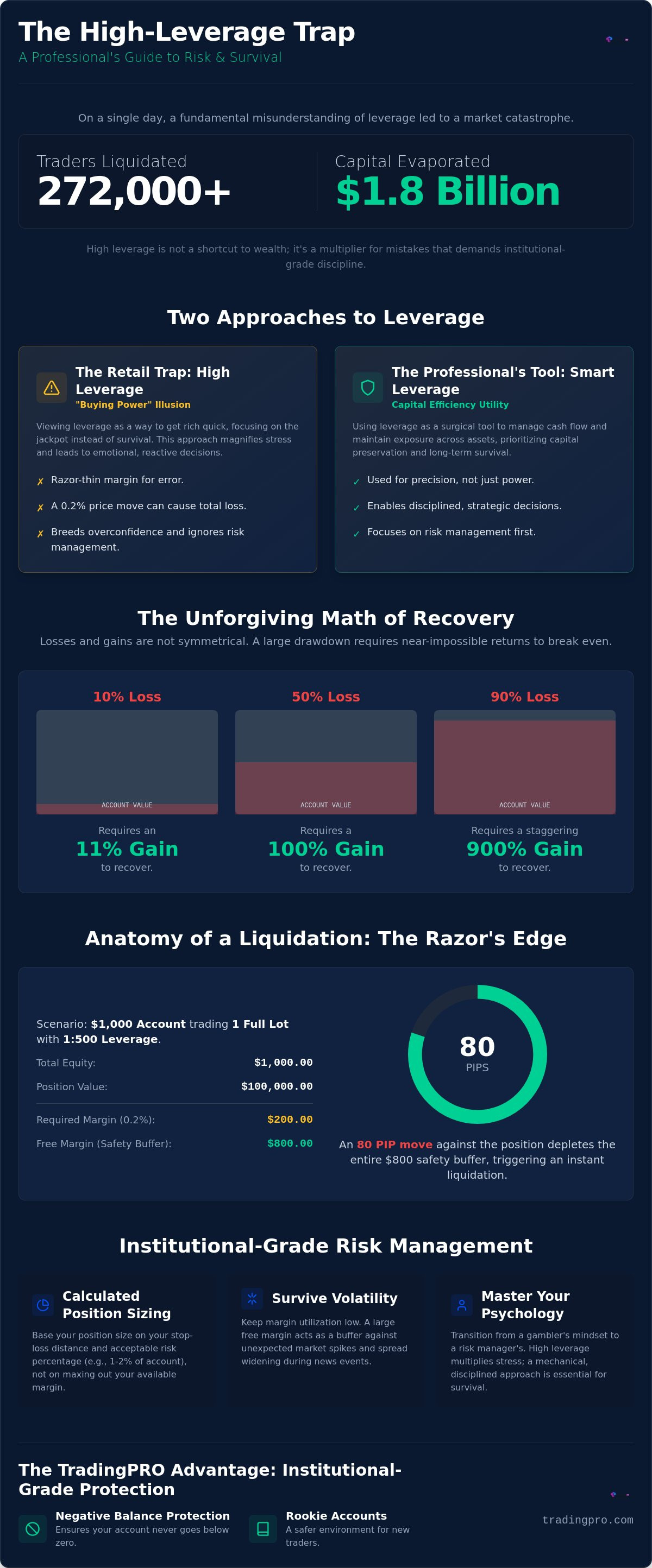
On June 2, 2026, over 272,000 traders watched $1.8 billion evaporate in a single wave of liquidations. It wasn't just a market dip that wiped them out. It was a fundamental misunderstanding of the risks of high leverage trading. When you utilize aggressive leverage, you aren't just magnifying your profit potential. You're shrinking your margin for error to a razor-thin edge where a tiny move against you results in a total account blowout. High leverage is not a shortcut to wealth; it is a multiplier for your mistakes that requires institutional-grade discipline to survive.
You've likely felt the crushing weight of a margin call just as the market prepares to turn in your favor. It's a common trap that breeds emotional stress and capital depletion. We'll help you master the mechanical and psychological triggers that lead to these disasters. This article provides the professional strategies you need to protect your capital while still maximizing your market exposure.
We'll dive into the math of liquidation and the reality of 2026 regulatory caps. You'll learn how to use leverage as a surgical tool. From understanding CySEC's 70% margin call threshold to utilizing a Rookie Account for a safer entry, it's time to professionalize your approach and trade with the confidence of a global leader.
Key Takeaways
- Learn why high leverage is a tool for precision rather than just a buying power multiplier, and how to avoid the mechanical traps that lead to instant liquidation.
- Master the "math of recovery" to understand why the risks of high leverage trading often require near-impossible gains to return an account to its baseline after a drawdown.
- Discover how to align your leverage with your specific strategy, whether you are utilizing high-speed execution or navigating multi-day market swings.
- Implement institutional-grade risk management by calculating position sizes based on stop-loss distance instead of simply maxing out your available margin.
- Secure your capital using TradingPRO’s Negative Balance Protection and select the account tier, such as the Rookie Account, that best fits your risk tolerance.
The Seduction of High Leverage: Why Traders Fall Into the Trap
Leverage is the ultimate financial amplifier. It transforms modest capital into a formidable market presence. By definition, high leverage is the use of a small amount of equity to control a significantly larger position. While this sounds like a shortcut to institutional-scale profits, it is the primary driver behind the risks of high leverage trading. Professionals view financial leverage as a utility for capital efficiency. Retail traders, however, often mistake it for a wealth-building strategy. This fundamental misunderstanding is where the trap begins.
Consider the "Buying Power" illusion. At a 1:500 ratio, a mere $100 deposit grants you $50,000 of market influence. This massive expansion of power is a double-edged sword. It amplifies your gains during winning streaks, but it accelerates catastrophic losses during even minor price corrections. Professional firms don't use leverage to "get rich quick." They use it to manage cash flow and maintain exposure across diverse assets without tying up all their liquid capital. They prioritize survival; the retail trader often prioritizes the jackpot.
The Psychological 'Multiplier' Effect
High leverage doesn't just multiply your money; it multiplies your stress. It magnifies the psychological risks of high leverage trading by forcing you to make decisions under extreme duress. When your position size is 500 times your actual balance, a 0.2% market fluctuation can wipe you out. This triggers an immediate "fight or flight" response. You stop thinking like a strategist and start reacting like a victim of the tape. Beginners who win early with high leverage face the greatest danger. This early success breeds overconfidence, leading them to ignore stop-losses and treat the market like a casino. To survive, you must transition from a gambler mindset to a disciplined risk manager mindset.
Leverage vs. Margin: Clearing the Confusion
Understanding the mechanics is vital for survival. Margin is the "good faith deposit" required by your broker to open and maintain a leveraged position. There is a strict inverse relationship at play. Higher leverage leads to lower margin requirements, which sounds beneficial until you realize it leaves you with no room for error. If you use a Rookie Account to start, you'll see how these requirements dictate your trade's lifespan. The Margin Call is the broker's last-resort safety trigger that automatically closes positions to prevent an account from falling into a negative balance. By keeping your margin utilization low, you ensure your account has the breathing room to survive the volatility that 2026 markets frequently deliver.
The Mechanics of Ruin: How High Leverage Liquidation Works
The most dangerous aspect of trading isn't the market. It's the math. Most retail traders focus on the potential for massive gains, but they ignore the "Math of Recovery" trap. This is a cold, mathematical reality where losses and gains are not symmetrical. If you lose 10% of your account, you need an 11% gain to get back to baseline. However, if the risks of high leverage trading lead to a 50% drawdown, you must generate a 100% return just to break even. At a 90% loss, you need a staggering 900% gain. In the high-velocity markets of 2026, reaching that 90% loss happens faster than you think.
Volatility expansion is the primary executioner of leveraged accounts. When you trade at 1:100 leverage, a simple 1% move against your position results in a 100% loss of your invested capital. Markets frequently move 1% in a matter of seconds during high-impact news events. When this happens, the "Stop Out" mechanism takes over. This is an automated safety protocol where the broker closes your trades to prevent your account from falling into debt. You also face the "Spread Gap" risk. During volatile periods, the difference between the buy and sell price can widen significantly. Even if the market price doesn't hit your stop-loss, a widened spread can trigger a premature liquidation of your entire position.
Visualizing the Liquidation Zone
To understand the danger, look at a $1,000 account trading 1 full lot ($100,000 value) at 1:500 leverage. Your required margin is only $200, leaving you with $800 in free margin. In this scenario, each pip movement is worth approximately $10. It takes a mere 80 pips of movement against you to wipe out your $800 cushion. Over-leveraging leaves zero room for the natural "breathing" of market prices. You aren't giving your strategy a chance to work; you're simply betting that the market won't move 80 pips in the wrong direction. For most currency pairs, 80 pips is a standard daily range, making this setup a statistical certainty for failure. To avoid these traps, consider registering for a professional account that offers the tools needed for precise margin management.
The Hidden Cost of High Leverage
Leverage is essentially borrowed money, and borrowing isn't free. When you hold a massive position, you're responsible for swap rates and financing costs. These are daily fees charged for maintaining your "borrowed" influence in the market. On a high-leverage position, these costs are calculated based on the total contract size, not just your $1,000 deposit. If you're stuck in a losing trade, these overnight costs eat into your remaining margin every single day. Holding a high-leverage loser is a mathematical death sentence. It accelerates your path to the stop-out level even if the market price remains stagnant. Professional risk management requires you to account for these fees before you ever click "buy."
High Leverage vs. Low Leverage: A Strategic Comparison
Your choice of leverage should never be arbitrary. It must be a direct reflection of your trading style, your timeframe, and your tolerance for volatility. Consider Scenario A: The Scalper. This trader operates in the high-frequency trenches of 1-minute charts. They utilize high leverage for short bursts to extract meaningful profit from tiny price vibrations. For them, leverage is a high-precision instrument. Contrast this with Scenario B: The Swing Trader. This professional navigates multi-day price swings and requires low leverage to ensure their positions survive the natural "breathing" of the market. Understanding the risks of high leverage trading means knowing exactly when to deploy this power and when to dial it back.
The most common "Rookie" error is applying high leverage to a low-probability setup without a proven entry strategy. Beginners often want the profit potential of a scalper but possess the slow reaction times of a swing trader. This mismatch is a recipe for disaster. TradingPRO offers tiered accounts specifically designed to match leverage to your current experience level. This tiered infrastructure ensures you aren't handed a high-performance tool before you've mastered the basics of capital preservation. You must match your tools to your objective to stay competitive in the 2026 landscape.
When High Leverage is Actually Useful
High leverage isn't inherently dangerous; it's a tool for superior capital efficiency. It allows you to diversify your exposure across multiple asset classes without the need to deposit massive amounts of liquid cash. You can also use it as a sophisticated hedging mechanism. By using high leverage on a small sub-account, you can protect a physical asset or a long-term portfolio during brief periods of market turbulence. The Scalp Account is engineered for these high-frequency environments, providing the institutional-grade execution and speed required for surgical market entries.
The Safety of Low Leverage (1:10 to 1:30)
Institutional traders and hedge fund managers rarely exceed 1:20 leverage in their professional portfolios. They prioritize the "Sleep Well at Night" factor. By keeping leverage low, you significantly reduce emotional interference in your decision-making process. You can watch a 50-pip retracement without the fear of an imminent margin call. This stability is essential for building a sustainable track record. If you intend to excel in Social Trading, low-drawdown management is your greatest asset. It proves to the market that you are a disciplined authority who values long-term growth over short-term gambles.
Actionable Risk Management: Leveraging Like a Professional
Professionals never treat leverage as a static number. While beginners see 1:500 as a permanent setting, elite traders view it as a dynamic risk factor that fluctuates based on market conditions. To neutralize the risks of high leverage trading, you must adopt the Golden Rule: never risk more than 1% to 2% of your total account balance on any single setup. This discipline ensures that even a string of losses won't result in a terminal drawdown. If you have a $10,000 account, your maximum loss per trade is $200. Period.
Mastering position sizing is the secret to institutional-grade execution. You should calculate your trade size based on your stop-loss distance, not your leverage. If your strategy requires a 20-pip stop-loss, your lot size must be adjusted so that those 20 pips equal exactly 1% of your capital. Leverage simply facilitates this position; it doesn't dictate it. Use the TradingPRO Trade Hub to perform these margin and risk calculations instantly. This precision allows you to use the "Fixed Fractional" method, where your trade sizes scale automatically as your account grows or shrinks. It's about maintaining a consistent risk profile regardless of your account's nominal value.
The 'Stop-Loss' is Your Only Real Protection
When you trade with leverage above 1:50, a stop-loss is non-negotiable. Without it, you aren't trading; you're gambling with total liquidation. Trailing stops are an excellent way to lock in profits while maintaining exposure to a trending market. However, you must account for slippage. In extreme market gaps, such as the liquidation events recorded in early 2026, a stop-loss is an order to sell at the next available price. It's not a 100% guarantee of the exact exit point, but it's the only barrier between a controlled loss and a catastrophic blowout.
Diversification as a Leverage Buffer
Don't make the mistake of exhausting your available margin on a single pair. Using all your "buying power" on one trade creates a single point of failure. By diversifying your trades, you dilute the risks of high leverage trading across various market sectors. You must also watch for correlated risks. If you're long on EUR/USD and GBP/USD simultaneously, you're effectively doubling your risk on the US Dollar. If the Dollar spikes, both positions will likely fail. Use the Micro Account to practice these position-sizing techniques with real cents before scaling up. This environment allows you to refine your approach without the stress of high-stakes capital. To start implementing these professional strategies today, register for your trading account and take control of your capital efficiency.
The TradingPRO Advantage: Institutional Grade Protection
TradingPRO serves as your strategic vanguard in a high-stakes environment. We don't just provide market access; we provide a fortress. While other brokers leave you exposed to the volatility of 2026, we implement Negative Balance Protection as a baseline standard. This ensures your losses can never exceed your deposits. You maintain full control. You trade with confidence. By neutralizing the structural risks of high leverage trading, we allow you to focus on execution rather than financial ruin. Our infrastructure is built for those who demand institutional stability and superior performance.
Success requires the right tools for the right stage of your journey. Our tiered infrastructure moves with you. You can start with the Rookie Account and scale toward Pro-level execution as your edge sharpens. If you prefer to leverage the expertise of others, our Social Trading Ecosystem connects you with seasoned masters who manage leverage with professional precision. In the fast-moving markets of 2026, speed is your greatest ally. Our high-speed execution minimizes slippage, ensuring your leveraged positions enter and exit exactly where you intend. Precision isn't an option; it's our standard.
Why the Rookie Account is Your Best First Step
The path to elite status begins with disciplined growth. Our Rookie Account features tailored leverage limits specifically designed to protect you from early execution errors. It's a safe-haven environment where you can master the mechanics of capital efficiency without the threat of instant liquidation. You gain full access to the TradingPRO Blog and a suite of educational resources to refine your strategy. We don't believe in rushing your progress. You transition to higher tiers only after you've proven consistent risk management. This modular approach builds the foundation for long-term profitability and global elite status.
Claim Your 2026 Trading Edge
Maximize your market influence with a reliable partner. The TradingPRO Deposit Bonus provides an additional margin cushion, giving your trades the breathing room they need during high-volatility events. This bonus isn't just a perk; it's a strategic buffer that enhances your capital efficiency. Navigating the complexities of 2026 requires a broker that values your time and security above all else. Don't settle for mediocre execution or unprotected exposure. Take the decisive step toward professionalizing your career. Open your Rookie Account and trade with professional safeguards today to experience the frictionless future of leveraged trading.
Dominate the 2026 Markets with Institutional Precision
The risks of high leverage trading are only terminal for those who ignore the math. You've now learned that leverage is a surgical tool for capital efficiency, not a shortcut to luck. By mastering position sizing and maintaining strict discipline, you transform from a market participant into a dominant force. Success in this high-velocity landscape requires more than just a strategy; it requires an elite partner that prioritizes your security above all else.
TradingPRO provides the multi-asset infrastructure you need, refined since 2017 to handle peak volatility. Our Negative Balance Protection ensures your capital remains shielded, while our tailored Rookie and Scalp accounts provide the exact environment your specific strategy demands. You don't have to navigate these complexities alone. Take the decisive step toward professionalizing your risk management and expanding your market potential with a global leader.
Master the markets with institutional-grade protection—Register for your TradingPRO Rookie Account today. The future of your trading career starts with the right safeguards. Step into the arena with confidence and claim your edge.
Frequently Asked Questions
Is high leverage trading always a bad idea for beginners?
High leverage isn't inherently bad, but it's dangerous without a disciplined framework. Beginners should use it to understand capital efficiency rather than chasing massive returns. We recommend starting with a Rookie Account. This provides a controlled environment where you can learn to manage risk without the typical account blowouts that plague undisciplined traders.
What is the safest leverage ratio for a $1,000 forex account?
A leverage ratio between 1:10 and 1:30 is generally considered the "safe zone" for sustainable growth. While 2026 regulations in major regions like the US and UK cap retail leverage at 30:1 or 50:1, many traders are tempted by offshore ratios of 1:500. Sticking to lower ratios ensures your $1,000 account can survive the natural price fluctuations that occur every day.
Can high leverage trading lead to debt beyond my initial deposit?
In many market environments, yes, a sudden gap can result in a negative balance. However, TradingPRO includes Negative Balance Protection as a core feature. This ensures that even if the risks of high leverage trading lead to a catastrophic market move, you can never lose more than your initial deposit. Your liability is strictly limited to the funds you've committed.
How does leverage affect the spread and my trading costs?
Leverage doesn't change the broker's spread, but it magnifies the impact of that spread on your available equity. A 2-pip spread on a 1:500 leveraged position represents a much larger percentage of your margin than on a 1:10 position. Larger leveraged positions also incur higher daily swap fees, which can eat into your capital if you hold trades overnight.
Why do professional traders often use lower leverage than retail traders?
Professional traders prioritize capital preservation and long-term track records over short-term gambles. They understand that the risks of high leverage trading include emotional interference and a lack of "breathing room" for their strategies. By using lower leverage, they reduce the probability of liquidation and maintain the psychological clarity needed for elite performance.
What happens to my leveraged position during a weekend market gap?
Your position remains open, but the market can reopen at a price significantly different from Friday's close. This "gap" can bypass your stop-loss entirely. If you're highly leveraged, a weekend gap can trigger an immediate stop-out or margin call the moment the market opens. Professionals often reduce their exposure before the weekend to mitigate this specific risk.
How can I calculate my required margin before I open a trade?
You can calculate it by dividing the total position value by your leverage ratio. For example, controlling $100,000 with 1:100 leverage requires $1,000 in margin. To make this process frictionless, use the Trade Hub tools on our platform. These tools provide instant calculations so you can see exactly how much capital is required before you commit to a trade.
Does TradingPRO offer tools to help manage leverage risk?
Yes, we provide a comprehensive suite of institutional-grade tools. Our Trade Hub allows for rapid margin calculation and risk assessment. We also offer tiered accounts, such as the Rookie and Scalp accounts, to match leverage limits to your experience level. Combined with Negative Balance Protection, these tools give you the "safe-haven" infrastructure needed to excel in 2026.


