




- Published on: 2026-11-03 10:46:56
Realistic Expectations for New Traders: A Practical Guide

A perfect trading system doesn’t exist. Realistic expectations for new traders start with accepting that no strategy succeeds in every market and that even a system with a 60% win rate can lose on 4 out of 10 trades. Consistency comes from following researched rules, managing risk, and judging performance across a series of trades, not expecting every position to win.
It’s natural to want quick progress, especially when trading content highlights dramatic returns or overnight success. But those stories can distort what steady learning looks like and push beginners toward rushed decisions. A stronger approach is to treat trading as a skill developed through practice, evidence, and deliberate risk control.
This guide explains how to set practical expectations, plan for losses as well as wins, manage position risk, and keep emotions from driving decisions. It also shows how to make expectations part of your pre-trade routine, so each trade has a clear purpose and plan before you enter.
Key Takeaways
- Set a defined risk limit before entering a trade, then size your position around the loss you can manage.
- Decide where you’ll exit if the market moves against you, and follow that plan instead of reacting under pressure.
- Separate trading results from self-worth: review decisions for useful lessons rather than comparing yourself with highlight reels.
- Build a pre-trade routine that checks your setup, risk, and emotional state before you act.
- Explore TradingPRO’s Rookie, Micro, Pro, and Scalp Account options to find an account tier aligned with your trading approach.
1. Realistic expectations and the myth of a perfect trading system
No trading system wins in every market. A system with a 60% win rate still loses on 4 out of 10 trades, so one losing position doesn’t prove the strategy has failed. Judge a researched method across a series of trades, including losses, rather than expecting each setup to deliver a profit.
Trading costs also shape what “profitable” means. Regulators said day traders must make a 56-percent profit just to cover commissions and fees, according to the U.S. Government Publishing Office. Treat that figure as a reminder to account for trading costs before evaluating results, not as a return target. Commissions, spreads, and taxes can all affect net performance.
Keep a journal that records each trade’s setup, planned entry and exit, risk, result, and emotional state. After a group of trades, look for specific patterns: perhaps you skip a planned exit after a loss or enter without a researched signal. Note what happened and adjust one rule at a time. This makes expectation problems visible instead of letting memory favor dramatic wins.
Research each trade before placing it. Define the setup, the evidence supporting it, the point that would invalidate it, and your planned response. A rules-based approach responds to actual market movement, not a hoped-for price target. Positive expectancy depends on both the proportion of winning trades and the average size of wins relative to losses, after costs. A high win rate alone does not establish positive expectancy.
Day trading, swing trading, and long-term investing call for different expectations because their holding periods and decision rhythms differ. Day trading demands frequent, timely decisions; swing trading holds positions longer; long-term investing focuses on a broader horizon. In each case, assess the process against its plan, risk, and suitable timeframe, not another trader’s results.
For U.S. beginners, the pattern day trader rule is a securities-account consideration. Don’t assume it applies identically to every product or account. Identify the rules governing the specific market and account before making frequent same-day trades, and understand the relevant account limits.
There’s no universal starting-capital figure for beginners. The amount depends on the product traded, position sizing, applicable margin requirements, and how much loss you can absorb without disrupting essential finances.
Trading costs vary with the instrument and your activity. Commissions, bid-ask spreads, and taxes can affect net results, so account for them in your trading records rather than assuming gross gains equal take-home profit.
There is no single realistic success rate for new retail traders. Read win rate alongside average gains, average losses, costs, and consistency across the trades recorded in your journal.
Beginners can’t reliably forecast trading income or how long it will take to become consistently profitable. Both depend on capital, strategy, costs, risk control, experience, and how the method performs in changing market conditions. Avoid revenge trading: after a loss, pause and review your journal. Take another trade only when its researched setup meets your written rules.
2. Risk management, stop losses, and position sizing
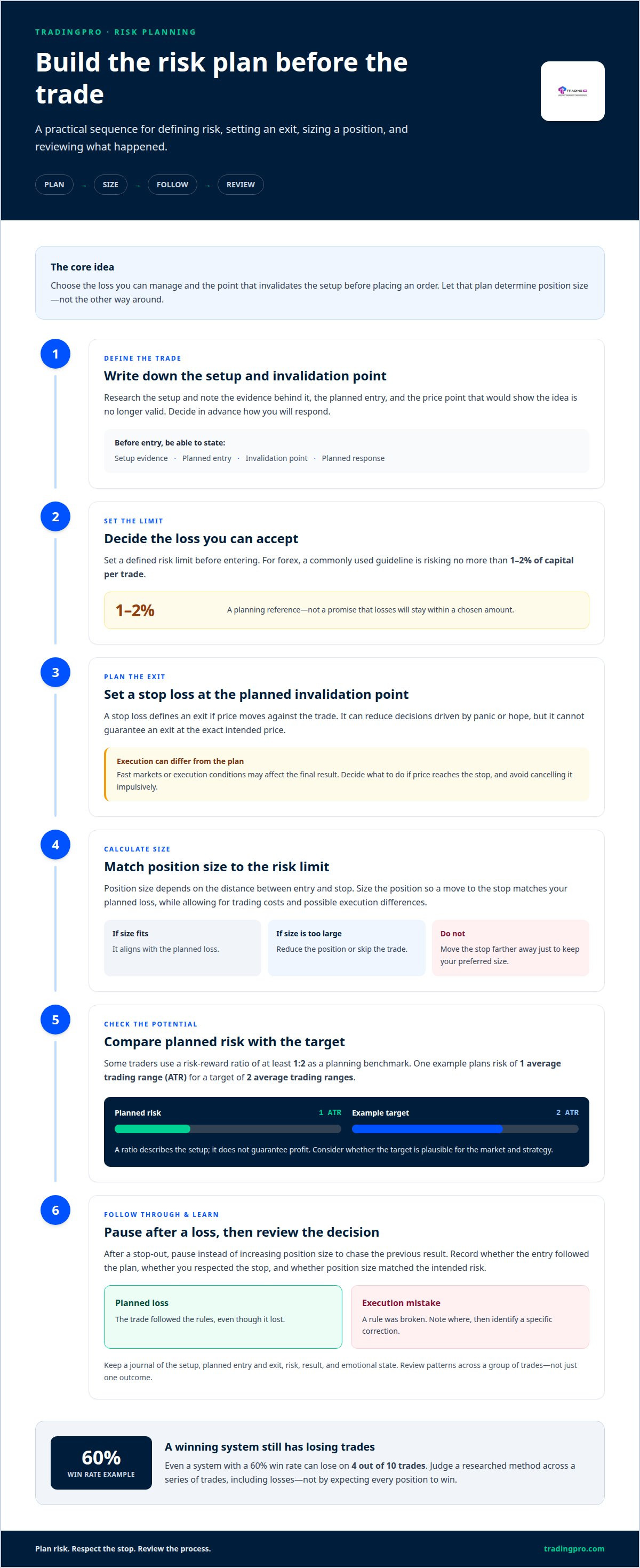
Risk planning starts before an order is placed. Decide what loss a trade could create, where the position becomes invalid, and what action follows. For forex, a commonly used guideline is risking no more than 1-2% of capital per trade. Treat this as a planning reference, not a promise that losses will stay within a chosen amount.
Position size connects your risk limit to the distance between entry and stop loss. First, identify the stop level from the trade setup. Then size the position so a move to that level matches your planned loss, allowing for trading costs and possible execution differences. If the required position is too large, reduce it or skip the trade. Don’t move the stop farther away just to preserve your preferred position size.
A stop loss defines an exit point if the price moves against your trade. It helps make your response less dependent on panic or hope, but it can’t ensure an exit at the exact intended price. Fast markets or execution conditions can affect the final result. Before entering, decide what you’ll do if the price reaches the stop, and follow that rule rather than cancelling it impulsively.
Some traders use a risk-reward ratio of at least 1:2 as a planning benchmark. In an example system, the planned risk is 1 average trading range (ATR), with a target of 2 average trading ranges. That ratio describes a setup, not a guarantee of profit. Consider whether the target is plausible for the market and strategy; a distant target can be less useful if price is unlikely to reach it.
Expect losses, including the possibility of losing the full amount allocated to trading. Oversized positions, repeated losses, and continuing to trade without reassessing risk can erode an account. The result depends on your exposure, the instrument, and your actions. Keep trading capital separate from money needed for essential expenses, and understand the risks attached to each position.
Take responsibility for a loss by reviewing your decision, not by searching for someone to blame. Record whether the entry followed your plan, whether you respected the stop, and whether position size matched your intended risk. If you broke a rule, identify exactly where and set a correction for the next trade. A loss within your plan is different from a preventable execution mistake.
Losses can trigger fear, anger, or the urge to recover money immediately. Pause after a stop-out, and don’t increase position size to chase a previous result. Set a daily or session-level stopping condition in advance, then step away when it’s reached. To set practical goals, track rule-following and risk control before focusing on account growth. If you’re ready to put your plan into action, begin your account setup.
3. Managing emotions and expectations
Luxury lifestyles, oversized profit screenshots, and promises of overnight success can make trading look effortless. They show a result without revealing the decisions, losses, or risks behind it. Making your first million in a week or a few months is an unrealistic expectation for a beginner. Building realistic expectations for new traders means separating dramatic content from evidence about a method’s performance.
Comparison can turn another person’s trade into pressure to act. You see a profit post, worry about missing out, then enter a setup that wasn’t part of your plan. Replace that impulse with a pause: name the emotion, identify the signal you’re responding to, and pass if it doesn’t meet your strategy’s criteria. Someone else’s result is not a trading signal.
Set goals around actions you control, not promised income or a date for success. For example, define whether you followed your entry criteria and respected your planned exit. Review those behaviors separately from the trade’s outcome. A profitable trade can still involve a poor decision, while a loss can follow a well-executed plan. This distinction keeps one result from resetting your expectations.
The market’s direction over the next year cannot be known for sure. That uncertainty makes predictions about a beginner’s future returns especially fragile. Treat a forecast as a scenario, not a commitment: identify what would support it, what would invalidate it, and what you’ll do if conditions change. A plan grounded in conditions gives you an actionable response when confidence or fear starts steering your decisions.
Trading also tests motivation. By month 6, a big portion of traders have seriously considered giving up at least once. Beginners can’t know whether trading suits them until they gain experience over time. Use that learning period to examine whether you can follow a process, tolerate uncertainty, and adapt after mistakes. Don’t interpret temporary frustration as proof of failure, or enthusiasm as proof of skill.
Experience alone doesn’t qualify someone to mentor you. A trader with 2 years of experience may know more than someone with 1 year, but that difference doesn’t establish a reliable teaching record. Assess advice by its reasoning: does it explain risk, changing conditions, and losing outcomes, or rely on lifestyle images and bold promises? That filter helps you resist emotional decisions based on authority or popularity.
When excitement or fear rises, slow down your decision. Step away from the screen, revisit the reason for the trade, and wait until you can assess the setup against your rules. If you feel compelled to recover losses or copy someone’s success immediately, don’t mistake that urgency for evidence. A deliberate pause protects your judgment and keeps expectations connected to the process you chose.
4. Accepting that trades can win or lose
No trader can know market direction for sure over the next minute or the next 15 minutes. A clear setup can still fail when price moves differently than expected. Plan for both outcomes before entering, then manage the position according to the conditions you defined.
The Subcommittee’s February hearings found that more than 75% of day traders lose some or all of their investment, according to the U.S. Government Publishing Office. That finding gives beginners a serious reason to understand risk before trading. It doesn’t predict any one trader’s result, but it shows why a plan must account for losses, not just winning examples.
There’s no single win rate that defines a sound strategy. One trainer says even the most experienced traders have a 35% win rate, while no setup works 100% of the time. Those figures illustrate why win percentage alone can mislead. A strategy’s outcomes also depend on how large its average wins and losses are, how often its signals appear, and what costs apply.
Consider a method that wins less often than it loses. It may still produce positive results if its average winning trade outweighs its average losing trade. The reverse can also happen: frequent small wins may be erased by a few much larger losses. Review the full pattern in your trade records, including the size and sequence of outcomes, instead of judging the method by its latest position.
Before every trade, write down two scenarios. First, identify what you’ll do if the price moves in your favor. Then state the level or condition that would show your idea is wrong, and follow the planned exit. This makes a losing trade an expected part of the process, rather than a surprise that prompts an impulsive change.
After closing a position, separate the result from your execution. A loss that followed the plan can offer useful information about the method; a win that broke the rules can reinforce risky behavior. Record what the market did, what you did, and whether the exit matched your plan. Use that review to decide whether the strategy needs an evidence-based adjustment, not an emotional overhaul after one trade.
Expect a sequence of mixed results. A winning position doesn’t prove future trades will win, and a losing position doesn’t prove every future setup will fail. Treat each trade as one of many, stay neutral about its outcome, and place confidence only in a method you’ve researched and tested. That balance keeps one result from controlling your next decision.
When uncertainty feels difficult, focus on the next planned action. Check the setup, confirm the invalidation point, and decide whether the potential loss fits your risk plan. If anything has changed, pause rather than forcing an entry. Preparation won’t reveal the next market move, but it can keep your response consistent through both wins and losses.
5. Building expectation control into a pre-trade routine
Expectation control works best when you separate strategy review from trade execution. Before a session, assess whether your rules have evidence behind them. During the session, focus on applying those rules. Mixing the tasks invites mid-trade changes, such as shifting a planned exit because one position suddenly feels unusually promising. Give each task its own time and purpose.
Start with a written expectation statement. Describe what the setup may do, what evidence supports that view, and what would challenge it. For example, “I’ll consider an entry if the price reaches my planned level and the signal remains valid” is more useful than “This trade should make money.” The first ties action to observable conditions. The second turns hope into an expectation.
Use a consistent checklist before entering. Confirm that the setup matches your researched strategy, note the evidence you see, and identify what would invalidate your reasoning. Then ask whether you’re acting on the signal or reacting to a recent win, loss, or market headline. If the setup doesn’t meet your written criteria, record why you’re passing. A deliberate no-trade decision is part of execution.
Keep the routine practical. A pre-trade note can include:
- Setup: What conditions must be present before you act?
- Evidence: What current market movement supports the setup?
- Expectation: What outcome are you anticipating, and what could prove that view wrong?
- Emotional check: Are urgency, frustration, or excitement affecting this decision?
During the trade, manage the position without reopening the strategy debate. If new market movement changes the conditions, follow the response you planned for that situation. If you feel tempted to improvise, note the urge and return to your rules. Keep a chart or journal entry for expectation-related problems, such as entering early because you feared missing the move.
After the trade, record the expected scenario alongside what actually happened. Note whether you followed the setup and whether your expectations influenced any decision. Review these notes separately from live execution, alongside your strategy rules and profitability. This separation helps reveal repeated behaviors without prompting an immediate strategy change after one result.
Build the routine around decisions you control: reviewing evidence, following rules, and recording deviations. If you’re ready to put a structured trading routine into practice, begin your account setup.
Recognizing misleading trading content and building a realistic path toward consistency are also part of developing a healthier trading mindset. A trading trainer notes that new traders may expect to turn $500 into $500,000 in one year. Treat that kind of expectation as a prompt to examine the evidence behind a claim, rather than as a target for your own routine. Ask whether a trading idea fits the strategy you have researched and whether your written conditions support acting on it. Keeping that distinction clear can help prevent ambitious claims from replacing a process based on observable evidence.
Lack of experience and knowledge are the main contributors to traders’ repeated losses or negative performance, as the author identifies. Use your review to find what you still need to understand, and keep expectations tied to the quality of your decisions rather than a promised outcome. A realistic approach leaves room to learn, record mistakes, and build consistency by applying your rules repeatedly.
TradingPRO
TradingPRO offers account options for traders putting a researched plan into practice. The Rookie, Micro, Pro, and Scalp Accounts provide distinct tiers for different trading approaches. Choose with your strategy, risk limits, and experience in mind, not an expectation of guaranteed returns. TradingPRO’s accounts may be a natural next step when you’re ready to follow a structured routine and explore options suited to your approach. Keep your goals grounded in preparation, disciplined execution, and ongoing review. Contact TradingPRO to learn more about its account options.
Make your next step a deliberate one
Your trading practice can develop as your understanding grows. Keep your approach open to adjustment, but make changes for a clear reason: recorded evidence, a shift in your goals, or a better understanding of how you respond to uncertainty. This keeps progress intentional instead of driven by pressure to move faster.
Realistic expectations for new traders are a foundation for patient, purposeful decisions. Let your next step reflect how you want to approach trading, not an image of instant success. A clear process gives you room to learn and refine your judgment over time.
If you’re ready to take that next step with TradingPRO, create your account. Move forward with focus, curiosity, and a commitment to learning.
Frequently Asked Questions
What U.S. rules apply to beginner day traders, including the pattern day trader rule?
For U.S. beginners, the pattern day trader rule is a securities-account consideration and may not apply identically to every product or account. Check which rules govern your specific market and account, including relevant account limits, before making frequent same-day trades.
How much starting capital do beginners need for different types of trading?
There’s no universal starting-capital amount. It depends on the product, position sizing, applicable margin requirements, and how much you can afford to lose without disrupting essential finances.


