




- Published on: 2026-10-30 10:43:20
Pro Trading Account Benefits Compared With Retail Accounts

A professional account isn’t automatically the better choice. Pro trading account benefits may include higher leverage, lower margin requirements, or different trading costs and execution arrangements, depending on the broker and account. These features can increase exposure to losses, so weigh the terms against your trading approach.
It’s easy to focus on leverage or headline spreads, but the full comparison matters. Eligibility and deposit requirements affect access, while margin, commissions, swaps, and execution shape how an account works in practice. This guide compares professional and retail accounts across those criteria, helping you identify which pro trading account benefits matter to your decisions and what to consider before choosing.
Key Takeaways
- Compare eligibility criteria and deposit requirements before deciding whether a professional account fits your trading profile.
- Assess how leverage and margin can change your exposure, not just the funds needed to open a position.
- Look beyond spreads: commissions, swaps, and execution can all shape the overall trading experience.
- Use a side-by-side comparison to weigh professional-account features against the terms and protections of a retail account.
- Choose an account type around your trading approach, experience, and ability to manage risk.
Pro account eligibility and deposit requirements
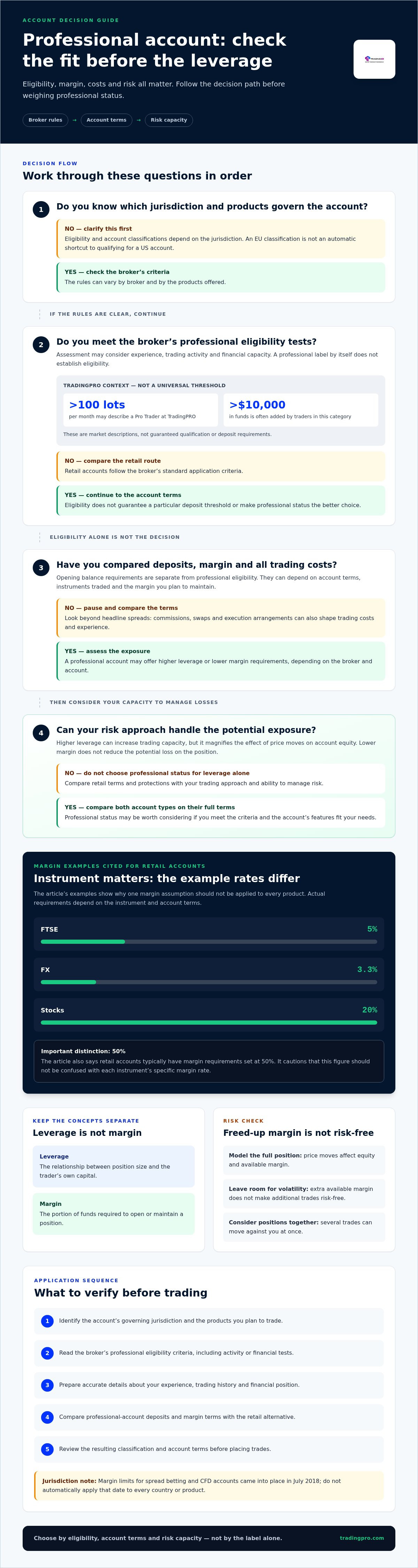
In the United States, eligibility for a professional trading account depends on the broker’s rules and the products offered. Review the broker’s criteria, then submit the requested application and supporting financial or trading information. A pro label alone doesn’t establish eligibility or guarantee a particular deposit threshold.
Professional status is generally assessed through experience, trading activity, and financial capacity. These measures help distinguish an active, experienced trader from someone seeking a higher-risk account solely for increased leverage. For context, a Pro Trader at TradingPRO may trade more than 100 lots per month, while traders in this category often add more than $10,000 in funds. These are market descriptions, not universal qualification thresholds.
Deposit rules are separate from professional eligibility. The required opening balance can depend on the account terms, the instruments traded, and the margin you intend to maintain.
EU eligibility rules shouldn’t be treated as a shortcut for a US application. Account classifications and their criteria depend on the jurisdiction governing the account. The available facts don’t identify which countries apply a particular EU eligibility route, so don’t assume that an EU classification automatically qualifies someone in the United States.
| Account option | Eligibility basis | Deposit context | Key consideration |
|---|---|---|---|
| Retail | Broker’s standard application criteria | Standard funding requirements apply | Compare account terms and product access |
| Professional | Broker-assessed experience, activity, or financial capacity | Depends on account requirements | Assess added risk alongside potential features |
Choose based on whether you meet the stated criteria and can manage the account’s exposure, not on the account label alone.
Use this sequence to approach an application:
- Identify the account’s governing jurisdiction and the products you plan to trade.
- Read the broker’s professional eligibility criteria, including any activity or financial tests.
- Gather accurate details about your experience, trading history, and financial position.
- Compare the professional account’s deposit and margin terms with the retail alternative.
- Submit the application and review the classification and account terms before trading.
For a US application, compare the broker’s specific eligibility requirements with your trading history and financial circumstances. Then complete the application process and assess the account terms before choosing professional status.
The page states that FCA rules protect 400,000 UK CFD traders each year from losses of up to £451m; this is UK context.
Higher leverage and lower margin requirements
Leverage lets a trader control a larger position with less capital set aside as margin. A professional account may offer higher leverage and lower margin requirements than a retail account. This can increase trading capacity, but it also magnifies the effect of price movements on account equity. Even a small market move can have a larger impact on a leveraged position.
Margin is the portion of funds required to open or maintain a position. Retail margin depends on the instrument: cited examples include 5% for FTSE, 3.3% for FX, and 20% for stocks. Retail accounts typically have margin requirements set at 50%, but this figure shouldn’t be confused with every instrument’s specific margin rate. The applicable requirement depends on the product and account terms.
Consider a trader comparing an FX position with a stock position. The retail examples assign different margin rates to each, so the same exposure can require different amounts of account equity. A lower professional margin requirement could free up funds for other positions. It doesn’t reduce the potential loss on the original trade, and available funds can change as prices move.
Leverage describes the relationship between position size and the trader’s own capital. Margin is the capital held against that position. Lower margin can make greater exposure possible, but it can also leave less room to absorb adverse movements. Focus on the position’s potential loss and the margin needed to maintain it, not only the amount required to enter.
- Compare by instrument. FTSE, FX, and stock examples show why one account-wide assumption can mislead.
- Model the full position. Consider how a price move affects both equity and available margin.
- Leave room for volatility. Avoid treating freed-up margin as risk-free capital for additional trades.
- Separate rules by market. Margin limits for spread betting and CFD accounts came into place in July 2018; that date shouldn’t be applied automatically to every country or product.
Before choosing higher leverage, compare the margin rules for each instrument you plan to trade. Then decide how much exposure fits your own risk limits, including the possibility of several positions moving against you at once. If you’re ready to explore account access, you can start the registration process.
Professional and retail trading account differences
A retail account is designed for clients classified as non-professional, while a professional account is for traders who meet the applicable eligibility criteria. This classification can affect leverage, margin, costs, and account protections. The practical difference goes beyond the label: consider how the terms fit your experience, trading activity, and approach to risk.
Consider two traders planning to trade EURUSD. One may value straightforward terms and a familiar retail setup. The other may prioritize professional classification and assess whether its terms suit a more active strategy. Neither profile is automatically better. Weigh account features against actual needs rather than treating professional status as a performance upgrade.
Account features can vary by broker and configuration. A professional classification doesn’t automatically include every platform tool, research feature, or market-data feed. For example, a trader who relies on charting should distinguish platform access from research content and data access. Each serves a different purpose, so review the account’s stated features.
What trading tools, research, or market data come with a pro account? There isn’t one universal package. These features depend on the broker and account configuration, so compare each separately rather than assuming professional status includes them.
What risks or disadvantages come with a pro trading account? Higher leverage can increase exposure to losses, while professional eligibility may require a stronger trading or financial profile. Account terms may also differ from retail terms, so compare protections and costs alongside potential advantages.
| Comparison point | Retail account | Professional account |
|---|---|---|
| Classification | Retail client status | Professional eligibility assessment |
| Account features | Set by the broker and account | Set by the broker and account |
| Tools and data | Feature access varies | Feature access varies |
| Risk assessment | Consider product exposure | Consider exposure and account terms |
Use the comparison to identify what changes for your intended trades. If you trade EURUSD, list the platform features you use, the information you need to make decisions, and the account terms that affect your positions. Then compare like with like: one tool against the same tool, and costs against the same trading activity.
- Separate classification from platform features.
- Compare account terms against your actual trading plan.
- Weigh additional access against exposure and any changed protections.
Spreads, commissions, swaps, and execution
A lower spread can reduce the entry cost of a trade, but it doesn’t show the full bill. Standard-account spreads are listed from 1.2 to 2.0 pips, while an ECN account may quote 0.0 pip plus a markup. Compare both charges using the same instrument, position size, and trading period.
These examples show why trading frequency matters: small per-trade differences can add up across repeated orders.
| Cost component | Standard-account example | ECN-account example |
|---|---|---|
| Spread | 1.2 to 2.0 pips | 0.0 pip plus a markup |
| Commission | Included in the spread example | |
| EURUSD illustration | Spread and commission both matter |
Volume changes the comparison. The example isn’t directly comparable with EURUSD because the instrument and trading volume differ. Use your planned symbols and frequency to compare account costs on equal terms.
Swaps add another cost when a position remains open beyond the trading day. For example, an overnight EURUSD position may incur a swap, so include financing costs if you hold trades. The amount depends on the instrument, direction, and account terms. A tight spread alone doesn’t show whether a trade costs less to hold.
Execution also affects the trade price. A quoted spread is not the only consideration: the order’s fill price and timing determine how closely execution matches the intended entry or exit. Review how market and pending orders behave in the platform, and compare fills across the same instrument and trading conditions. Don’t assume a 0.0-pip quote means every order executes at the displayed price.
- Compare spread plus commission, not either charge in isolation.
- Multiply per-lot costs by your actual trade volume and frequency.
- Add swaps when your plan holds positions overnight.
- Assess execution using your order type and intended trading conditions.
Choose the structure that fits your trading pattern: frequent EURUSD trades make per-lot costs especially visible, while overnight positions call for a closer look at swaps. Compare equivalent trades before treating a narrower quoted spread as a lower total cost.
What is a pro trading account and who is eligible?
A pro trading account is a classification for traders who meet the applicable broker and jurisdiction criteria. It can have different terms from a retail account, including leverage, margin, and protections. The label alone doesn’t show whether the account suits you. Compare the classification with your trading approach and ability to manage greater exposure.
Eligibility isn’t one universal test for every country or trading product. A broker may assess experience, trading activity, or financial capacity, while the jurisdiction can shape how professional status is defined. For example, a US applicant should use the criteria for the specific account and products they’re applying for, rather than assume an EU classification applies.
Trading activity can help demonstrate experience. A market description of a Pro Trader often refers to trading more than 100 lots per month, but that is not a universal eligibility threshold. Treat it as an activity example, not a substitute for the broker’s stated assessment. Frequency alone also says little about whether a trader understands product risk or can sustain losses.
Separate three decisions before applying: whether you meet the criteria, whether you want professional classification, and whether you can manage the account’s terms. A trader may meet an activity test but still prefer retail terms. Another may have substantial experience but need to weigh changes in protections before changing classification. Eligibility and suitability are related, but they aren’t interchangeable.
Use this practical sequence to evaluate a professional account:
- Identify the jurisdiction and trading products covered by the account.
- Read the broker’s criteria and note each experience, activity, or financial test.
- Prepare accurate records that support the information requested in the application.
- Compare the proposed professional terms with your current retail account.
- Decide whether the account’s leverage, margin, costs, and protections fit your plan.
Keep your evidence consistent. If an application asks about trading experience, for example, describe the instruments and strategies you actually use. If it assesses financial capacity, provide information that accurately reflects your circumstances. Don’t treat a large deposit or frequent trading as automatic proof of qualification.
A professional account can suit experienced, active traders who understand its terms and need its features. A retail account may be a better fit for someone who values its structure or doesn’t meet professional criteria. Compare the specific terms before deciding on a classification.
Ready to take the next step? Start your trading account registration and review the available account choices as part of your decision.
TradingPRO: Rookie Account
TradingPRO offers the Rookie Account as an option to consider if professional-account terms don’t fit your experience or trading plans. Use this guide’s comparison to decide which account category better matches your approach, then review the available Rookie, Micro, Pro, and Scalp accounts.
The Rookie Account is an option to weigh alongside the Pro Account, without assuming one classification suits every trader. Compare account terms with your intended trading style and approach to risk before choosing. If professional eligibility is your priority, assess it separately from the account name.
For an account comparison aligned with your trading plans, visit TradingPRO’s website.
Choose the account that supports your next move
Make your account choice part of a clear trading plan. Identify the markets and strategies you intend to focus on, then decide which account features matter most. Prioritize the pro trading account benefits that fit your needs and risk controls, not simply the ones that sound most advanced.
TradingPRO offers Rookie, Micro, and Pro Accounts. Compare them against your experience and intended trading style before deciding which direction to take. A deliberate choice gives you a stronger starting point for building consistent trading habits.
Ready to take the next step? Explore account options and register with TradingPRO. Move forward with a plan, stay focused on your goals, and choose with confidence.
Frequently Asked Questions
What are the advantages of a professional trading account?
A professional account can suit experienced traders who need terms aligned with active, higher-volume strategies. Its value depends on how those terms support your process, including position sizing, order frequency, or the markets you trade. For example, a trader using a defined strategy across several instruments may prioritize flexibility, while another may gain little from professional classification. Compare practical value, not status.
Is a Pro Account better for all strategies?
No. A Pro Account isn’t automatically a better match for every strategy. A trader holding positions longer may care more about overnight costs, while a short-term trader may focus on spreads and execution. A strategy involving modest exposure and few trades may not benefit from professional terms. Match account conditions to your holding period, instruments, order habits, and risk limits.
Should I switch to a Pro Account if I only trade one pair?
Trading one pair alone doesn’t determine whether switching makes sense. Someone trading EURUSD frequently, for example, should assess total trade volume, holding time, execution needs, and overall costs. A trader placing occasional EURUSD positions may value different features. Use your own trade records to compare, then consider whether professional eligibility and account terms suit your routine.
What matters more: spread, commission, or execution?
It depends on how you trade, because each factor affects a different part of the transaction. Frequent traders should calculate spread and commission across their usual order sizes. Those placing orders in fast-moving markets should pay close attention to execution quality and the difference between intended and filled prices. For overnight positions, include swap costs too. Compare the full cost of a representative trade.
What benefits do pro trading accounts offer compared with standard accounts?
Professional accounts can have different leverage, margin, and trading-cost terms from standard accounts, but the exact comparison depends on the account and product. For a trader managing several positions, these terms can affect available capital and exposure. Compare protections as well as trading conditions. Professional classification is useful only when its specific features support your trading plan.
What are the typical minimum deposits and account fees for pro trading accounts?
There isn’t one universal deposit or fee schedule for professional accounts. Separate opening deposits from trading charges, which may include spreads, commissions, and swaps. Compare the account’s stated funding threshold and cost structure with your expected trading activity, instrument choices, and usual holding periods.
Do pro trading accounts offer lower commissions or tighter spreads?
Professional accounts can use a different pricing structure, but status doesn’t guarantee lower total costs. One account might show a narrower spread but charge a separate commission; another might include more of its trading cost in the spread. Compare equivalent trades using the same instrument, position size, and holding period. Include overnight charges where relevant, rather than basing your decision on the headline spread alone.
Do pro trading accounts provide higher leverage or margin, and what are the rules?
Professional accounts can have higher leverage and lower margin requirements, subject to the account terms and the rules for its jurisdiction and product. Consider a position that moves against you: greater leverage increases its impact on your account, while margin determines the funds committed to maintaining exposure. Compare requirements for each instrument and understand how the account handles changing equity before using more leverage.


