




- Published on: 2026-10-11 06:40:53
Mirror Trading Platforms: How to Compare Them in 2026

The most impressive strategy history isn’t enough to make a mirror trading setup a good fit. Mirror trading platforms can replicate trades automatically, but past performance doesn’t guarantee future results, and copied trades may behave differently in your account.
It’s easy to blur the lines between mirroring, copy trading, and social trading. The terms can overlap, but automation and user control may differ. Before choosing a setup, find out what gets copied, what you can adjust, and how clearly the platform presents a strategy’s history and risks.
This guide explains how mirror trading works and offers practical criteria for comparing platforms in 2026. You’ll learn how to assess strategy transparency, risk controls, costs, and account fit, while remembering that trading outcomes can vary. We’ll also look at how your experience and trading approach can inform account selection within TradingPRO’s brokerage environment, which includes Rookie, Micro, Pro, and Scalp accounts alongside Social Trading and Copy Trading. Use these insights to make a considered choice, not to assume automation removes risk.
Key Takeaways
- Learn how mirror trading platforms replicate selected activity and why copied trades may not match the strategy provider’s results.
- Compare strategy information, available controls, risk visibility, cost disclosures, and supported markets.
- Look beyond historical returns to understand how a strategy behaves and what its track record leaves out.
- Use a pre-activation checklist to review terms, choose an allocation, understand available controls, and plan ongoing monitoring.
- See how TradingPRO’s Social Trading and Copy Trading ecosystem sits alongside its Rookie, Micro, Pro, and Scalp accounts.
What Mirror Trading Platforms Do, and What They Do Not
A mirror trading platform reproduces selected trading activity in a connected user account, following the platform’s rules for copying trades. Instead of entering each position yourself, you choose a strategy or market participant to mirror, then the system acts on that selection. Features and terminology vary, so focus on what the setup actually replicates and what control remains with you.
The terms mirror trading, copy trading, and social trading can overlap. Some services use them interchangeably; others distinguish automatic replication from features that let users choose or adjust individual trades. For a closer terminology comparison, see social trading versus copy trading. Wikipedia’s Mirror trading overview also provides context on the term and related approaches.
How mirror trading differs from placing every trade yourself
With mirror trading platforms, you select a strategy or trader, connect it to your account, and enable replication according to the service’s rules. The platform then processes subsequent trade actions, so you don’t have to research, place, and manage every position manually. That changes the workflow, not your responsibility to understand the activity in your account.
Manual trading puts each decision directly in your hands: you choose what to trade, when to enter, and when to close. Mirroring delegates some of those actions to an automated process. Controls for pausing or stopping replication vary. Before enabling it, read how the connection works, including what happens to open positions if you stop copying.
What a mirror trading platform does not guarantee
Replication automates actions, not outcomes. A strategy’s past performance can’t guarantee future results, and copied strategies may experience losing trades or drawdowns. Market conditions can change, and execution in your account may differ from that of the strategy you follow. Previous gains provide context, not proof of what comes next.
That distinction matters even when the process feels hands-off. A copied position can lose money, and losses can accumulate while a strategy moves through a drawdown. You remain exposed to the risks of the markets and products involved. Mirroring isn’t passive income, risk-free investing, or a substitute for oversight.
Stay engaged. Understand the strategy’s approach and the products it trades, decide whether potential losses fit your circumstances, and review your account after replication begins. If you can’t explain what the platform is doing or how you’d respond to losses, pause before connecting. Automation can reduce the work of placing trades, but informed decisions still require attention.
How Mirror Trading Replicates Trades, and Why Results Can Differ
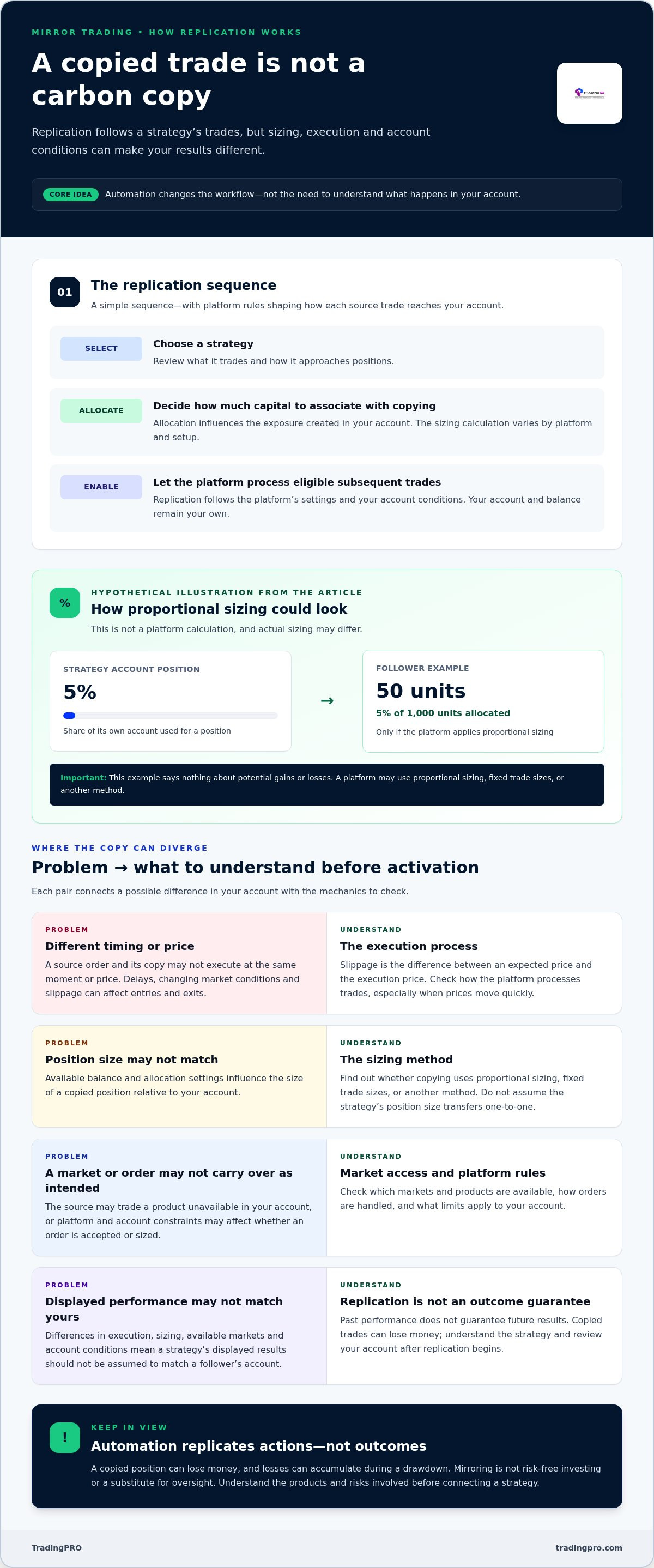
Replication generally follows a simple sequence: choose a strategy, decide how much of your account to allocate, then enable copying under the platform’s rules. Those rules determine how a source trade becomes a position in your account, including how its size is adjusted and what happens if an order can’t be placed as intended. Understand the mechanics before activation, not just the strategy description.
- Select a strategy. Review what it trades and how it approaches positions.
- Set an allocation. Decide how much account capital to associate with replication.
- Enable copying. The platform processes eligible subsequent trades according to its settings and your account conditions.
From a selected strategy to a position in your account
The source trader doesn’t hand over their account. Instead, replication places corresponding trades in your connected account. The platform’s rules determine how each source order maps to your balance and allocation. Your positions and account balance remain your own. Allocation matters because it influences the exposure created in your account, but the calculation varies by platform and setup.
Hypothetical example, not a platform calculation: If a strategy uses 5% of its own account for a position, a follower with 1,000 units of allocated capital might see a corresponding 5% proportion, or 50 units, if the platform applies proportional sizing. Actual sizing may differ, and this illustration says nothing about potential gains or losses. Check whether the platform uses proportional sizing, fixed trade sizes, or another method.
Replicated trades can differ in timing, exposure, and outcome.
Why copied performance can diverge
A source order and its copy may not execute at the same moment or price. Delays, changing market conditions, and slippage, the difference between an expected price and the execution price, can affect entries and exits. Even a brief delay can matter when prices move quickly. Available balance and allocation settings also influence the size of a copied position relative to your account.
Instrument access matters too. If the source trades a market or product unavailable in your account, the platform may not reproduce that position as intended. Platform rules can also affect whether an order is accepted, how it is sized, or how account constraints are handled. These differences help explain why a strategy’s displayed results shouldn’t be assumed to match a follower’s account. The IOSCO report on Regulatory aspects of mirror trading discusses imitative trading practices and their benefits and risks for retail investors.
Before enabling replication through mirror trading platforms, understand the sizing method, execution process, and limits that apply to your account. To explore a TradingPRO account setup, you can begin your TradingPRO registration.
Compare Mirror Trading Platforms With a Clear Evaluation Framework
Assess the system and the strategy separately. A platform may offer clear controls and useful reporting, but that doesn’t prove a selected strategy is sound. Likewise, a strong-looking track record doesn’t show whether the platform provides enough information or control for you to manage your account. Apply the same criteria to mirror trading platforms, then weigh them against your experience and approach.
| Criterion | What to examine | Why it matters |
|---|---|---|
| Strategy data | History period, drawdowns, trading frequency, and performance context | Shows more than a headline return |
| User controls | Ways to monitor, adjust, pause, or stop replication under platform rules | Clarifies how you can respond as conditions change |
| Risk visibility | Position details, exposure information, and explanation of potential losses | Helps you understand what the strategy may mean for your account |
| Costs disclosure | Trading costs and any service-related charges explained before activation | Costs can affect net performance |
| Supported markets | Instruments available for replication in your account | Some strategy activity may not be accessible or replicated as intended |
Transparent performance context and usable controls are essential comparison criteria. Use them to distinguish a polished interface from a setup that gives you practical information for making decisions. NICE Actimize discusses investment-related risks alongside broader compliance considerations in its overview of risks and compliance in mirror trading. Keep those contexts distinct: retail strategy replication and institutional compliance issues relate to the same term, but they aren’t the same activity.
Check strategy information beyond headline returns
Look at the length of the track record, the size and duration of drawdowns, how often trades are made, and the context behind reported performance. A short history may reveal little about how a strategy behaves through different market conditions. Don’t rely on a single return figure. Consider the risks, trading activity, and time period behind it. No universal threshold makes a strategy suitable for everyone.
Compare control, visibility, and account fit
Check whether you can view open positions and adjust or stop replication under the platform’s rules. Review how costs and trading conditions are presented before activation, not just after selecting a strategy. Then consider whether the account environment suits your experience and trading approach. TradingPRO offers Rookie, Micro, Pro, and Scalp accounts, designed for different trader profiles and experience levels. Compare the account terms with your needs rather than relying on the name alone.
Make a shortlist by recording what each platform discloses, what you can control, and what remains unclear. Then assess each strategy on its own merits. Platform functionality can support your decision-making, but it can’t validate a strategy or remove the possibility of losses.
Can You Trust a Mirror Trading Platform? Evaluate Risk Before Connecting
Automation can reduce the effort of entering trades, but it can’t remove market risk or guarantee that a strategy will perform well. Trust starts with understanding the process: what the platform does, what information it shows, and what choices remain yours. Before connecting an account, use this checklist to identify unanswered questions and decide whether the setup fits your risk tolerance.
A five-step check before enabling replication
- Read the terms and cost disclosures. Understand how copied trades are handled, what costs may apply, and what happens to open positions if you pause or stop replication. Don’t activate a feature if key conditions are unclear.
- Review the strategy data. Look beyond headline returns. Check the history period, drawdowns, trading activity, and how performance is presented. Past results can’t establish what will happen next.
- Choose an allocation deliberately. Decide how much capital you’re prepared to expose to the strategy, based on your circumstances and tolerance for loss. Keep money needed for bills or other obligations separate from trading funds.
- Locate the controls. Know where you can monitor positions and whether the platform lets you adjust or stop replication. Read the rules, including what pausing means for positions already open.
- Plan ongoing monitoring. Decide when you’ll review the account and what would prompt you to reassess. A strategy can change its activity, and market conditions can shift while copying is enabled.
Treat this as a decision process, not a box-ticking exercise. If you can’t explain the possible downside, how the allocation works, or how you would respond to a loss, wait before activating mirror trading platforms. A clear process gives you a stronger basis for deciding whether the setup is appropriate. It doesn’t make the strategy safer or assure a particular outcome.
Warning signs that deserve closer scrutiny
Pause if a service or strategy promises guaranteed returns or pressures you to act immediately. Claims of certainty don’t replace clear information about risk. Missing performance context, vague explanations of costs, or unclear rules for stopping replication are also reasons to investigate further rather than proceed on assumptions.
Be especially careful not to copy solely because a trader shows a high short-term return. That figure may not reveal the drawdowns, trading approach, or conditions behind the result. Compare the available history with the strategy’s risk information and decide whether you understand the exposure. If essential details remain unclear, don’t connect your account until you have a better picture.
Once you’ve reviewed the terms, controls, and potential downside, you can make a more informed decision about your next step. To explore a TradingPRO account setup, start your TradingPRO registration.
Explore TradingPRO Mirror Trading and Choose Your Next Step
TradingPRO offers Social Trading and Copy Trading within a multi-asset brokerage environment. Its social trading system lets clients automate trades by copying experienced market participants. Strategy access and account selection are related considerations, but neither is evidence of likely performance or reduced risk.
How TradingPRO fits the platform criteria
Use the comparison criteria in this guide to assess how a platform presents strategy information, explains replication, and supports ongoing oversight. Before activating a strategy, understand what activity may be copied and what information and controls are available. Continue reviewing your positions and account activity after you begin. Social and copy trading can streamline trade replication, but they don’t remove the need to make informed decisions.
TradingPRO offers Rookie, Micro, Pro, and Scalp accounts for different trader profiles and experience levels. The account names alone don’t determine which one is right for you. Review the terms and consider your experience, approach, and tolerance for risk. If you’re assessing where to begin, explore the Rookie Account alongside the strategy and platform information.
Move from comparison to an informed next step
Before opening an account, return to your checklist. Make sure you understand the strategy’s record and drawdowns, applicable costs and trading conditions, how your funds would be allocated, and what options are available for monitoring or stopping replication. These criteria help you compare mirror trading platforms on practical terms instead of choosing based only on a headline return or polished interface.
Review the account terms that apply to your location and the relevant TradingPRO entity before committing funds. Make sure you understand the products and trading conditions involved, and only allocate money you can afford to put at risk. If the process or potential downside still feels unclear, take time to review it before proceeding.
Copied trading involves the risk of loss and requires ongoing oversight. Stay engaged with your account, and reassess your setup as your circumstances or the strategy’s activity changes.
Make Your Next Trading Decision Deliberately
Let your comparison lead to a decision you can explain, not a rush to activate automation. Before committing, consider whether the approach fits your experience, your tolerance for potential losses, and the attention you can give to ongoing oversight. A clear decision starts with your own limits.
TradingPRO offers Social Trading and Copy Trading alongside Rookie, Micro, Pro, and Scalp accounts. Use that range as a starting point for reviewing your account options, not as a promise of suitability or results. Compare the relevant account terms with the way you plan to trade, and remember that mirror trading platforms can’t eliminate market risk.
When you’re ready, register with TradingPRO to explore its trading environment. Review the applicable account terms and trading risks, then make considered choices about account use and any copied strategies. Stay engaged and keep risk in view as you build your approach.
Frequently Asked Questions
Is mirror trading the same as copy trading?
Not always. Providers may use the terms interchangeably, while some use “mirror trading” for automatic strategy replication and “copy trading” for features that let users choose or adjust copied activity. Don’t rely on the label alone. Check whether selecting a trader copies every eligible position or gives you control over individual trades, and read how the platform describes the feature.
Can mirror trading platforms guarantee profits?
No. Mirror trading platforms can’t guarantee profits, and a strategy that has made gains can later lose money. Treat any promise of guaranteed returns as a warning sign, not evidence of reliability. Before following a strategy, consider what you could lose, how you’d respond to a downturn, and whether the approach still makes sense without relying on past performance continuing.
How much money do I need to start mirror trading?
There’s no single starting amount that applies to every platform or account. The required amount can depend on minimum funding terms, the instruments traded, and how positions are sized. Review the terms that apply to your account, then distinguish any account minimum from the capital you choose to allocate. Only use trading funds you can afford to put at risk, not money reserved for essential expenses.
What happens if the trader I mirror closes a position?
The platform may send a corresponding closing order to your account, but the handling depends on its replication rules and execution conditions. A close could occur at a different price or time, and your position may not match the source position exactly. Before copying, understand how the system handles partial closes, rejected orders, or positions you’ve adjusted yourself. Review your open positions rather than assuming they always mirror perfectly.
Can I stop mirroring a trader whenever I want?
That depends on the platform’s terms and controls. Some services may let you pause future copied trades or end a connection, but this doesn’t necessarily close positions already open in your account. Find out how to stop replication and what happens to existing or pending orders before you start. If you stop, review your account so you know which positions remain and can manage them deliberately.
Is mirror trading suitable for beginners?
It may make trade execution less hands-on, but it doesn’t remove the need to understand trading risk. Beginners should first learn what the copied strategy trades, how losses can affect their account, and what the platform’s controls do. If a feature or term is unclear, pause and learn more before allocating funds. Consider whether you can monitor the account and make decisions if the strategy performs differently than expected.
What happens if the trader I follow starts losing?
Your account may also incur losses as copied positions move against the strategy, although the amount can differ because of allocation and execution. Don’t add funds or increase your allocation simply to try to recover losses. Review the current positions, compare the strategy’s activity with your original reasons for following it, and decide whether to continue, pause, or stop under the platform’s rules.


