



- Published on: 2026-07-16 10:10:24
Mastering the Pulse: How to Trade Major News Events with Precision in 2026
Most traders treat a 4.2% CPI print or an FOMC rate decision like a high-stakes coin flip, but for the elite, it's a precision strike. Trading major news events shouldn't feel like a gamble against the house. You've likely felt the sting of massive slippage or the paralysis of conflicting signals when the charts start moving at light speed. It's frustrating to watch a potential windfall turn into a stop-out because of a single, emotional decision during a volatility spike.
You deserve a strategy that matches your ambition. This guide delivers the exact frameworks professional traders use to dominate the news cycle and turn market-moving events into calculated opportunities. We'll move past the noise to identify which releases actually matter in 2026. You'll learn to execute with institutional-grade speed and deploy the risk management protocols that keep your capital secure. Get ready to transform high-volatility chaos into a repeatable, high-performance playbook that scales with your success.
Key Takeaways
- Identify the "Big Three" news pillars of Interest Rates, Employment, and Inflation to understand exactly which data points dictate global market sentiment.
- Master the "Release Window" strategy by clearing your desk 30 minutes before an announcement and focusing on high-impact price gaps.
- Leverage institutional-grade infrastructure like the Scalp Account to ensure the ultra-fast execution required for trading major news events with minimal slippage.
- Implement a disciplined "if/then" logic framework to eliminate emotional decision-making and turn high volatility into calculated profit opportunities.
- Use Micro or Rookie accounts to refine your news trading strategies in a live environment without exposing yourself to excessive initial risk.
The Anatomy of Volatility: Why Trading Major News Events is Your Edge
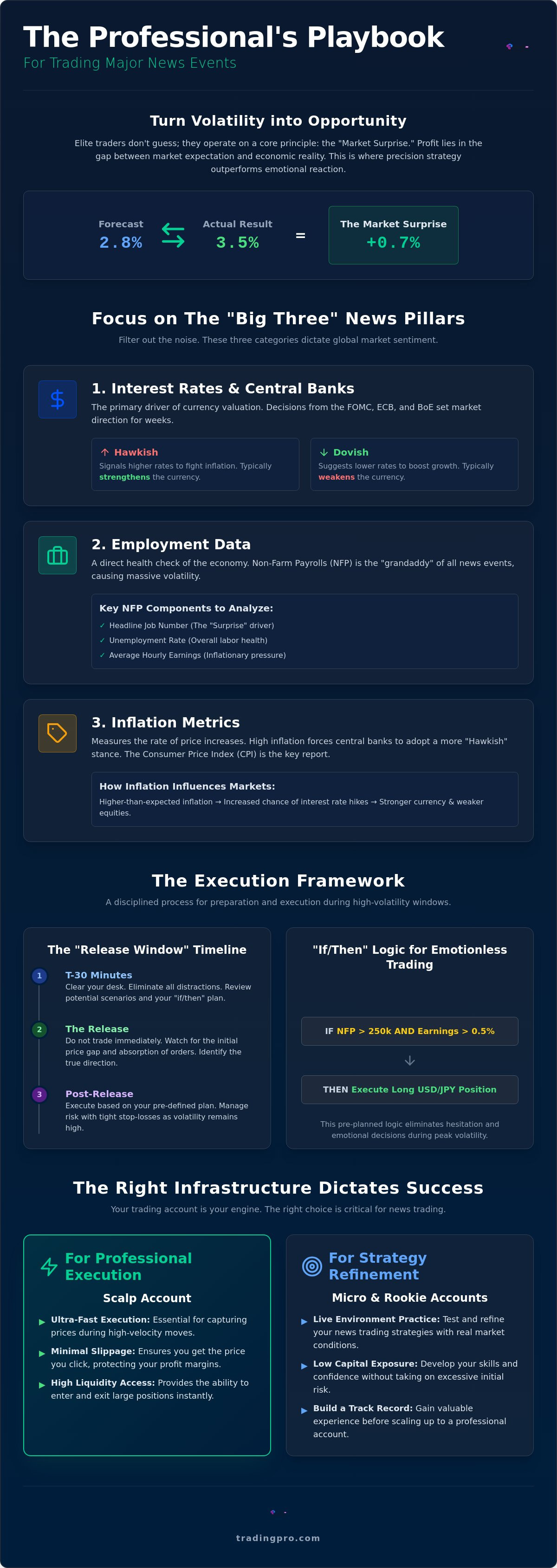
Volatility isn't a threat to your capital; it's the engine of your success. Trading major news events represents the most direct way to capitalize on market-moving catalysts that technical analysis alone often misses. While retail traders stare at lagging indicators, elite performers focus on the "Market Surprise." This is the delta between forecast expectations and actual results. When these two numbers diverge, the resulting price gap creates a high-velocity environment where significant moves happen in seconds. This is where professional frameworks outperform guesswork every single time.
News events generate the highest liquidity windows in the 24-hour cycle. Orders flood the market, creating a surge in volume that allows for rapid entry and exit. Amateurs often fear this movement, viewing it as chaotic or dangerous. Professionals understand that this volatility is a calculated opportunity. By using Fundamental analysis to identify the core drivers of value, you can position yourself ahead of the crowd. This approach transforms market noise into a structured signal, provided you have the right infrastructure to handle the speed.
The Role of Market Expectations vs. Reality
Markets are forward-looking machines. This means that a "good" economic report can actually cause a price drop if the market had already priced in an even better result. You must look beyond the raw numbers and focus on the consensus. If the actual data matches the forecast, the market may barely move. However, when a "Market Surprise" occurs, the sudden repricing creates a vacuum that drives aggressive price action. Successful traders use consensus figures to gauge the potential for shock, entering only when the delta is large enough to trigger a sustained move.
Identifying High-Impact vs. Low-Impact Events
Not all news is created equal. You need to distinguish between "Red Folder" events, such as Non-Farm Payrolls or Consumer Price Index releases, and routine data that the market ignores. Central bank speeches can often be more explosive than raw data reports because they provide forward-looking clues about interest rate policy. Because the US dollar sits at the center of the financial world, US news impacts every global currency pair, including emerging market assets. To trade with precision, you must prioritize events that have the power to shift global sentiment. Using a high-performance Scalp Account ensures that you can execute during these high-impact windows without being held back by slow execution or excessive slippage.
The Big Three: Deciphering the News That Moves Global Markets
Success in trading major news events requires ruthless prioritization. While thousands of economic indicators hit the wires every month, most are mere noise. To dominate the 2026 markets, you must focus on the three pillars that dictate global sentiment: Interest Rates, Employment, and Inflation. The Federal Reserve stands at the absolute top of this hierarchy. When the Fed moves, every other asset class reacts. These releases don't just create minute-long spikes; they ignite trends that can last for weeks. For instance, the FOMC decision on June 17, 2026, to maintain the target range at 3.50% to 3.75% established a definitive trend for the dollar throughout the following month. Understanding inter-market correlation is vital here. A hawkish shift in rates typically strengthens the currency while putting immediate, downward pressure on equities and gold.
Central Bank Decisions & The Interest Rate Cycle
The FOMC, ECB, and Bank of England are the primary architects of market direction. You'll encounter the terms "Hawkish" and "Dovish" constantly. A hawkish stance suggests higher rates to combat inflation, which typically boosts a currency. A dovish tone implies lower rates or "easy money" to stimulate growth, often weakening the currency. Don't just look at the headline rate number. The accompanying "Statement" is where the real volatility lives. It reveals the bank's future path and internal sentiment. If you're ready to capitalize on these institutional shifts, you can register for a professional account to start positioning for the next release cycle.
Employment Data: The Power of Non-Farm Payrolls (NFP)
NFP remains the "Grandaddy" of news events. It's a high-octane release that provides a comprehensive health check on the world's largest economy. You must analyze three distinct parts: the headline job number, the unemployment rate, and average hourly earnings. Mixed data is common. If the headline number beats expectations but hourly earnings fall, the market might whip violently in both directions before choosing a path. Watch the reaction in the first five minutes to see which component the institutional algorithms are prioritizing.
Inflation Gauges: CPI and PPI Dynamics
Inflation is the dominant theme of the 2026 economic landscape. The U.S. Consumer Price Index reached 4.2% in May 2026, marking a significant peak that forced traders to re-evaluate their long-term positions. This data dictates the "Real Yield" shifts that drive global capital flows. When inflation surprises to the upside, investors rush into the currency in anticipation of higher interest rates. You aren't just trading a number; you're trading the market's collective belief about the central bank's next move. Precision during these windows is non-negotiable.
Strategic Execution: 3 Proven Frameworks for News Trading
Successful execution when trading major news events isn't about guessing direction; it's about deploying a pre-defined "if/then" logic. If the CPI print hits 4.3% or higher, then the dollar long bias is confirmed. This removes the paralysis of emotional decision-making. Speed is your primary weapon during these spikes. A Scalp Account is non-negotiable because even a millisecond of lag can transform a winning setup into a slippage-riddled loss. Always adopt a risk-first mindset. Never enter a position during a news release without a hard stop-loss. Professionals divide their focus between "Trading the Release", which captures the initial explosive burst, and "Trading the Aftermath", which capitalizes on the sustained trend that follows.
The Straddle Strategy: Profiting from Directional Breakouts
The Straddle Strategy involves placing buy-stop and sell-stop orders approximately 10 to 15 pips above and below the pre-release consolidation range. You're betting on a breakout, regardless of the direction. The primary risk is a "Whipsaw," where extreme volatility triggers both orders before the market settles. This framework works best for high-impact events with binary or unknown outcomes, such as unexpected central bank interventions or surprise interest rate adjustments. It ensures you're positioned for the move without needing to predict the data.
Fading the Move: Capitalising on Market Overreaction
Fading the move targets the exhaustion point of the initial five-minute spike. After the first wave of algorithmic buying or selling, the market often overextends beyond its intrinsic value. You identify institutional support and resistance levels to enter a mean-reversion trade. This requires elite execution speeds to avoid being "run over" if the momentum persists. It's a high-precision play for those who can recognize when the initial news shock has been fully absorbed by the market and the price begins to normalize.
The Retrace Entry: Patience as a Competitive Advantage
The Retrace Entry relies on patience as your ultimate competitive advantage. Instead of chasing the volatile spike, you wait for the "first pullback" once the news has established a definitive trend. Use Fibonacci levels, specifically the 50% or 61.8% retracement, to find entries that align with the new directional momentum. This is the safest method for Rookie Account holders. It allows you to participate in the trend with a much tighter and more logical stop-loss placement compared to the initial 60-second chaos.
The Professional’s Playbook: A Step-by-Step Guide to News Preparation
Professionalism in trading major news events is defined by what you do before the numbers hit the tape. You must operate within a strict "Release Window," which spans from T-minus 30 minutes to T-plus 60 minutes. During this 90-minute block, your focus must be absolute. Clear the deck by closing unrelated small positions or trailing their stops to breakeven. You don't want a minor currency pair distraction when a high-impact release is pending. Utilize the TradingPRO Trade Hub to map real-time sentiment and institutional positioning. Finally, respect the "No-Trade" rule. If the spread on your target pair exceeds your predefined limit during the pre-release volatility, stay on the sidelines. Preservation of capital is your first priority.
T-Minus 30: Analysis and Sentiment Mapping
The 30 minutes leading up to the release are for final reconnaissance. Verify the exact release time and the delta between previous and consensus values on your economic calendar. Identify key technical levels, specifically the Daily High and Daily Low, as these often act as magnets for price during the initial spike. Review the Social Trading feed to see how elite traders are positioning. This isn't about following the herd; it's about understanding where the liquidity sits and where the "pain point" for the market might be if the data surprises.
The Release: Managing Slippage and Spreads
When the data drops, liquidity often vanishes for a split second, causing spreads to widen significantly. You must account for this by widening your stop-loss or adjusting your entry criteria. Market orders are high-risk during these spikes because they leave you vulnerable to the next available price, which could be pips away from your target. Precision traders prefer Limit orders to ensure they only enter at their desired price. Execution speed is the only way to combat news-induced slippage. Without institutional-grade execution, you're essentially trading with a handicap. If you're ready to trade with elite infrastructure, register for a TradingPRO account today.
Post-Release: Trade Management and Exit Logic
Once the trade is live, switch to management mode. Implement a "Time Stop." If the anticipated move doesn't materialize within 10 to 15 minutes of the release, the market surprise has likely been absorbed, and you should exit. As price moves in your favor, trail your stop-loss aggressively to lock in profits while the volatility is still high. The final step of the playbook is journaling. Record the market's reaction versus your expectation. This data is the foundation of your future success, allowing you to refine your "if/then" logic for the next major event.
Institutional Infrastructure: Why Your Account Choice Dictates News Success
Mastering the frameworks of news trading is only half the battle. Without institutional-grade hardware, your strategy remains a theory. Trading major news events demands an ecosystem that prioritizes speed and security above all else. You need an environment where execution is instantaneous and your capital is protected from the extreme tail risks of 2026 volatility. This is where your choice of account type becomes your most significant competitive advantage. Whether you're deploying a high-frequency strategy or testing a new retrace entry, the underlying infrastructure determines your final fill price and overall profitability.
Security is the foundation of high-stakes performance. TradingPRO provides Negative Balance Protection across all account tiers, acting as the ultimate safety net during black swan events or extreme slippage windows. If you're just starting to navigate the "Big Three" releases, Rookie and Micro accounts allow you to test your "if/then" logic with lower capital requirements. This ensures you can refine your execution in a live market environment without exposing yourself to institutional-sized risks before you're ready.
Speed as a Feature: The Scalp Account Advantage
In the milliseconds following a Non-Farm Payrolls release, latency is the difference between a winning trade and a rejected order. The Scalp Account is engineered for ultra-low latency, ensuring your orders hit the market with maximum precision. Professional news traders prioritize execution speed over every other feature because they know that raw spreads are essential when every pip counts. By eliminating the middleman and providing direct access to institutional-grade liquidity, this account type minimizes the price gaps that often trap retail traders using inferior platforms.
Copying the Experts: Social Trading During News
You don't have to face the news cycle alone. Social Trading allows you to observe how seasoned professionals position themselves before a major central bank announcement. By monitoring the risk levels and entry points of "Master Traders," you can effectively outsource your fundamental analysis while you're still building your own expertise. It's a powerful way to see how elite players manage the "Release Window" in real-time. For a deeper breakdown of these mechanics, review our Social Trading vs Copy Trading guide to decide which approach fits your performance goals.
Next Steps: From Preparation to Profit
The transition from a prepared observer to a profitable trader starts with practice. Open a Demo Account today to stress-test the Straddle strategy on the next "Red Folder" event. Use this risk-free environment to master your timing and order placement before moving to a live Scalp or Pro account. Volatility is not something to be feared; it's a massive opportunity for the prepared. Take control of your trading future by aligning your strategy with the infrastructure built for peak performance.
Dominate the News Cycle with Precision
The window of opportunity during high-impact releases is narrow. Command the chaos and claim the rewards. You now possess the strategic frameworks to transform market-moving data into a high-performance profit engine. Success requires a relentless focus on the core pillars of inflation, employment, and interest rates. Trading major news events is no longer a gamble when you operate with definitive "if/then" logic and elite infrastructure.
Align your ambition with a partner that delivers results. Our platform provides the institutional-grade execution speeds necessary to capture price gaps with total precision. Whether you're testing strategies on a Rookie Account or dominating the tape on a Scalp Account, we provide the tools for peak performance. We secure your journey with Negative Balance Protection on all accounts, creating a safe-haven for your capital amidst high-stakes volatility. The next global shift is coming. Position yourself for success and lead the market.
Master the Markets: Register Your Professional Trading Account Now
Frequently Asked Questions
What are the most important news events to trade in 2026?
Focus on the "Big Three" catalysts: central bank interest rate decisions, CPI inflation reports, and Non-Farm Payrolls (NFP). In the current 2026 landscape, the Federal Reserve's target range of 3.50% to 3.75% makes every FOMC meeting a primary driver of global capital flows. These high-impact releases generate the institutional-grade volatility required for significant directional moves.
How much capital do I need to start trading major news events?
You can begin with minimal capital by utilizing a Micro or Rookie Account. These tiers allow you to test your "if/then" logic and execution timing in a live environment without excessive financial exposure. As you refine your frameworks and seek higher performance, you can scale into our Pro or Scalp Account tiers to maximize your potential.
Why do spreads widen so much during economic data releases?
Spreads widen because liquidity providers often withdraw their orders to manage risk during a "Market Surprise." This creates a temporary liquidity vacuum where the gap between the bid and ask price expands. We combat this by providing access to institutional-grade liquidity, ensuring you maintain a competitive edge even when the market is moving at its fastest.
Can I use automated robots to trade news events on TradingPRO?
Yes, our infrastructure fully supports Expert Advisors (EAs) and high-frequency trading robots. Automated systems are exceptionally effective for trading major news events because they eliminate human hesitation and execute orders in milliseconds. Deploying your bot on a Scalp Account ensures you benefit from the ultra-low latency required for peak algorithmic performance.
What is slippage, and how can I avoid it during high volatility?
Slippage occurs when your trade is filled at a different price than requested due to rapid market movement. To minimize this, prioritize execution speed and use Limit Orders rather than Market Orders during spikes. Our Scalp Account is specifically engineered with high-speed technology to ensure your fills are as precise as possible during explosive volatility windows.
Is news trading suitable for beginners with a Rookie Account?
Beginners can certainly participate, provided they use a disciplined approach like the "Retrace Entry" method. A Rookie Account offers the perfect entry point to practice these strategies with controlled risk. We also recommend utilizing our Social Trading feed to observe how veteran professionals position themselves before high-impact releases hit the tape.
What happens if the news is good but the price goes down?
This is a classic "sell the fact" scenario where the market had already priced in the positive result. If the actual data doesn't significantly exceed the consensus expectations, institutional traders may take profits, driving the price lower. Always analyze the delta between the forecast and the actual print to gauge the true potential for a market shock.
How do I protect my account from a total wipeout during a market crash?
We provide Negative Balance Protection on all accounts to ensure your losses never exceed your account balance. Combine this institutional safety net with hard stop-losses and responsible leverage to keep your capital secure. This multi-layered security approach allows you to pursue ambitious trading goals with the confidence that your downside is strictly limited.


