




- Published on: 2026-11-19 18:01:44
Margin Call vs Stop-Out Level: What Triggers Position Closures

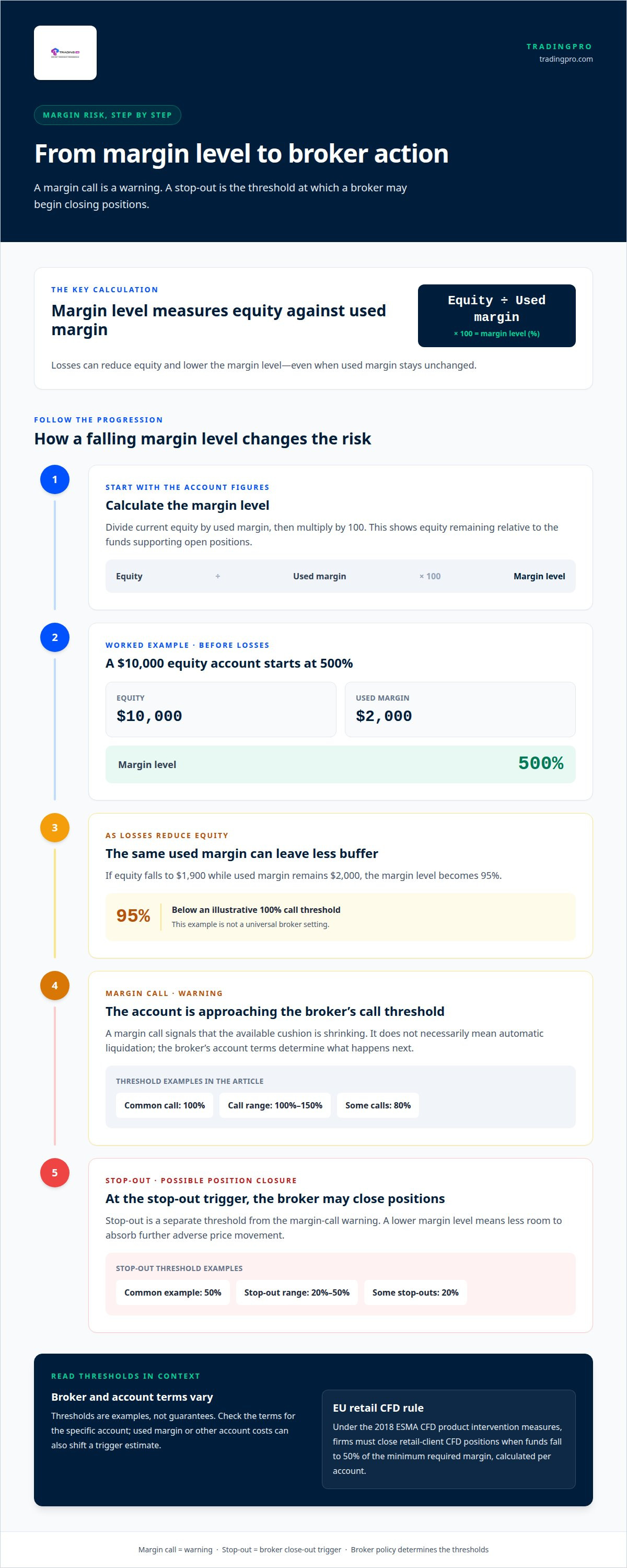
A margin call is a warning; a stop-out is the threshold at which a broker may begin closing positions. Understanding the margin call level versus the stop-out level starts with the margin-level percentage: brokers commonly use 100% for a margin-call threshold and 50% for a stop-out threshold, but settings vary. As losses reduce your equity, leverage can make that level fall faster than expected.
It’s easy to mistake these terms for the same warning, but they have different consequences. A margin call signals that your account’s available cushion is shrinking; a stop-out can trigger automatic position closures.
This guide explains how to calculate margin level, how the two thresholds work, and how falling equity can move a position from warning to liquidation. You’ll also see how position size, leverage, and risk controls can help you manage exposure before a stop-out is triggered.
Key Takeaways
- Separate a margin-call warning from a stop-out trigger, and learn why the broker’s thresholds determine what happens next.
- Track equity, used margin, and free margin to see how much room your positions have before risk escalates.
- Follow a worked example to understand how losses can push a margin level from entry toward forced liquidation.
- See how brokers may close positions at stop-out and why the execution price can differ in fast-moving markets.
- Explore how TradingPRO’s Rookie, Micro, Pro, and Scalp Accounts serve different trading styles.
Stop-out level vs margin call: What’s the difference?
A margin call is a warning tied to a broker’s threshold; a stop-out can trigger forced position closures. Margin level compares account equity with the margin currently used to support open trades.
Margin Level and Equity Thresholds
Margin level expresses equity as a percentage of used margin: divide equity by used margin, then multiply by 100. This measure shows how much equity remains relative to the funds supporting open positions.
For example, an account with $10,000 in equity and $2,000 in used margin has a 500% margin level. If equity falls to $1,900 while used margin remains $2,000, the level becomes 95%. That is below an illustrative 100% call threshold.
Losses reduce equity, so margin level can fall even if used margin stays unchanged. At each threshold, the broker’s policy determines whether you receive a warning, face restrictions, or have positions closed. A lower margin level means less room to absorb further adverse price movements.
Broker Policies and Threshold Variations
Broker policies set the margin-call and stop-out thresholds, which determine when warnings or liquidation may occur. Common examples include a 100% margin-call threshold and a 50% stop-out threshold, but these aren’t universal.
Thresholds also vary across brokers: margin calls are often set between 100% and 150%, while stop-outs commonly fall between 20% and 50%. Some brokers use an 80% call threshold or a 20% stop-out threshold. Treat these as examples, not a guarantee of any account’s settings.
For IUX account types, the applicable threshold is the one in the terms for the specific account. Don’t assume that a percentage used by another broker, or for another account type, applies to your position. Under the EU’s 2018 ESMA CFD product intervention measures, firms must close retail-client CFD positions when funds fall to 50% of the minimum required margin, calculated per account, according to the European Securities and Markets Authority.
Calculating Trigger Prices
To estimate a trigger price, first calculate the equity needed to reach the broker’s threshold. Convert the percentage to a decimal and multiply it by used margin, then compare the required equity with current equity. The difference is the loss that would bring the account to that threshold, assuming used margin stays unchanged.
To estimate a market price, translate that potential loss into a price movement using the position’s size, direction, and value per price increment. Falling prices affect a long position; rising prices affect a short position. Changes in used margin or other account costs can shift the estimate.
In the US, applicable rules for the instrument and account apply alongside the broker’s stated margin and liquidation policies. Those terms shape when warnings occur and how open positions may be closed. A margin call does not necessarily mean automatic liquidation; the stop-out policy defines the broker’s close-out trigger. Read the threshold and execution terms together before relying on a calculated price.
How Can You Avoid Margin Calls and Stop-Outs?
Track equity, used margin, and free margin together to see how losses and position size affect your account’s available buffer. Understanding margin call level vs stop out level also means watching how these figures change as open positions move.
Equity, Used Margin, and Free Margin
Balance records the account value before floating profit or loss; equity reflects that value after including open positions’ unrealised results. Used margin supports open positions, while free margin is equity minus used margin.
For example, $1,000 in equity against $500 in used margin leaves $500 free margin and a 200% margin level. Calculate margin level as equity divided by used margin, multiplied by 100. The formulas turn account data into a usable risk signal.
Watch the relationship, not just the balance. A trading loss can reduce equity while the balance remains unchanged until the position closes. As equity falls, free margin contracts and the margin level declines. At a 100% margin level, equity equals used margin and free margin is zero. There is no remaining free margin buffer at that point.
Use the platform’s live figures to monitor open positions as prices move. Floating profit can raise equity, while floating loss can lower it. Recalculate after opening or closing a position, since used margin can change too. The displayed margin level is more useful than balance alone.
Managing Position Size and Available Equity
Position sizing determines how much equity is exposed to market movement and how much margin a trade uses. Reducing position size generally lowers used margin, leaving more free margin to absorb adverse movement.
Leverage magnifies exposure relative to the margin committed. With 1:100 leverage, a trader puts up 1% of the position value as margin. That can make a small price move meaningful to account equity. Keep the exposure aligned with the loss you can accept, rather than using all available margin.
One risk approach is limiting the amount at risk per trade idea to 0.5%-1% of equity. Margin level above 200% is a useful target whenever possible; above 300% offers a wider buffer in the cited guidance. These are risk-management targets, not broker guarantees. A margin level above 500% is described as conservative, with room to absorb spikes.
Margin Calls as Equity Warnings
A margin call warns that equity has approached the broker’s call threshold. It signals that you should reassess exposure before falling equity reaches the stop-out trigger. Understanding margin call level vs stop out level helps distinguish this warning from the later possibility of forced position closures.
At the warning stage, the broker may require action under its account terms. Adding funds or reducing positions can change equity or used margin, but the outcome depends on price movements and the broker’s policy. A warning does not mean every open position will be closed immediately.
Build a routine: monitor equity and free margin, size positions conservatively, and plan the loss each trade can create. To put that approach into practice, create a trading account and assess your position sizing before trading.
Example of margin level falling from entry to liquidation
The example uses a hypothetical account and leveraged position. It shows how a percentage can move from an initial buffer to a margin-call threshold, then a stop-out threshold. These thresholds are illustrative, not universal broker settings.
At entry, the position requires $585 in used margin. Dividing $2,000 equity by $585, then multiplying by 100, gives a starting margin level of 341.9%. Each pip on this one-lot EUR/USD position is worth $10. That pip value converts an adverse price move into a potential account loss.
With an illustrative 100% margin-call threshold, equity must equal used margin. In this case, that means equity reaches $585. At $10 per pip, the loss corresponds to an adverse move of 141.5 pips. The margin level has fallen from 341.9% to 100%.
The illustrative stop-out threshold is 50%. At the same pip value, an adverse move of 170.75 pips reaches the stop-out line. The distance between the two illustrative triggers is 29.25 pips.
The interval between thresholds matters. After the margin-call threshold, further adverse movement can quickly bring positions closer to forced closure. The broker’s policy determines whether and how open positions are closed at stop-out. A calculation estimates a trigger under stated assumptions; it cannot guarantee an execution price, especially if prices move before an order fills.
Position size changes the starting buffer. For the same example account, opening three lots produces a starting margin level of 114%, while opening 0.2 lots produces 1,709%. The larger position begins much closer to the illustrative call threshold. Leverage affects required margin, while exposure and price movement determine how quickly losses reduce equity.
A separate account example shows how a different threshold changes the trigger. With $5,000 equity and $2,000 used margin, the margin level is 250%. At a 150% call threshold, equity of $3,000 triggers a warning. If the illustrative stop-out threshold is 50%, equity of $1,000 reaches that level. The same account figures produce distinct warning and liquidation points because the thresholds differ.
How stop-out levels trigger automatic position closures
A stop-out begins when an account’s margin level reaches the broker’s close-out threshold. The platform then closes positions according to its liquidation procedure, aiming to reduce exposure and restore the required margin level. Unlike a stop-out, a margin call warns that equity has weakened before the close-out trigger.
Once the trigger is reached, the broker can automatically close one or more open positions. A common approach is to close the largest losing position first, then reassess the account’s margin level. If it remains below the required threshold, the broker may close another position. This can continue until the margin level recovers or no positions remain.
Consider a stop-out example where closing a losing position releases $1,500 in used margin. That release can reduce the margin supporting open trades and help restore the account’s margin level. However, closing also realises that position’s loss, which affects equity. The final result depends on both changes, so releasing margin doesn’t mean the account necessarily returns to a healthy level.
Execution price matters. Stop-out orders execute at the next available market price, which may differ from the price when the threshold was reached. In fast markets, prices can move before an order fills. Weekend gaps can also lead to worse fills, increasing the realised loss and affecting equity after the position closes.
Broker procedures determine which positions are selected and how the platform responds after each closure. The largest losing position is often closed first, but remaining exposure and margin requirements also affect the outcome. If several open positions are contributing to falling equity, closing one may not restore the threshold. Under its policy, the platform can continue closing positions as needed.
Position sizing can reduce the chance of reaching this forced stage. A larger position can use more margin and expose more equity to adverse price movements. Smaller exposure leaves more room for prices to move before the broker’s trigger is reached. Reassess position size as account equity changes instead of assuming the original size remains suitable in every market condition.
Monitor margin level while trading, especially when open positions move against you. A margin call is an early signal to review exposure, but it does not guarantee extra time before a stop-out. Know the account’s threshold and liquidation method before relying on manual action. In a fast market, automatic closing may happen before you can react, and later closures can lock in additional losses.
What happens to open positions when margin level reaches the margin call level?
At the margin-call level, your account has reached the broker’s warning threshold, but this does not automatically mean every open position will close. The exact response depends on the account terms. A broker may display a platform alert, restrict additional trading, or require you to restore the margin level. The key change is urgency: losses have reduced equity enough to reach the stated threshold.
For an illustrative 100% call threshold, equity equals used margin and free margin reaches zero. A further loss can push the account below that line, changing the margin level while positions remain exposed to market movement. The warning gives you a point to assess risk, not a fixed amount of time to act. Price changes can continue while you decide what to do.
Review each open position against current account equity and used margin. Closing a position realises its gain or loss and releases the margin assigned to it. Reducing exposure can therefore change both equity and used margin. The net effect depends on the position’s result and margin requirement. After making a change, recheck the displayed margin level rather than assuming the account’s buffer has been restored.
Adding funds can increase account equity, while closing a losing position can reduce the funds tied up as used margin. Neither action removes market risk from the positions that remain open. If prices keep moving adversely, equity can fall again and the account can approach the broker’s stop-out threshold. Treat a margin call as a prompt to reassess the whole account, not just the position showing the largest loss.
Broker policies matter at this stage. One broker may issue a warning without closing trades at the call threshold; another may impose account-specific restrictions. The stop-out level is a separate trigger that can initiate automatic closures. Read the call and stop-out terms together, including how the platform communicates warnings and handles open positions. A threshold calculation alone does not explain the full liquidation process.
Use the warning to make a deliberate decision before the account reaches stop-out. Consider position size, the loss already reflected in equity, and how much margin each remaining trade uses. Avoid adding exposure simply to recover a loss, since that can increase used margin while equity remains under pressure. Register for an account and apply a clear position-sizing plan before opening trades.
TradingPRO
TradingPRO offers Rookie, Micro, Pro, and Scalp Accounts for different trading styles. Once you understand how margin calls and stop-outs affect open positions, consider which account environment fits your approach. Position size, leverage, and account margin terms still shape liquidation risk, so plan your exposure before entering a trade.
If you’re interested in following other strategies, TradingPRO also offers Social Trading and Copy Trading. These options complement your own risk decisions; they do not remove the need to understand how equity and margin levels change.
For a next step, contact TradingPRO to discuss your trading approach.
Turn Risk Awareness Into a Trading Routine
A sound trading plan treats risk decisions as part of the process, not as an emergency response. Use your understanding of the margin call level versus the stop-out level to set boundaries before opening a position. Decide what account exposure fits your approach and define in advance what would prompt you to reduce it.
Keep your plan practical. Review whether your position size still fits your available capital as market conditions and account equity change. Consider how you’ll respond if a trade moves against you. A deliberate routine helps you follow your plan rather than react under pressure.
Ready to take the next step in your trading journey? Register with TradingPRO and put your risk plan into practice with focused preparation and clear decisions.
Frequently Asked Questions
Can I Lose More Than My Deposit?
Yes, an account can fall below zero during extreme market conditions if losses exceed its funds. Many brokers offer negative balance protection to prevent this, but protection depends on the broker and account terms. Do not assume it applies automatically to every trade or situation. Understand how your account handles negative balances before trading, and remember that protection does not prevent losses up to your deposited funds.
Can a Stop Out Fill at a Worse Price Than Expected?
Yes, a stop-out order can fill at a worse price than the level that triggered it. The order executes at the next available market price, and prices may move before execution. For example, a fast market or weekend gap can leave fewer available prices near the trigger. The resulting fill may increase the realised loss, so a calculated stop-out price is not a guaranteed execution price.
Does a Stop Out Close All My Positions?
Not necessarily. A broker generally closes losing positions, often starting with the largest loss, then checks whether the account’s margin level has recovered. If it remains below the threshold, further positions may be closed. The procedure depends on the broker’s liquidation policy and the margin released by each closure. Review the account terms to understand how positions are selected and when the process ends.
How Is Margin Level Calculated in Forex?
Calculate forex margin level by dividing account equity by used margin, then multiplying the result by 100. Equity includes the effect of unrealised gains or losses, while used margin reflects funds supporting open trades. For instance, a floating loss can lower equity before the position closes, reducing the calculated percentage. Use the platform’s current figures, since both equity and used margin can change while trades remain open.
What Happens to Your Trades During a Stop-Out?
During a stop-out, the broker can automatically close one or more trades to bring the account back above its required margin threshold. Each closure realises that position’s current gain or loss and changes the margin tied to the remaining trades. If the first closure does not restore the account, the broker may close another position. Fast market movements can affect execution before the closure is complete.
What Is a Margin Call in Forex Trading?
A margin call is a broker’s warning that account equity has fallen to a level requiring attention under its margin policy. It signals that open trades are using much of the account’s available capacity. Depending on the broker’s terms, the warning may prompt you to reduce exposure or add funds. It does not guarantee a grace period, and market prices can keep moving after it appears.
What Is a Margin Call Level in Forex and CFD Trading?
A margin-call level is the margin percentage at which a broker issues a warning or applies the response described in its terms. It is calculated from equity relative to used margin, so floating losses can bring the account closer to that level. Thresholds differ by broker and may vary by instrument or account conditions. Check the relevant terms rather than relying on a percentage used elsewhere.
What Is a Stop-Out Level in Leveraged Trading?
A stop-out level is the margin threshold at which a broker may begin closing positions automatically. It is a liquidation trigger, not simply an alert to review risk. The broker’s stated policy determines how positions are selected and whether closures continue until the account recovers. Because leveraged exposure can magnify the effect of adverse price movements on equity, this threshold matters before opening or increasing a trade.


