




- Published on: 2026-10-30 02:15:45
How to Switch Trading Styles to Match Your Time and Goals

A trading style should fit the time you can give the markets and the goals you’re pursuing. Learning how to switch between trading styles means reassessing how long you can monitor positions, how often you want to trade, and how much activity you can manage consistently. A style sets your trading pace and holding period; a strategy defines when to enter and exit trades.
If your schedule or priorities have changed, consider whether your current approach still fits. Switching isn’t simply a matter of choosing a faster or slower style. Trading frequency affects the time, costs, and emotional pressure involved.
This guide explains how scalping, day trading, swing trading, and position trading differ, and what each requires of your time and decision-making. You’ll learn how to weigh your goals against trading frequency and costs, then make a considered change without confusing a new style with a new strategy.
Key Takeaways
- Match your trading style to the time you can actively monitor markets and the holding period that fits your goals.
- Compare trading frequency as well as potential transaction costs; a faster pace demands more attention and consistent decision-making.
- Separate your trading style, which shapes pace and holding time, from your strategy, which defines trade entry and exit points.
- Change your approach deliberately, using a clear plan rather than reacting to a difficult stretch of trading.
- Consider how overnight exposure, market gaps, and emotional pressure fit your preferred way of managing risk.
Swing trading and short- to medium-term market movements
Swing trading aims to capture a price move developing over a short- or medium-term trend. Positions often remain open for days or weeks rather than closing within the same trading day. An individual swing trade can last for varying lengths of time, depending on the move. This makes swing trading less tied to intraday price changes than day trading, but more active than longer-term investing.
Compared with a longer-term investor, a swing trader focuses more closely on near-term price patterns and planned exits. Positions may remain open through market closes while a trend develops, creating exposure to price gaps at the next open if news arrives outside trading hours. A day trader, by contrast, closes positions within the same trading day. Swing trading can require fewer decisions during market hours, but you still need a plan for overnight moves.
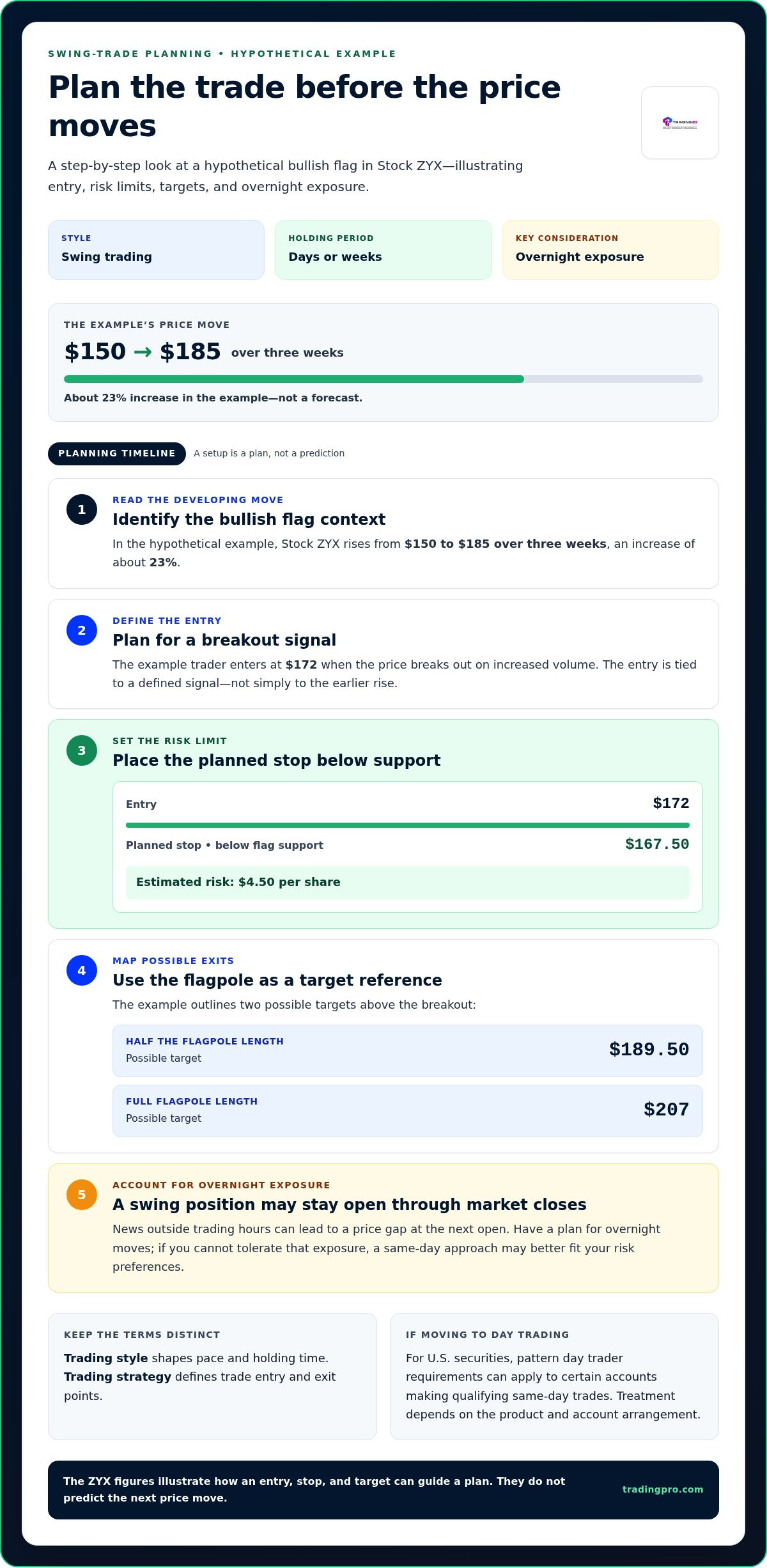
Consider a hypothetical bullish flag in Stock ZYX. The price rises from $150 to $185 over three weeks, an increase of about 23%. A trader enters at $172 when the price breaks out on increased volume. The planned stop is $167.50, below flag support, making the estimated risk $4.50 per share. Possible targets are $189.50, about half the flagpole’s length above the breakout, and $207, the full flagpole length above it. These levels illustrate how an entry, exit plan, and risk limit can guide a swing trade. They don’t predict the next price move.
For U.S. securities trading, pattern day trader requirements can apply to certain accounts making qualifying same-day trades; treatment depends on the product and account arrangement. Factor account-specific requirements into a move from swing trading to day trading rather than assuming your existing approach automatically carries over.
To assess whether swing trading fits, match its holding period to your schedule and tolerance for overnight exposure. Define the signal that would prompt an entry, the condition that invalidates it, and the exit you’ll use if the expected move develops. A strategy sets entry and exit points; a trading style determines how often you trade and how long positions remain open. Keep that distinction clear when considering how to switch between trading styles. A new holding period may call for different monitoring habits, but it doesn’t automatically mean abandoning every part of your strategy.
Use the ZYX example as a planning model, not a forecast. A breakout entry alone doesn’t make a trade suitable; the stop, target, and possibility of an opening gap matter too. If you can’t tolerate holding through news outside market hours, a same-day approach may better fit your risk preferences. If you can manage overnight exposure and prefer to follow a developing move, swing trading offers a middle ground between intraday trading and a longer investment horizon.
Trading frequency and transaction costs
Trading frequency affects how often costs can eat into your results. Depending on the instrument and account terms, each trade may involve costs such as the spread, commission, slippage, or financing. A strategy that enters and exits repeatedly can accumulate more transaction costs than one that trades less often. Compare results after costs, not just the market move you captured. A promising-looking entry can produce a smaller net result once execution costs are included.
Consider two approaches to the same market. One waits for a defined setup and makes fewer trades; the other responds to several short-lived price moves. The second creates more opportunities to act, but also more occasions for spreads, commissions, or slippage to affect the outcome. Slippage occurs when an order executes at a different price than intended. Fast movement or limited liquidity can make execution especially important to the result.
Costs depend on more than trade count. The instrument, order type, market conditions, and time a position stays open can all affect what you pay or experience. For example, holding a position beyond the trading day may involve different costs from opening and closing a trade within the session. Review the applicable terms for your instrument, then record how each cost affects your results. Don’t assume a faster trading pace is worthwhile just because it creates more activity.
High-frequency trading is different from simply placing trades frequently. It’s an algorithmic method used by large organizations to execute many orders in seconds. Switching to day trading or scalping doesn’t mean you’re using high-frequency trading. The key distinction is the execution method: algorithms automate rapid order activity, while individuals may make decisions manually. Set a pace you can sustain with the time and attention available.
Before changing styles, use your trade records to compare activity with outcomes. Track the reason for each entry, the exit, and the costs involved. Look for patterns: do repeated trades improve your process, or add activity without strengthening your decisions? Then consider whether the new style’s monitoring demands fit your schedule. Focus on net results and decision quality, not trade volume alone.
- Review execution costs: identify spreads, commissions, slippage, and any relevant holding costs.
- Compare trading pace: assess whether more frequent decisions add value to your plan.
- Test your routine: choose an activity level you can manage consistently.
Use that review to make a deliberate adjustment, rather than increasing activity simply to feel more involved. If you’re ready to put a trading plan into practice, you can register for an account as a next step.
Choosing and changing a trading style
Choose a style based on your goals, available time, and tolerance for uncertainty. A trading style sets holding time and frequency; a strategy defines trade entry and exit points.
Testing a New Trading Style
Paper trading simulates decisions without real-money positions, while backtesting applies rules to historical market data. Both can help you assess whether a new style’s pace and signals suit your process before you commit capital. For example, test how a swing-trading rule handles entries, exits, and overnight gaps. Use historical results to examine consistency, not to predict future performance.
Adjusting Strategy and Timeframes
Adapting your strategy means aligning its signals, indicators, and chart timeframes with the new holding period. A short-term approach may require closer monitoring than a longer-term setup, so indicators chosen for one pace may not suit another. Change one element at a time, then record how it affects entries, exits, and trade management. This makes it easier to identify which adjustment helps.
Avoiding Style-Switching Mistakes
Switching styles can create mismatches between your plan, schedule, and risk limits. Avoid changing approaches after one difficult trade or adopting several unfamiliar rules at once. If your written plan still fits your goals, assess how you’re executing it before abandoning it. Impulsive changes can lead to inconsistent entries and unclear exits; set a review point to judge the new approach instead.
Position size should reflect the distance between your entry and planned exit, along with the loss you’re prepared to accept. When moving from swing trading to day trading, don’t simply reuse the same position size: a different stop distance changes your exposure. Set the exit condition first, then size the position to keep planned risk within your own limit. Reassess when the instrument or setup changes.
Use this sequence to make the transition deliberate:
- Write down why your current style no longer fits.
- Choose the new holding period and define its entry and exit rules.
- Test the rules through paper trading or backtesting.
- Review execution, risk, and schedule fit before adjusting the plan.
Base your review on evidence from your own decisions. A clear plan helps you distinguish a genuine mismatch from the discomfort of learning a different trading rhythm.
Emotional discipline and suitability
A trading style shapes the emotional demands of each decision. Scalping requires rapid choices while positions may last seconds or minutes, leaving little time to reconsider an entry. Day trading keeps decisions within the same trading day, while swing trading can involve holding positions overnight. Choose a pace you can manage without abandoning your plan whenever prices move against you.
Use a specific scenario to test whether a style fits. Imagine a swing trade remains open after the market closes, then opens lower following overnight news. If that gap would prompt you to change your exit impulsively, overnight exposure may not suit your current temperament. Day trading avoids holding positions beyond the session, but requires you to make and manage decisions during market hours.
Emotional suitability also depends on how you handle waiting. A position trader may hold for weeks, months, or years, so frequent price checks can prompt unnecessary reactions. A scalper faces the opposite challenge: rapid movement can pressure a trader to enter before a planned signal appears. Notice which situation makes it hardest to follow your rules. That matters more than choosing a style because it sounds exciting.
Before changing approaches, identify the emotional trigger you want the new style to address. For example, someone who can’t monitor markets during the day may prefer a longer holding period. But a longer timeframe doesn’t automatically remove worry; overnight price gaps can still test discipline. Someone drawn to frequent trades should ask whether each entry follows a defined setup or simply reacts to movement.
- Track reactions: note when fear, impatience, or excitement changes a planned decision.
- Match the pace: compare your available attention with the demands of scalping, day trading, or swing trading.
- Keep rules visible: write down entry, exit, and risk conditions before opening a position.
- Review decisions: separate following your plan from whether a trade made money.
A useful review focuses on process, not one outcome. If a losing trade followed your written rules, that alone doesn’t prove the style is unsuitable. If you repeatedly break those rules, examine whether the pace, holding period, or monitoring demands are creating pressure. Change one part of your approach at a time, then compare your behavior with your plan. This gives you a clearer basis for deciding whether the style fits your routine and emotional discipline.
Build suitability into your trading plan before switching. Define how much time you can give the markets, what kind of price movement unsettles you, and which decisions you can make consistently. A style that respects those limits is easier to follow deliberately, even when a trade challenges your confidence.
What are the differences in time commitment and typical holding periods for each trading style?
Holding period is a useful starting point, but it doesn’t capture every demand on your schedule. A position may stay open for weeks while still requiring attention to market changes and planned exit conditions. By contrast, day trading concentrates decisions within the same trading day. Compare both how long a position remains open and how much attention your approach requires.
Scalping involves holding a position for a few seconds to a few minutes at most. That short window makes timing central to the approach. Day trading can involve holding trades for seconds, minutes, or hours, provided each position is closed within the same trading day. Both styles keep decisions within the trading session, but their holding periods differ sharply.
Swing trading typically holds positions for days or weeks, though an individual swing can last as briefly as an hour or as long as a week. This approach follows shorter-term market moves without requiring every position to close before the day ends. Position trading can hold a security for weeks, months, or years. Its longer horizon can mean fewer decisions tied to intraday fluctuations, but you still need a plan to review positions and respond to changed conditions.
Use the distinctions to test a real schedule. If you can’t follow market activity during the trading day, scalping and day trading may be difficult to manage consistently. If you can review a position over a longer period and accept overnight exposure, swing or position trading may fit better. A longer holding period doesn’t mean you can stop monitoring. Changing market conditions can matter whether your intended horizon is days or years.
- Scalping: a few seconds to a few minutes at most, with decisions focused on very short moves.
- Day trading: seconds, minutes, or hours, with positions closed within the same trading day.
- Swing trading: commonly days or weeks, with individual trades varying by the move.
- Position trading: weeks, months, or years, with a longer-term holding horizon.
Before choosing, compare each style with your available attention, preferred holding time, and ability to manage positions outside market hours. For example, someone with limited daytime availability may find a same-day approach hard to execute, even if its holding period sounds appealing. Someone uncomfortable with overnight exposure may prefer to consider a shorter horizon. Compare a style’s actual demands with your routine, not just its label.
Use these holding periods to narrow your options, then decide which pace you can follow with a clear plan. If you’re ready to put that choice into practice, register for an account.
TradingPRO: Rookie Account
TradingPRO’s Rookie Account is a next step to consider once you’ve identified a trading style and want an account option suited to your approach. TradingPRO also offers Micro, Pro, and Scalp accounts, alongside Social Trading and Copy Trading. These options provide account tiers to consider as your trading routine and preferences take shape.
Choose based on the style you’ve settled on, not just the pace you hope to trade. A Scalp Account may be relevant if scalping is your chosen approach, while the Rookie Account is another available account option. Social Trading and Copy Trading offer a different way to engage with trading by replicating other traders’ strategies. Explore TradingPRO’s offerings and visit TradingPRO to learn more.
Make Your Next Trading Decision Deliberately
Your trading approach doesn’t have to define you permanently. As your schedule, priorities, or comfort with market exposure change, revisit whether your current style still supports the way you want to trade. Treat that review as a decision about fit, not a reason to chase every new market move.
A practical way to think about how to switch between trading styles is to make the change intentional: know what you want your new routine to do differently, and keep your decisions aligned with your plan. Give yourself time to assess the approach before making another adjustment. Consistency comes from decisions you can explain and repeat, not from switching because a different style sounds faster or more exciting.
When you’re ready to explore your next step, view TradingPRO’s account options. Choose a direction with purpose, stay disciplined, and build a trading routine that fits the goals you’ve set.
Frequently Asked Questions
What is a trading style?
A trading style is the overall approach you use to manage market positions. It shapes how involved you are during a trading session and how you handle open exposure. For example, a trader who prefers to review markets at set intervals may choose a different approach from someone who wants to make frequent intraday decisions. Your style should reflect your routine, not just the latest market trend.
What are the main trading styles, such as day trading, swing trading, and position trading?
The main styles include scalping, day trading, swing trading, and position trading. Scalping focuses on brief price movements; day trading concentrates activity within the session. Swing traders seek to participate in market moves that develop across sessions, while position traders take a broader view of market direction. The key distinction is how each approach handles timing, monitoring, and exposure, not which style is inherently best.
How do I choose a trading style that fits my goals, schedule, and risk tolerance?
Start with your actual calendar and the situations that challenge your discipline. If meetings prevent you from watching prices during the session, a highly active intraday approach may clash with your routine. Consider whether you’re comfortable holding positions outside market hours and how you react to sudden price changes. Then compare those preferences with your goals and choose a style you can follow consistently.
What steps should I take to switch from one trading style to another?
To decide how to switch between trading styles, first identify what no longer fits: your schedule, monitoring demands, or comfort with exposure. Define the new approach’s entry, exit, and risk rules, then test them through paper trading or historical data before applying them with real money. Change one part of your process at a time and keep a decision log. Review whether your actions followed the plan, not just whether trades won.


