



- Published on: 2026-11-01 10:15:26
How to Reduce Trading Fees Across Trades and Accounts

A zero-commission trade isn’t necessarily a low-cost trade. To understand how to reduce trading fees, look beyond the headline commission: your total cost can also depend on the spread, the asset and venue, and charges tied to holding or managing the account. The right comparison is the full cost of trading for your account and trading style.
It’s easy to focus on the fee shown beside an order. But spreads, overnight charges, data fees, withdrawal costs, and account charges can also affect what you pay, and they vary across brokerage models. A fee that barely affects an occasional trade can add up for an active strategy.
This guide explains the main types of trading costs and how commissions, spreads, and other charges work together. You’ll learn what to compare across accounts, why a low advertised commission may not mean the lowest overall cost, and how trading frequency and holding time shape your fees. Use this framework to compare accounts and make informed trading decisions.
Key Takeaways
- Compare the full cost of each trade, not just the commission displayed at order entry.
- Match the brokerage model to your trading frequency, account needs, and preferred assets.
- Review account charges alongside transaction fees to see how costs can build over time.
- Understand how spreads and trading activity can affect the price you receive for stocks, ETFs, options, and other assets.
- Include overnight, data, withdrawal, and fund-related charges in your cost comparison.
Overnight charges, data fees, and withdrawal costs
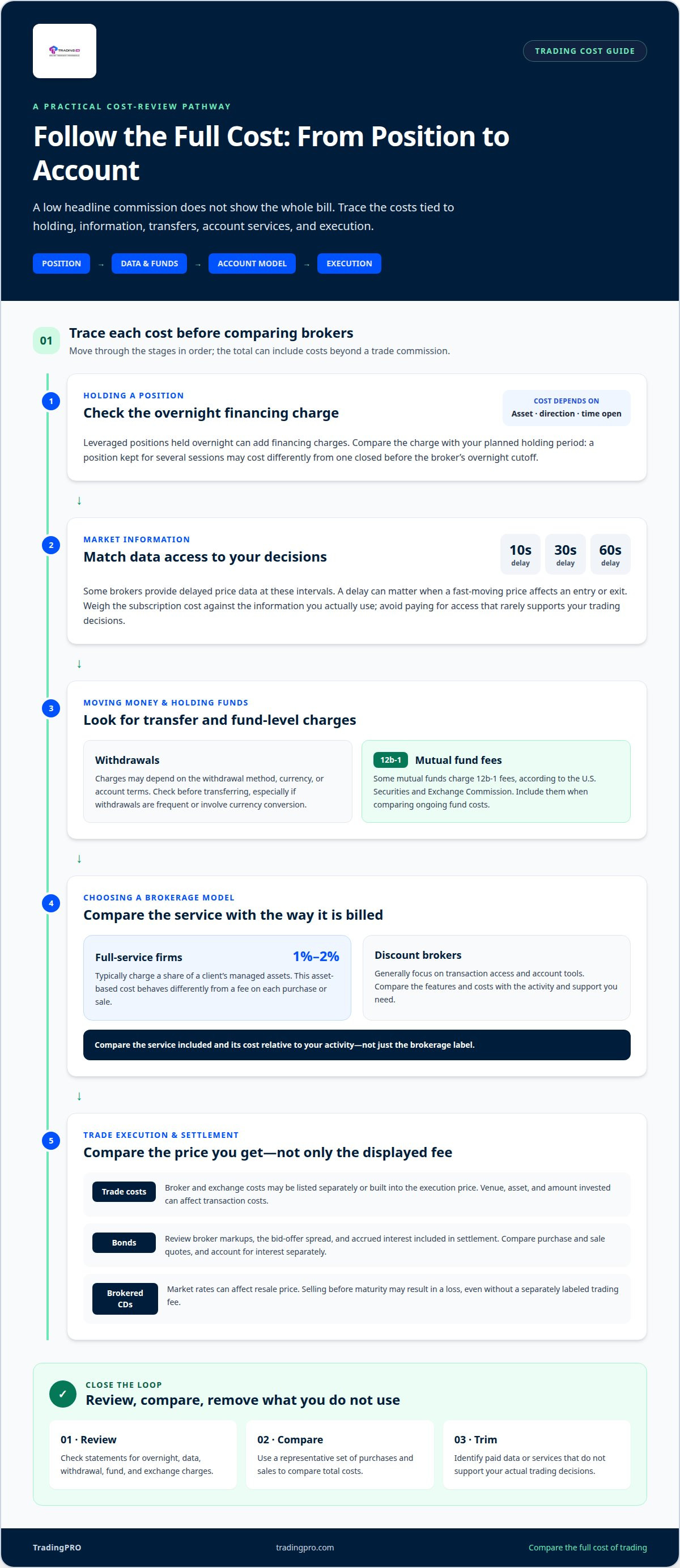
Holding a leveraged position overnight can add financing charges to the cost of opening and closing a trade. The amount may depend on the asset, position direction, and how long it remains open. Compare the overnight charge with your planned holding period before entering a position. A trade held for several sessions may have a different total cost from one closed before the broker’s overnight cutoff.
Market data can also carry a cost or arrive with a delay. Some brokers provide delayed price data at intervals of 10, 30, or 60 seconds. That delay can matter when a fast-moving price affects an entry or exit. Separate the price of a data subscription from the value of the information: choose the feed that fits your trading decisions, rather than paying for access you rarely use.
Withdrawal charges deserve attention when moving funds out of an account. The cost may depend on the withdrawal method, currency, or account terms. Review the charge before submitting a transfer, especially if you make frequent withdrawals or move funds between currencies. Mutual fund ownership can add another layer: according to the U.S. Securities and Exchange Commission, some mutual funds charge 12b-1 fees. Include that expense when comparing a fund’s ongoing cost with its purchase and sale costs.
Brokerage models also shape the bill. Full-service firms typically charge 1% to 2% of a client’s managed assets, while discount brokers generally focus on transaction access and account tools. The relevant comparison is the service included and its cost relative to your activity. For an investment managed around a portfolio, an asset-based charge behaves differently from a fee attached to every purchase or sale. Match the model to the work you need, not just its label.
Bond and certificate of deposit (CD) transactions need a separate cost review. A bond’s quoted price may not show the full effect of a broker markup, the bid-offer spread, or accrued interest included in settlement. Compare purchase and sale quotes, then account for interest separately. A brokered CD’s resale price can also be affected by market rates. Selling before maturity may result in a loss, even without a separately labeled trading fee.
Broker and exchange costs may appear as separate line items or be built into the execution price. The venue, asset, and amount invested can all affect transaction costs, so compare completed trades rather than relying on one advertised charge. A difference between the displayed quote and execution price can be a meaningful expense, even when the commission looks small.
Review your costs regularly to spot charges before they accumulate. Record each charge by type and link it to the trade or account activity that triggered it.
- Review account statements for overnight, data, withdrawal, fund, and exchange charges.
- Compare total costs across a representative set of purchases and sales.
- Remove paid data or services that don’t support your actual trading decisions.
Brokerage fees and account charges
A brokerage account can carry charges even in months with few trades. Separate transaction costs from account-level fees, then identify whether each charge is fixed, annual, or tied to account value. This shows what you pay for trading activity and what you pay simply to keep an account open, making comparisons between brokerage models more accurate.
A percentage-based charge grows with the balance, while a flat charge stays the same as capital changes. For example, a $100,000 portfolio, a 1% annual fee, and a 4% annual return leave an actual return of 3%. The fee reduces the return before you assess investment performance.
Time magnifies that effect. In the example, fees accumulate to an additional $28,000 over the next 20 years, almost 30% of the initial investment. Treat that figure as an illustration of compounding, not a forecast for every account. Compare the annual charge against your expected holding period, account balance, and services used. An advisor’s guidance may matter to one investor, while another may prefer a self-directed account.
Service fees can cover account administration, paper statements, transfers, or other features. Custody fees relate to holding and administering investments, rather than buying or selling them. Check when each charge applies, whether it recurs, and whether account activity affects it. Include service-specific fees in your comparison when that service fits your plan.
Trading frequency can affect commission tiers. A lower commission per transaction may not reduce your total charges if it encourages unnecessary trading. Compare your actual monthly activity with the tier threshold, then calculate the total cost at both rates before changing your approach.
- Review the last 12 months of statements and fee schedules.
- Mark each charge as annual, transaction-based, or service-related.
- Compare flat fees with percentage charges at your current balance.
As you weigh account structure against your trading activity, consider whether the Rookie, Micro, Pro, or Scalp Account suits your approach. You can begin with account registration when you’re ready to compare your account options.
Online stock, ETF, and options commissions
Online commission schedules range from per-trade charges to zero-commission offers. Compare the commission with your order type and any other costs that affect execution.
Can a broker’s premium plan or token reduce trading fees? It can when the broker’s terms apply a discount to your trades. Compare the savings with the plan cost or token-related conditions to see whether your total cost actually falls.
Frequent-Trading Commission Discounts
A frequent-trading discount lowers the commission rate when your account meets the broker’s stated activity threshold. It matters most when your strategy naturally generates enough trades to qualify. Estimate your usual activity, then compare the regular and discounted commission schedules against it.
Don’t increase trading just to reach a lower rate. Extra trades can add costs and change your exposure, even when each commission is smaller. Compare the full monthly commission under both schedules, using your usual number of trades and the stocks or options you actually trade.
Zero-Commission Trading Platforms
A zero-commission platform removes the stated commission from eligible trades. This can reduce a visible line item, but it doesn’t mean every transaction or account cost disappears.
Check which products qualify and whether the offer covers both opening and closing a position. Then compare execution prices and other charges for the same type of order. An ETF with no trading fee, for example, may still have an expense ratio that affects its ongoing cost.
Premium Plans and Broker Tokens
A premium plan or broker token may qualify an account for lower commissions under the broker’s pricing terms. The benefit matters only if the reduced trading charges outweigh the plan cost or the conditions attached to holding a token.
Compare the total cost of your expected trades, not just the advertised discount. Include recurring plan charges and consider whether token requirements fit your risk tolerance. If the benefit depends on frequent activity, test the calculation against your usual trading pattern rather than assuming the discount will pay off.
Commission structures also differ by broker and product. That commission is .02 percent of the purchase value. Compare both the rate and the amount charged per order before selecting a schedule.
Options commissions may be calculated per contract, per order, or through a combination of charges. Check how the broker treats multi-leg strategies, since one strategy can include several contract orders. For stocks and ETFs, distinguish commission-free trading from funds with ongoing expenses. When comparing an ETF with a mutual fund, include the fund’s costs and your purchase frequency. Lower trading commissions can still be outweighed by costs that apply while you hold the investment.
Common types of trading fees
Trading costs can include commissions, spreads, contract charges, and exchange fees. Maker-taker pricing and fee tiers determine how order type or trading activity affects some charges.
Trading Fees Across Asset Types
A broker’s fee structure can differ across stocks, ETFs, options, crypto, and forex, so compare costs by asset. Stock costs may be quoted per share, while options and futures can carry contract charges. Forex costs may be reflected in the spread.
For each asset you trade, identify whether its fee schedule lists a commission, spread, contract charge, or other transaction cost. Then compare the same order type across brokers. This focuses your comparison on expenses you’re likely to incur, rather than a headline rate for a different market.
Maker-Taker Fees
Maker-taker fees are exchange charges that differ depending on whether an order adds liquidity or takes available liquidity. A resting limit order may add liquidity; an order that immediately matches an existing quote takes it. The distinction matters because the exchange may charge differently for each execution type.
Check how the exchange classifies your order after execution, not just how you intended it to behave. A limit order can execute immediately if its price crosses the available quote. Compare the resulting fees with your strategy before changing order settings, since execution price and certainty matter too.
Trading Fee Tiers
Trading fee tiers set different rates based on account activity, volume, or another stated threshold. A tier can lower your rate once you qualify, making the fee schedule particularly relevant for active traders. Compare the qualification period and eligible trades with your actual trading pattern.
Don’t assume a lower tier automatically cuts total expenses. Calculate the cost using your usual order volume, then compare it with the requirements for the next tier. Trading more solely to qualify can increase market exposure and other charges, offsetting the reduced rate.
Contract fees show how a per-unit charge scales with order size. Include the contract count on both sides of a trade when estimating total commission. This makes the cost clear before considering the position’s gain or loss.
Percentage-based fees work differently from fixed charges. A percentage applies to the transaction value, so the dollar cost changes with the size of the purchase or sale. Compare that calculation with any per-share or per-contract charge in the same fee schedule. The lower rate isn’t always the lower cost for your order size.
Separate exchange charges from broker commissions when reviewing a confirmation. Record each line by asset and order type, then compare completed trades across your usual strategies. This gives you a practical view of the fees actually paid, including costs that a single advertised commission may not capture.
What fees do stock, ETF, options, crypto, and forex brokers charge?
Broker charges vary by asset and order structure. Compare the cost components for the investments you actually trade, not just one headline commission.
Stocks and ETFs
Stock trades can involve a commission, a spread, or both. The spread is the gap between available buying and selling prices, so execution price matters alongside any stated commission. Review trade confirmations to see how the order filled and which charges applied.
ETF costs can include a trading charge and an ongoing fund expense ratio. A no-trading-fee offer covers the purchase or sale, not the fund’s continuing expenses. Compare an ETF’s expense ratio with its investment approach and expected holding period. If a fund charges a trading fee, consider whether that charge is proportionate to your planned investment.
Options
Options commissions may apply per contract, per order, or through a combination of charges. Contract count matters: an order covering multiple contracts can have a different total commission from a single-contract trade. Include every leg when estimating a multi-leg position, then compare the total charge with the order’s intended purpose.
Liquidity also affects the prices available to options traders. Compare available quotes before placing an order, and consider whether a limit order suits your price objective.
Crypto and Forex
Crypto trading costs can include transaction commissions and a spread between buying and selling quotes. The platform’s fee structure and the specific trading pair determine which components apply. Compare the quoted purchase and sale prices with the commission shown for the same order, then include any separate transaction charges.
Forex brokers may build trading costs into the spread or charge a separate commission. Some pricing structures combine both. Compare the full cost for the currency pair and order size you plan to trade. If you hold a position overnight, include any applicable financing charge.
Use a consistent method to compare asset classes: choose a representative order, record the execution price and each listed charge, then calculate the total. Repeat this separately for stocks, ETFs, options, crypto, and forex. This shows which charges drive costs for your activity, rather than assuming one broker’s cheapest asset reflects its entire pricing model.
Ready to put your trading-cost comparison into practice? Start your account registration and review the available trading setup.
TradingPRO: Rookie Account
TradingPRO’s Rookie Account is an option for newer traders comparing commissions and other trading costs. Use the fee framework in this guide to identify which charges apply to your activity, then compare account options with your trading style.
The Rookie Account may suit readers starting out, while the Micro, Pro, and Scalp Accounts offer other options. Focus on the account type that aligns with how you plan to trade, rather than assuming its label alone determines your total costs. Review the relevant account information as part of your decision.
Explore the Rookie Account at TradingPRO and decide whether it fits your approach.
Make your next trading decision with a clearer cost view
Turn your fee comparison into a practical habit. Before placing a trade, consider how its cost fits your strategy, expected holding period, and account choice. Keep a simple record of actual charges alongside your trading activity. Over time, this can help you spot patterns and make more deliberate decisions about how to reduce trading fees.
TradingPRO offers the Rookie, Micro, and Pro Accounts, giving traders different options as their approach develops. Choose the account type that aligns with your current trading style, then use the cost factors in this guide to assess your setup.
Take the next step when you’re ready to explore your options. Register with TradingPRO and move forward with a clearer plan for your trading activity.
Frequently Asked Questions
How high are the transaction costs for trading?
Transaction costs vary with the asset, provider, trading venue, and amount invested. The displayed commission is only one possible part of the total. This is why execution price matters alongside the fee shown on an order screen.
How much does a trade cost?
A trade’s cost depends on its size, asset, order type, execution price, and applicable account charges. To estimate it, start with the amount paid or received, then include transaction charges and any difference from the quote you expected. A short-term position may also incur holding costs. The same account can therefore have different total costs for different assets, order sizes, and holding periods.
Why are there fees for trading?
Trading fees pay for services and processes involved in placing, executing, and maintaining investments. A transaction charge may relate to order handling, while an account fee can cover ongoing administration. Funds may also have operating expenses separate from a broker’s charge. Identifying who receives each fee helps explain why costs appear in different places and why one headline commission doesn’t represent every expense.
How Can You Keep Investing Costs in Check?
Keep costs visible by reviewing account statements and comparing each investment’s ongoing expenses with its trading charges. To understand how to reduce trading fees, assess each cost against your investment plan and trading activity. For a diversified ETF portfolio, one approach is to select funds with expense ratios of 0.25% or less per year. If a fund charges a trading fee, consider investing more than $1,000 per fund.
Is DIY Trading Cheaper Than Managed Solutions?
DIY trading can avoid a fee for ongoing portfolio management, but it leaves research, decision-making, and monitoring to you. Managed solutions can include professional oversight, with costs depending on the service and account structure. Compare the services provided, not just the fee label. DIY may suit someone comfortable making investment decisions; a managed approach may fit someone who values delegated portfolio decisions.
What Are Commissions in Investing?
Commissions are charges a broker applies for handling an investment transaction. Depending on the asset and pricing structure, they may be calculated per trade, share, or contract. A commission differs from a fund’s ongoing expenses and from the gap between quoted and executed prices. To understand its effect, review the transaction confirmation and identify the amount specifically attributed to the broker’s commission.
What Hidden Costs Do Bid-Ask Spreads and Slippage Add?
The bid-ask spread is the gap between the price available to sell and the price available to buy. Slippage is the difference between the expected execution price and the price received. Less-liquid assets and rapid price changes can make execution costs more noticeable.
Which brokers have the lowest trading fees in the United States?
No single broker has the lowest costs for every trader in the United States. Pricing depends on the assets traded, order size, activity, and account features. To decide how to reduce trading fees for your activity, compare the total cost of your usual assets and order patterns. A platform with no stated commission may still have other transaction or account costs, so don’t choose based only on an advertised commission.


