




- Published on: 2026-11-17 13:36:19
How to Read a Forex Signal and Check Its Key Details

A forex signal is a trade idea, not a complete trading decision. To learn how to read a forex signal, identify the currency pair, trade direction, entry level, stop loss, take-profit target and timeframe, then consider whether the details still make sense when you receive it.
It’s natural to focus first on a signal’s potential target. But timing, risk-to-reward, and the provider’s track record matter just as much. A chat-group message may leave out important context, so even a clear-looking instruction needs careful interpretation.
This guide explains what each signal detail means and how to assess performance claims, trading practices, and provider credibility. You’ll also learn what to watch for in chat groups, including pressure to act quickly or trust unsupported claims. A consistent review process can help you judge whether a signal is clear, timely, and suited to the risk you’re prepared to take.
Key Takeaways
- Identify the pair, direction, entry, exit levels and timeframe to understand what a signal actually proposes.
- Consider how the signal was produced and whether its performance claims include enough context to assess them.
- Watch for chat-group pressure, missing trade details and messages that may arrive too late to act on as intended.
- Use the entry, stop loss and target to evaluate risk-to-reward, then account for how a later entry can change the calculation.
- Match your trading approach to an account type that fits your experience and preferred style.
What are Forex Signals?
A forex signal is a trading instruction or analysis suggesting a possible action on a currency pair. It may identify a buy or sell opportunity, explain the reasoning, and include levels for managing the trade. Signals can come from an analyst, an automated system, a technical indicator, or analysis of economic news. Their format and detail depend on how the provider generates and shares them.
An analyst-written signal reflects a person’s reading of market conditions. The analyst may assess chart patterns, price levels, or an upcoming economic release before outlining a trade idea. An automated signal follows programmed rules, such as a technical indicator reaching a chosen condition. A news-linked signal interprets an event, such as a central-bank announcement, as a possible catalyst. Since these approaches use different reasoning, identify whether the message explains its trigger or simply gives an instruction.
Manual and automated describe how a signal is generated, not how it reaches you. A provider may send signals by SMS, email, push notification, or a trading-platform add-on. Traders may also receive ideas in chat groups. A copied signal differs from an independently generated one: it follows another trader’s activity through a copy-trading arrangement, rather than asking you to interpret each message and enter every trade yourself. In either case, understand which actions are copied or suggested.
To place a signal trade on a trading platform, select the stated pair and confirm the buy or sell direction. Enter the specified entry, position size, stop loss, and take-profit level, then review the order before submitting it. The signal provider supplies the idea, but you place the trade.
That distinction matters when a signal arrives late. Forex signals are time-dependent, so the quoted entry may no longer match the available market price when you act. Compare the current price with the signal’s entry instruction; don’t assume the original levels still describe the same trade. If the message gives a range, follow its stated conditions rather than treating every price as interchangeable.
Manual providers may publish an analyst’s explanation with each idea, while automated providers may issue alerts when their rules are met. A copied source can transmit another trader’s decisions, but copying doesn’t explain why a trade was opened. Read the signal’s method, timing, and instructions together. Learning how to read a forex signal means distinguishing the trade idea from its source and from your separate decision to place an order.
Signal components: pair, direction, entry, stop loss, take profit and timeframe
Each field describes a different part of the proposed trade. Pip values affect potential gains or losses, while the spread can change the effective entry price and reduce profit.
Reading Signal Fields
A signal’s fields identify the market, trade direction, price levels, and intended duration. Read them together: a buy entry means something different from a sell entry.
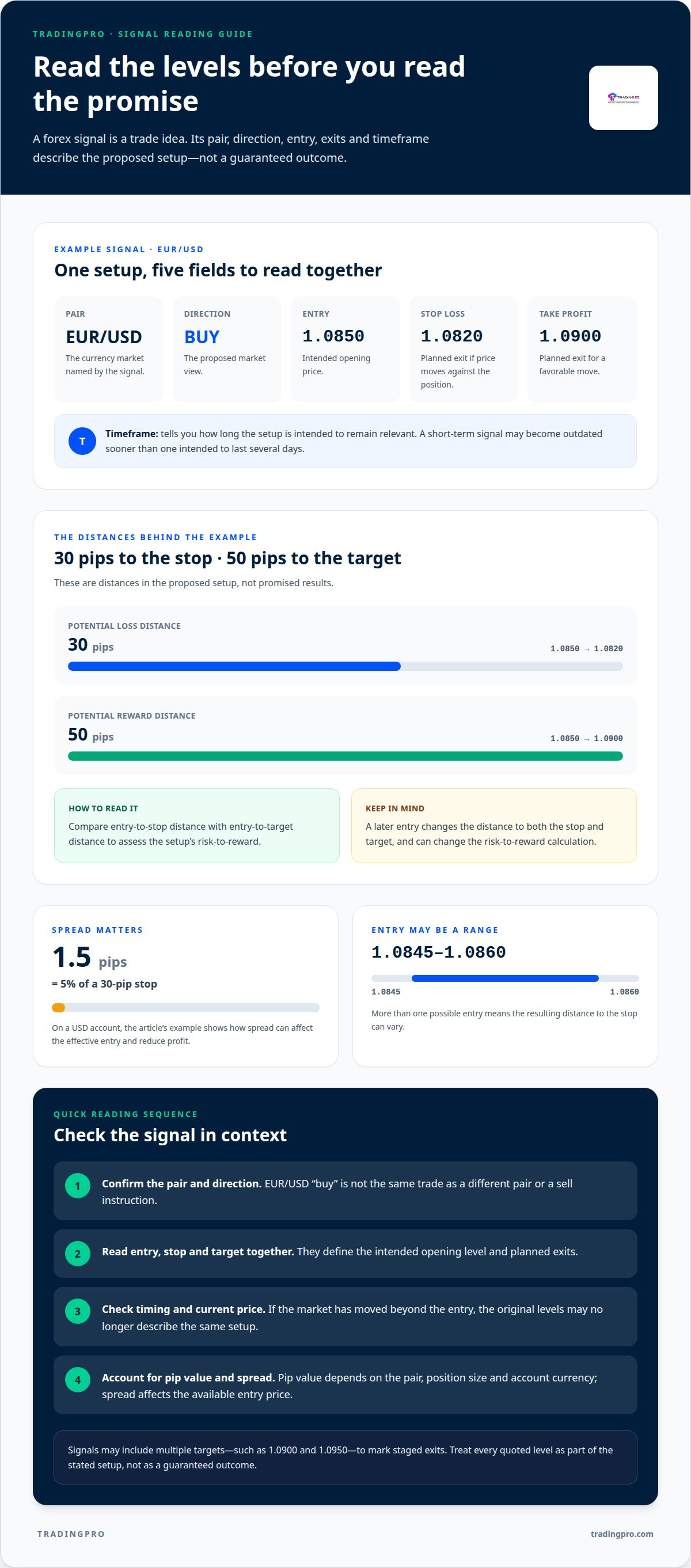
For example, EUR/USD names the currency pair, while “buy” indicates the proposed direction. An entry of 1.0850 gives the intended opening price; a stop loss at 1.0820 marks the exit if price moves against the position. A take-profit level at 1.0900 identifies a planned exit for a favorable move. The timeframe explains how long the setup is intended to remain relevant.
Check the instrument and direction before interpreting any price. A trader who mistakes EUR/USD for another pair, or reads “sell” as “buy,” would act on a different market view. Then note whether the signal gives one entry price or a range. A range such as 1.0845-1.0860 gives more than one possible entry level, so the resulting distance to the stop loss can vary.
Entry and Exit Levels
Entry and exit signals indicate where a trade may open and close. Together, they show the intended path from execution to a planned outcome.
In the EUR/USD example, an entry at 1.0850 and a stop loss at 1.0820 place the stop 30 pips away. A take-profit level at 1.0900 sits 50 pips above entry. These distances describe the proposed setup, not a guaranteed result. Multiple targets, such as 1.0900 and 1.0950, can mark staged exit points.
A timeframe adds context to those levels. A short-term setup may become outdated sooner than a signal intended for a trade lasting several days. If the market has already moved beyond the entry, compare the current quote with the signal’s intended level. A later fill changes the distance to both the stop and target, affecting the potential reward relative to risk.
The spread is the gap between a pair’s buy and sell prices, so it affects the price available for entry and the distance price must move before a trade can show profit. On a USD account, a 1.5-pip spread equals 5% of a 30-pip stop. Pip value also depends on the currency pair, position size, and account currency, so the same pip movement can produce different gains or losses.
Use these fields to understand the setup before deciding whether its levels fit your trading plan. If you’re ready to put that understanding into practice, create your trading access.
Assessing signal-source quality and performance claims
Assess a signal source by its reputation, strategy, and recorded results. A polished win-rate claim means little without the trades behind it. Look for clear explanations of how signals are generated and what conditions invalidate them. An analyst who explains a setup gives you more context than a message showing only a direction and target.
Performance needs a consistent record, not a handful of winning screenshots. A source with no trading edge and a 50% chance of winning each trade would produce seven or more winners across 10 trades about 17% of the time. That means a short winning streak alone cannot establish skill. Review a longer sequence, including losing trades and periods when the approach performed poorly.
Log 50 or more signals to assess a source more reliably than relying on 10 trades. Record each signal when it arrives, then compare the stated entry and exits with the actual market prices available. Include signals that were missed, delayed, or invalidated. Otherwise, a record can reflect selective examples rather than the provider’s full performance.
- Method: Note whether an analyst, automated rule, indicator, or news event generated each signal.
- Timing: Record the signal’s arrival and whether its entry was still available.
- Outcome: Track wins, losses, and trades that never reached an entry.
- Risk: Compare the stop distance and target, not just the winning percentage.
- Costs: Include spread and slippage when comparing the quoted result with actual execution.
A 70% win-rate claim, for example, does not show how much each winning or losing trade gains or loses. A string of small wins can be outweighed by a larger loss. Compare each outcome with its planned risk, and note whether the provider reports closed trades or only favorable price movements. Those distinctions change what a headline percentage actually represents.
The strategy matters too. A source focused on news releases may behave differently from one built around technical indicators or longer-term analysis. Check whether its stated method matches the trades in its record. If explanations change after losses, or key details appear only after prices move, it becomes harder to evaluate results consistently.
Judge the provider using the same standard across all 50 or more logged signals. Compare the published setup with its timestamp, entry, stop, target, and outcome. Then consider whether the actual record supports the performance claim, including losing trades and execution costs. This disciplined review separates a repeatable approach from a persuasive presentation.
Risks of signals shared through chat groups
Risks include delayed entries, incomplete instructions, slippage, and sudden market moves. A EUR/USD message may give a direction but omit its timestamp, stop, or reason for entry.
A fast-moving chat can disguise missing context. A signal posted after the price has moved may no longer match its original setup. For example, members who see a “buy” message at different times may enter at different prices. Their positions then have different distances to the same stop loss and take-profit level. Treat the timestamp and full trade details as part of the signal.
Edits and follow-up messages can cause confusion. A group administrator might update an entry range, cancel an idea, or post another signal while older messages remain visible. Anyone who reads only the first alert could act on outdated instructions. Before acting, follow the thread from the initial signal through its latest update. Confirm that the pair, direction, entry, stop, and target all refer to the same trade idea.
Slippage is the difference between an expected price and the executed price. During a sudden market move, the price available when an order reaches the platform may differ from the one shown in the chat. That can shift the entry and change the distance to the stop or target. A stop level is part of the plan, but it doesn’t make the quoted entry or outcome identical to the actual execution.
Group pressure can also distort decisions. Messages such as “enter now” or “everyone is buying” don’t show whether the original entry remains valid. Several members may follow one instruction but get different prices, position sizes, and fills. Repeated messages and confident reactions don’t replace the signal’s trading logic. Separate specific trade information from members’ opinions and urgency.
Use a simple review before acting on a chat signal:
- Match the latest message to the correct currency pair and direction.
- Find the original timestamp, entry level, stop loss, and take-profit target.
- Check whether a later post changed or cancelled the setup.
- Compare the stated entry with the current market price and account for slippage.
- Decide whether the position still fits your own risk limit.
Forex signals are time-dependent, so a chat alert can lose relevance as prices change. A signal provider supplies ideas but doesn’t place trades for you. The timing and order decision remain yours. If a post lacks a clear entry, exit plan, or update history, group enthusiasm cannot make up for those missing details.
Calculating risk-to-reward from forex signal levels
Risk-to-reward compares the distance from entry to stop with the distance from entry to target. Divide potential reward by potential risk to express the ratio. If a signal risks 30 pips for a possible 60-pip gain, its ratio is 2:1. This describes the planned trade, not the probability of winning or a guaranteed outcome.
Calculate both distances from the intended entry, not just from the target. For a buy, risk is the gap from entry down to the stop; reward is the gap from entry up to the target. For a sell, the price directions reverse, but the calculation still uses absolute distances. Measure both in the same unit, such as pips, before dividing.
Entry timing can sharply change the result. In the EUR/USD example, an eight-pip-late entry reduces the sender’s 2:1 reward-to-risk ratio to about 1.37:1. The stop and target haven’t moved, but the available reward has shrunk while the distance to the stop has grown. Recalculate from the price you could actually enter, rather than relying on the ratio quoted with an earlier entry.
Risk-to-reward also differs from account risk. The ratio compares price distances; account risk estimates the potential loss in money if the stop is reached. The position calculation depends on the account-risk limit, stop distance, and pip value. The page’s example uses a 1% account-risk limit with a 30-pip stop. A smaller position reduces the potential loss, while a wider stop requires a smaller position to maintain the same limit.
For a $10,000 USD account risking 1%, the example calculates 0.333 lots and rounds down to 0.33 lots. That produces actual risk of $99, or 0.99%. For a $500 USD account, the example calculates 0.017 lots and rounds down to 0.01 lots, risking $3, or 0.6%. Rounding down changes actual exposure, so use the final position size in your calculation.
Assess both measures before acting on a signal. A favorable ratio can still put too much account capital at risk if the position is oversized. A controlled position can still have a weak ratio if the target is close to entry. Spread and slippage may also affect execution and reduce the effective reward, so the quoted calculation may differ from the actual trade.
Use the signal’s entry, stop, and target to calculate its ratio, then size the position against your chosen account-risk limit. Create a trading account to put your signal-reading process into practice.
TradingPRO
TradingPRO offers a choice of account environments for putting market decisions into practice. After assessing a signal’s levels, timing, and risk-to-reward, consider which trading approach fits your needs. The Rookie, Micro, Pro, and Scalp Accounts provide distinct tiers for different trading styles, including scalping and professional market access.
A signal is an input, not a substitute for understanding the trade. Use the details in this guide to make informed decisions about entries, exits, and position risk within your chosen trading approach.
Contact TradingPRO to discuss your trading needs.
Build a More Deliberate Trading Routine
Treat each signal as a chance to sharpen your decision process, not as a command to follow. As you practice how to read a forex signal, focus on consistency: apply the same review standards across providers and market conditions. Over time, your notes can show which details support better decisions and where you tend to act too quickly.
Pause when a message creates urgency. A clear routine helps separate your own plan from the noise of a busy market or chat group. Keep learning, stay selective, and make each trading decision deliberately.
Connect with TradingPRO and take your next step. Build your confidence through informed, disciplined choices.
Frequently Asked Questions
Should I copy the lot size in a signal?
No. A provider’s lot size reflects their account and risk choices, which may differ from yours. Calculate your position size using your account balance, risk limit, stop-loss distance, and the pair’s pip value. For example, the same lot size can expose two traders to different losses if their account currencies or stop distances differ. Treat a suggested size as context, not a personal sizing instruction.
What information is usually included in a forex signal?
A forex signal commonly identifies the instrument, trade direction, entry level, stop loss, take-profit target, and timeframe. Some messages also include an entry range, multiple targets, a timestamp, or a brief explanation of the trade idea. These details help clarify when the setup applies and what may invalidate it. If key fields are missing, you have less information to assess the proposed trade.
How do you interpret a forex signal's currency pair and buy or sell direction?
Read the pair as two currencies quoted against each other. In EUR/USD, EUR is the base currency and USD is the quote currency. A buy signal means the provider expects EUR/USD to rise, while a sell signal means they expect it to fall. This describes the pair’s direction, not a guarantee that either currency will move as predicted. Check the exact symbol before interpreting the instruction.
What do entry price, stop-loss, and take-profit mean in a forex signal?
The entry price is the level where the signal proposes opening a position. The stop loss sets a planned exit if the market moves against the trade, while the take-profit marks a planned exit after a favorable move. For a sell trade, those levels fall in different price directions than for a buy. Read all three as one setup, since changing the entry affects the distance to both exits.
How do forex signal timeframes and expiration times work?
A timeframe describes the period the trade idea is designed to cover, while an expiration time sets a deadline for acting on or cancelling the signal. They are related but not interchangeable. A signal intended to remain relevant for several days may have an entry condition that becomes invalid sooner. Check the message for both details, and don’t assume an old alert remains active just because its target hasn’t been reached.
How should position size be calculated from a forex signal and account risk?
Start with the maximum account loss you’re prepared to accept if the stop is reached. Divide that amount by the estimated loss per lot at the signal’s stop distance, using the pair’s pip value and your account currency. The result is the position size. If the platform only allows size increments, round down to stay within your chosen risk limit, then recalculate the resulting exposure.
What is the difference between manual and automated forex signals?
A manual signal comes from a person’s analysis and judgment; an automated signal is triggered by programmed rules or indicator conditions. Manual analysis may explain context that a rule doesn’t capture, while automation can apply its criteria consistently. Neither method removes market risk. To understand a signal’s limits, distinguish how it was generated from how it was delivered or how a trader chooses to follow it.
How can you verify a forex signal provider's track record and avoid scams?
Look for a complete record that includes losing trades, timestamps, and the original entry and exit instructions, not just winning examples. Compare reported outcomes with market prices available when each alert arrived, and account for execution differences. Be wary of pressure to act immediately, guaranteed-profit claims, or requests to send funds directly to an individual. Keep control of your account credentials and trading decisions.


