




- Published on: 2026-11-11 11:19:38
How to Learn Trading Skills Through Copy Trading

Copy trading can be more than a way to follow another trader’s positions. Using copy trading to improve trading skills means studying how a lead trader opens, adjusts and closes trades, then comparing those decisions with your own understanding of the market. Treat each copied trade as a learning opportunity, not a substitute for learning the fundamentals.
Copying can provide market exposure without requiring you to watch charts all day. However, recent results alone don’t show whether a trader’s approach fits your goals or how it may perform when conditions change.
This guide explains how copy trading works and what to assess beyond headline returns, including trading history, drawdowns, consistency and strategy changes. You’ll also learn how to track copied trades, consider the reasoning behind decisions and turn your observations into a repeatable process for improving your trading skills.
Key Takeaways
- Understand how copied trades flow into your account and why spreading exposure across traders with different approaches can help manage concentration.
- Assess a trader’s history, consistency and drawdowns rather than selecting one based on recent returns alone.
- Watch for changes in a lead trader’s strategy, risk-taking or instruments, and review your allocation when their approach shifts.
- Track copied trades and study the decisions behind them to turn observation into practical trading lessons.
- Build skill through a repeatable cycle of preparation, practice and review instead of following trades blindly.
1. What is Copy Trading, and How Does It Work?
Copy trading links your account activity to a lead trader’s decisions. When that trader opens, adjusts or closes a position, the platform may replicate the move in your account. Copying can provide market exposure without constant chart watching, but it doesn’t automatically explain the reasoning behind each trade.
Before copying, review how trade sizing works. In proportional sizing, a copied position can use the same 10% account allocation as the lead trader. That can magnify losses as well as gains, so set your own risk limit and position size rather than assuming the lead trader’s allocation suits you.
Diversifying across traders means choosing approaches that differ in strategy, instruments or trading pace. For example, one trader may follow forex trends while another trades commodities. Two profiles with similar methods can still react alike to changing market conditions, so following more traders alone doesn’t ensure meaningful diversification.
Also consider diversification across lead traders and providers. Several lead traders on one provider may share similar execution conditions or platform risks. Using different providers may reduce dependence on one platform, but it can add complexity and won’t remove market risk. Compare each trader’s history, approach and instruments before allocating funds.
How does copy trading compare with paper trading and managing trades independently? Paper trading uses simulated positions, while copy trading can expose your account to live market movements. With independent trading, you make the entry, position-sizing and exit decisions yourself. To learn from copying, record why a trader entered and compare that reasoning with what happened.
What U.S. regulations and tax rules apply to copy trading? For U.S. investors, relevant considerations depend on the instruments traded and how the service is structured. Identify those details before copying, and keep transaction records for tax preparation.
How much money should you start with? Some platforms allow as little as $100, but that is an access point, not a recommended allocation. Choose an amount that fits your objectives and risk tolerance, and start smaller before considering any increase.
What are the risks, including leverage and past-performance bias? Leverage can magnify losses, and strong recent profits don’t show how a trader may perform under different market conditions. Review drawdowns, trading history and risk-taking. When trading forex or derivatives, use only funds you can afford to lose.
To make copying a learning tool, keep a simple trade log with the instrument, entry, exit and your explanation of the decision. Review it regularly. This turns copied activity into material for study, while diversification and risk limits can help prevent one trader’s choices from dominating your entire approach.
2. Avoiding decisions based only on recent performance
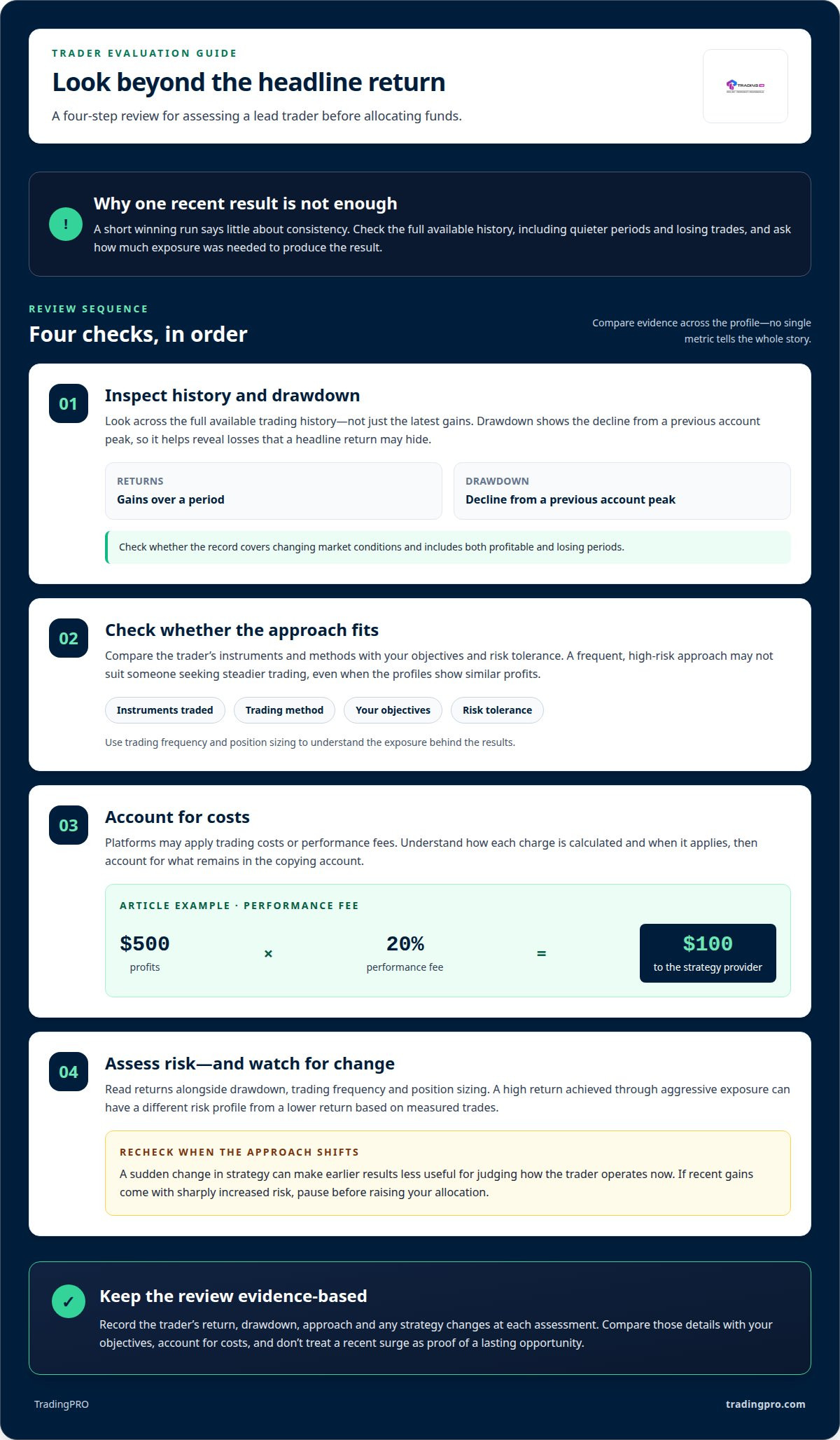
A trader’s latest profit can look compelling, but a short winning run says little about consistency. Compare performance across the full available history, including quieter periods and losing trades. A profile showing only a headline return leaves key questions unanswered: how much exposure produced it, how deep were the losses, and did results depend on one market move?
Beginners should look for a clear trading history, understandable strategies, consistent results and drawdown information. Compare those details with your goals and risk tolerance. A trader using frequent, high-risk positions may not suit someone seeking a steadier approach, even if both profiles show similar profits.
Read performance metrics together, not in isolation. Returns show gains over a period; drawdown shows the decline from a previous account peak. Trading frequency and position sizing add context: a high return achieved through aggressive exposure may involve a different risk profile from a lower return based on measured trades. Check whether the history covers changing market conditions.
Consistency doesn’t mean every trade wins. Look for evidence that the trader follows a recognizable process through profitable and losing periods. For example, compare the trader’s stated strategy with their recorded instruments and trade patterns. A sudden change in approach can make earlier results less useful for judging how they operate now.
Costs also affect the result you experience. Platforms may apply trading costs or performance fees, so understand how each charge is calculated and when it applies. In one example, a 20 percent performance fee on $500 in profits gives $100 to the strategy provider. That deduction changes the profit retained in the copying account.
Use a repeatable review before allocating funds. First, inspect the full history and drawdown. Next, consider whether the trader’s instruments and methods match your objectives. Then account for costs and assess whether the risk level fits your plan. Don’t treat a recent surge as proof of a lasting opportunity.
Keep your review tied to evidence. Record the trader’s return, drawdown, approach and any strategy changes at each assessment. If recent gains come with sharply increased risk, pause before raising your allocation. To put that evaluation into practice, you can set up a copy-trading account and make trader selection part of a measured process.
3. Reviewing lead-trader performance and strategy changes
Copying can automatically mirror a lead trader’s position openings, adjustments and closures. Your account may therefore reflect decisions as they happen, but execution details can differ. Compare the copied position with the lead trader’s activity, including its size and timing, to see what the platform replicated and what appeared in your account.
Review performance at the end of each trading week. Check whether the trader followed their plan, respected stop-loss and take-profit levels, and used position sizes consistent with their approach. These checks reveal more than a weekly profit figure. They help you assess whether results came from a repeatable process or changing levels of risk.
Track one measurable learning point each week. For example, note whether the trader waited for a planned entry or changed course during a market move. Compare that observation with the trader’s stated strategy. This makes copying an active study process, rather than a stream of positions you watch without understanding.
Include drawdown in every review. Compare returns with the size and duration of declines from a previous peak. A profitable period alongside a sharp drawdown may signal risk you hadn’t recognized. Record both measures, then consider whether the trader’s current exposure still fits your risk limits.
Watch for strategy changes in three areas: risk, instruments and trading method. A lead trader might increase position sizes, switch from forex to commodities, or move from short-term trades to longer holds. Each shift can change how copied positions behave. Reassess the fit instead of assuming earlier performance describes the new approach.
A sudden drawdown calls for a closer review. Compare the recent decline with the trader’s previous pattern, then look for changes in position size or execution. Don’t decide based on one number alone. A deeper decline combined with a changed strategy can be stronger grounds to reconsider your allocation.
Some trading platforms provide stop-loss orders that let users set limits to cut losses if a lead trader’s strategy performs poorly. Understand how that control works alongside copied trades, rather than treating it as a replacement for review. If the trader changes instruments or increases risk, reassess both your allocation and any limits you set.
Keep a simple weekly record of the trader’s strategy, key positions, drawdown and any notable changes. At the next review, compare those entries with your own observations. This repeatable process helps you stay involved, learn how strategies respond to changing conditions, and decide whether continued copying still supports your trading objectives.
4. Assessing provider track records and drawdowns
A provider’s headline return is only one signal of how its strategy performed. Review the full track record alongside drawdown, trading frequency, position sizing and instruments. Beginners should look for a pattern they can explain, not a striking profit figure without context. A record that includes difficult market conditions offers more insight than a winning stretch alone.
Drawdown measures a decline from an account’s previous peak to a later low. It shows how much capital was lost before recovery, if recovery occurred. Compare the deepest decline with the return achieved over the same period. Strong returns paired with a severe drawdown may involve more risk than your plan can tolerate.
Use matching periods when comparing providers. Place their returns and drawdowns side by side over the same available dates, then note differences in instruments and trading frequency. A trader focused on short-term forex positions may face different market movements from one trading commodities. Similar profits don’t mean similar exposure or risk.
Look beyond the final account balance. Check whether the provider’s trading history shows repeated large losses, abrupt changes in position size or extended periods below a previous peak. These details help explain the path behind reported returns. For example, a fast recovery after a deep decline still means there was a period with less capital available.
Leverage can make a small market move have a larger effect on an account. Examine whether a provider’s strategy relies on high exposure, and consider how losses could affect your allocation. Don’t treat a short run of gains as proof that the approach will continue to work. Focusing only on recent profits can lead to past-performance bias.
Make the review actionable. Record the provider’s return, largest drawdown, instruments, position-sizing pattern and any visible strategy shifts. Then compare each item with your own limits. If the provider takes risks you wouldn’t choose independently, copying can expose your capital to decisions you don’t understand.
Check how the provider’s records are presented, including whether the trade history and risk measures give enough context to interpret performance. Without an explanation, a return can be difficult to assess. Consider how spreads, swaps and slippage affect copied trades, since execution costs can change the result in your account.
Finally, use drawdown as a decision point, not an automatic stop signal. Review what caused the decline, whether the strategy changed, and whether the risk still fits your objectives. If losses exceed your planned tolerance, reduce exposure or stop copying. This gives your review a clear action instead of letting hope or recent gains decide.
5. Learning trading strategies through copy trading
Copying a position shows what a trader did, not why the decision made sense. Turn each trade into a study prompt: note the instrument, entry level, exit level and market context. Then write down what you think the strategy was trying to capture. Compare your explanation with later price action, including trades that closed at a loss. A practical way of using copy trading to improve trading skills is to treat each position as evidence to examine, not an instruction to follow.
For a trend-following example, the provider may risk 2% per trade. Observe how the trader identifies a trend, chooses an entry and manages the position. Don’t treat the percentage as a template for your own account. Focus on how risk relates to the trade idea, and whether the trader applies that method consistently.
Price levels give your review a practical focus. Mark the area where the trader entered, the level where the trade thesis would weaken, and the point where the position closed. Ask whether the exit followed a planned signal or reacted to short-term movement. This exercise helps distinguish a strategy’s rules from explanations made with hindsight.
Use copy trading platforms as observation tools, then test your understanding separately. For example, record a copied setup and later review historical price data to see how similar conditions behaved. Backtesting can help you examine a rule across past market examples, but it doesn’t establish that the same outcome will happen again.
Study losing trades as carefully as profitable ones. Compare the original idea with what changed: Did price break a key level, did the trader exit according to plan, or did the position stay open after its rationale weakened? A loss can reveal whether the strategy manages risk as designed, while a win alone may hide weak execution.
Build a repeatable learning cycle: learn the rule, practice identifying it, backtest examples, observe execution, review the result and refine one decision. For instance, spend a week checking whether entries followed confirmation instead of chasing a fast price move. Focusing on one improvement makes progress easier to assess than changing several habits at once.
Keep your notes specific. Record the setup, entry signal, stop-loss or exit logic, result, and any spread or slippage you observed. Compare notes across trades using the same strategy. If you can explain why the approach entered, held or exited, you’re developing transferable knowledge rather than merely following activity. Using copy trading to improve trading skills works best when you connect those observations with your own independent analysis.
Set a clear learning objective before you copy: understand trend entries, risk control or exit timing. Review that objective alongside your trade notes, and revise it when the evidence points to a gap. To put this structured learning approach into action, start with a copy-trading account.
TradingPRO: Social Trading / Copy Trading
TradingPRO offers Social Trading / Copy Trading for traders who want to observe and replicate other traders’ strategies. Use it to complement your own study: track copied decisions, review how they fit your objectives, and stay in control of your risk choices.
Choose an account tier that aligns with the way you plan to trade. TradingPRO offers Rookie, Micro and Pro Accounts alongside Social Trading / Copy Trading. Focus on the learning process, not simply the appeal of another trader’s results. Review your notes regularly and reassess whether the approach fits your goals.
If you’d like to discuss Social Trading / Copy Trading and your learning goals, contact TradingPRO.
Turn observation into a deliberate next step
Make your next move a learning decision, not an automatic increase in exposure. Set a clear objective, such as understanding how a trader manages entries, and keep your own risk limits in view. A disciplined approach to using copy trading to improve trading skills gives every copied position a purpose: observe, question and build knowledge you can apply independently.
TradingPRO offers Rookie, Micro and Pro Accounts alongside Social Trading / Copy Trading. Choose an account option that aligns with your trading plans, then focus on learning rather than chasing another trader’s results. Progress comes from applying your observations consistently and refining your own decisions over time.
Contact TradingPRO to discuss your options and take a considered next step toward building your trading skills.
Frequently Asked Questions
What is Copy Trading, and How Does It Work?
Copy trading lets an investor connect their account to a lead trader’s activity, with positions replicated automatically or through available platform controls. The copied trade’s size may depend on the copying settings and account allocation. For example, if a trader opens a position, the platform can create a corresponding position in your account. You still choose whom to follow and how much exposure to allocate.
How does copy trading work, and how can it help improve trading skills?
A copied position gives you a real example to examine: what instrument was traded, where the trader entered, and how the position changed. To make it educational, pause after an entry and write down what you think the trade thesis is. Compare your reasoning with how the position is managed later. Using copy trading to improve trading skills can help you connect decisions with market movement, rather than simply watching account results.
How can I evaluate a trader’s performance, risk, and trading strategy?
Look for an understandable approach and assess its results alongside the risks taken to pursue them. Check whether the instruments and holding style match your objectives, then consider how the strategy might behave in different market conditions. A trader focused on short-term moves, for example, may not suit someone who prefers longer-term decisions. Favor an approach you can explain over one chosen only for its displayed return.
How can I use copy trading to learn without becoming dependent on it?
Before reviewing a copied position, form your own view of the market and record the conditions that would support or weaken a trade idea. Then compare that view with the lead trader’s actions. Using copy trading to improve trading skills should support, not replace, independent analysis. Practice applying what you learn through chart analysis or paper trading, building decisions you can make without relying on another trader for every entry and exit.
How do I manage risk with stop-losses, position limits, and diversification?
Set a maximum allocation for each copied strategy and decide how much total exposure you’re comfortable holding across them. Use stop-loss controls where available, and understand how the platform applies them to copied positions. A stop-loss order can help define an exit point, while position limits restrict how much capital is exposed. Diversification works best when strategies differ, not merely when you follow several traders using similar methods.


