




- Published on: 2026-11-04 10:20:14
How to Convince My Spouse About Trading Without a Fight

A trading conversation is calmer when it starts with household limits, not a pitch. If you’re figuring out how to convince your spouse about trading, begin by separating family savings from trading funds and agreeing on a maximum loss together. Then discuss uncertain income, including what would make you pause or stop.
Your spouse may be concerned about more than market risk. They may also be thinking about bills, savings, and the effect trading could have on shared plans. Take those concerns seriously. The goal isn’t to win an argument or secure permission; it’s to be clear about the risks and make a decision you can both live with.
This article shows how to discuss risk without turning the conversation into a sales pitch. You’ll learn how to protect family savings, talk through uncertain income, set a loss limit, and agree on practical ground rules before trading affects household finances. Start with transparency, listen to each other, and make the boundaries as clear as the trading plan.
Key Takeaways
- Separate trading funds from family savings to protect household essentials and create clear financial boundaries.
- Discuss potential losses and uncertainty openly, focusing on shared concerns rather than trying to win an argument.
- Plan for uneven trading income before it affects bills, savings, or career decisions.
- Agree on a maximum loss and what happens when you reach it, including when to pause or stop.
- Set shared ground rules for trading with family finances, from transparency to a review point for the plan.
1. Keeping family savings separate from trading funds
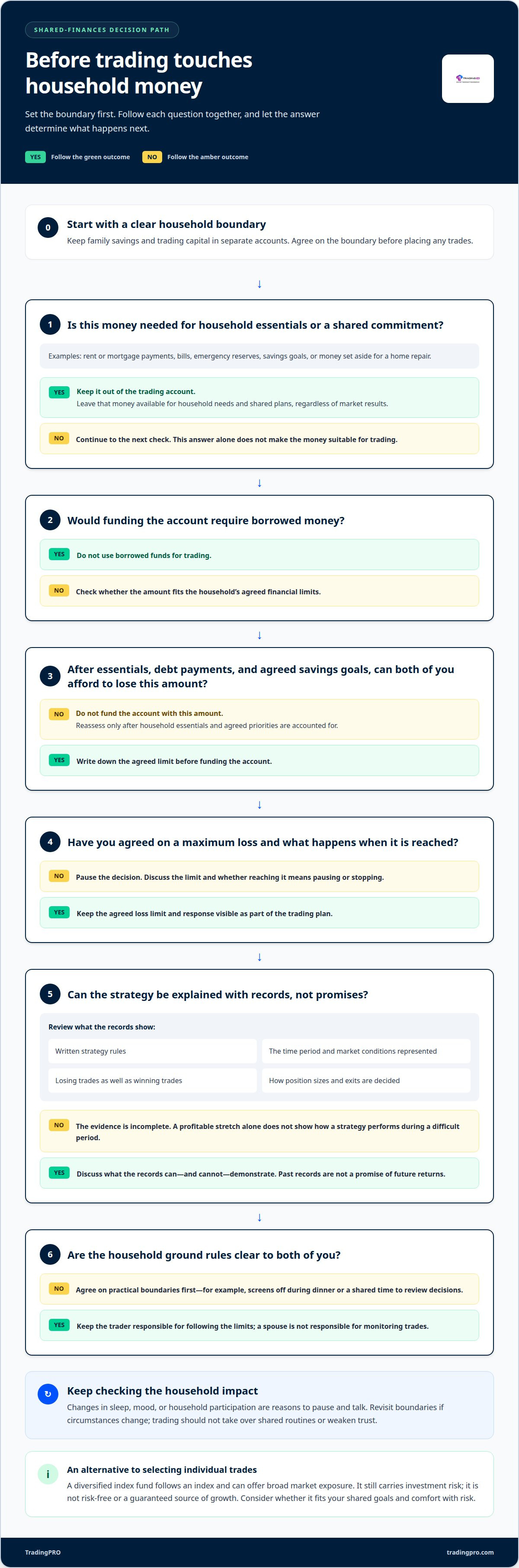
Start with a clear boundary: keep family savings and trading capital in separate accounts. Leave rent, mortgage payments, bills, emergency reserves, and money set aside for shared goals out of the trading account. For example, if you’re saving for a home repair, that money stays available for the repair, regardless of market results. Agree on this boundary before placing any trades.
A diversified index fund can be an alternative for people seeking broad market exposure without choosing individual trades. It follows an index rather than relying on a trader to select each position, but it still carries investment risk. Discuss whether it better fits your shared goals and comfort with risk. Don’t present it as risk-free or as a guaranteed source of growth.
There isn’t one suitable trading amount for every beginner. Choose an amount only after accounting for household essentials, debt payments, and agreed savings goals, and use money both spouses can afford to lose. Never use rent or bill money, emergency savings, borrowed funds, or money reserved for a shared commitment. Write down the limit before funding the account.
Bring evidence, not promises of future returns. Show the strategy’s written rules, the time period and market conditions represented in its records, losing trades as well as winning ones, and how position sizes and exits are decided. Explain what the records can and can’t demonstrate. A profitable stretch alone, for example, doesn’t show how the strategy performs during a difficult period.
Trading can draw attention away from family routines if market checks interrupt meals, childcare, or planned time together. Agree on practical boundaries, such as turning off trading screens during dinner or setting a shared time to review decisions. Invite your spouse to discuss concerns, but don’t make them responsible for monitoring trades. The trader remains responsible for following the agreed limits.
Financial strain can affect the whole household, not just the person placing trades. Missed savings goals, hidden losses, and repeated arguments can weaken trust and reduce family involvement. Treat changes in sleep, mood, or household participation as reasons to pause and talk. Moving forward may involve stopping trading, restoring transparent financial routines, and accepting support from trusted people.
If gambling-related distress becomes part of the situation, people in the United States can call or text 988 for the 24/7 Suicide & Crisis Lifeline. In an emergency in the United States, call 911, according to the Federal Communications Commission. These options matter when immediate safety or severe distress takes priority over a discussion about trading.
2. Discussing risk and uncertainty in a marriage
Begin with the concern behind the disagreement. Your spouse may fear losing savings, carrying bills alone, or watching trading take over shared time. Ask which outcome worries them most, then listen without defending the strategy. If you’re wondering how to convince my spouse about trading, treat their concern as useful information, not resistance to overcome.
Separate a trading plan from a promise of profit. Explain what market research informs your decisions, what would make you enter or exit a position, and when you would stay out. Describe a losing scenario as plainly as a winning one. For example, show how a price move against your position could affect the account and what you would do next.
Use evidence carefully. Share the strategy’s written rules and records, including losing trades, the period covered, and the conditions represented. Explain whether results are simulated or based on actual trading, where that distinction applies. A strong stretch alone can’t show how a strategy performs in a different market. Invite your spouse to question the assumptions instead of asking them to endorse a forecast.
A coin-flipping contest with 99 other contestants offers a useful conversation prompt: even a confident participant faces competition and uncertainty. Don’t present that analogy as a measured probability or a forecast. Use it to explain why one position can go against a plan, why several outcomes are possible, and why a trading decision needs limits before the result is known.
Keep the conversation structured. Set aside time when neither of you is rushing, agree on one topic, and pause if either of you feels overwhelmed. Replace “you don’t trust me” with “what would help you understand the risk?” Then summarize what you heard before responding. If you’re thinking, “How do I convince my spouse about trading?”, focus on shared concerns rather than winning an argument.
Make uncertainty practical by agreeing on what information you’ll share and when. You might review the trading record together at a planned interval, discuss any strategy change before acting, and revisit household impact if circumstances change. The review should inform shared decisions, not turn your spouse into a trading supervisor. If both of you agree on the boundaries, you can put your trading plan into action with those limits in view.
Education, tools, and a strategy can help someone demonstrate to a spouse that trading is not gambling, Bill Fanter says. A systematic review and meta-analysis found that problem gambling is associated with a heightened risk of intimate-partner violence, including both experiencing and inflicting violence. It’s important to distinguish a discussion of trading risk from signs of gambling-related harm or violence.
One respondent asserts that 99% of traders lose their money. A forum participant estimated that 98%+ of people considering full-time trading would not achieve their expectations, and a forum participant estimated that the chance of trading long-term without losing the account was 0.3% or less. One answer advises a trader to use only 1/4th of their capital until they have consistent results. Treat these as attributed claims and estimates, not assurances about a particular plan.
3. Unpredictable trading income and household financial stress
Trading income doesn’t arrive like a salary. A strong day doesn’t establish dependable monthly income, and a quiet stretch can collide with rent, childcare, or debt payments. Build the household budget around dependable income, not a trading target. Treat trading proceeds as variable until they’re realized and available, rather than counting an open position as money for next month’s bills.
Set a shared timeline for the career decision. One forum example suggested reviewing results after six months and asking whether trading income matches or exceeds income from regular work. Use that point to compare actual net results with household needs, not to defend a forecast. Discuss in advance what happens if income falls short, including whether the trader returns to employment.
Translate an income goal into its practical demands. A forum discussion included a target of $50-75 grand per year and an estimate of $200 to $300 per day on average. Those figures are examples, not a household forecast. Ask how the estimate accounts for losing periods, trading days, withdrawals, and essential expenses. A daily average can conceal uneven results that make monthly bills difficult to plan.
Before relying on trading for household income, estimate how long it would take to find comparable work. One forum participant advised holding savings sufficient for double the estimated job-search period. The useful amount depends on how long replacing income might take and the household’s essential expenses. Discuss this runway together, including health benefits, debt payments, and costs that continue during a job search.
Agree on a fallback before financial pressure rises. If trading starts producing losses or can’t provide enough income, one forum participant recommended stopping, using savings, and looking for a job. Make that a specific decision process: identify the shortfall that triggers a review, who needs to be involved, and how quickly you’ll act. A plan made calmly is easier to follow during a difficult month.
Keep career options open while evaluating results. A trader who continues working can protect a regular income stream, while the household assesses trading without immediately depending on it. If full-time trading means losing job-based health benefits, include replacement coverage in the budget before deciding. Write down the income review date, fallback steps, and responsibility for household bills, then revisit them together when circumstances change. One forum participant estimated a full-time trader’s chance of earning the proposed income at 2% or less, a reminder to test assumptions rather than treat a target as likely. At 6 months, compare realized income with a regular job’s. Keep savings for double the job-search estimate, and if losses begin or income falls short, stop trading, use savings, and look for a job.
4. Agreeing on a maximum loss
Day trading can lead to rapid losses when a position moves against you. A beginner can lose the amount committed to trading, so agree on a budget and stop point before placing trades. Never fund a loss with money reserved for household needs.
Separate a pause threshold from a final stop threshold. One forum example described a trader with $100k saved who agreed to pause after losing $10k and stop trading after losing $20k. Those figures illustrate a structure, not a suitable limit for every household. Choose limits based on what both spouses can accept losing without sacrificing shared obligations.
Set the budget by working back from household priorities. First identify essential expenses and savings commitments. Then decide what amount, if lost entirely, wouldn’t interfere with those commitments. Keep it separate from family savings, and don’t increase it after a losing streak without discussing the change together.
Write the rules in plain language. Specify which account the budget applies to, what counts toward the loss, and when you’ll review the balance. Set a response for each threshold: at the pause point, stop trading and review the plan; at the final limit, close the trading activity and add no more funds. Clear actions leave less room for an emotional exception.
A maximum loss needs a time frame as well as an amount. Decide whether the limit applies to the whole trading plan or a defined review period. Agree on who can approve changes and how both spouses will see the account balance. For example, reaching the pause threshold should prompt a conversation, not an immediate deposit.
Make the agreement resilient to pressure. Losses can create an urge to recover money quickly, while a successful trade can tempt someone to raise the budget. Decide in advance that neither reaction changes the limit automatically. Record the agreed amount and pause rule somewhere both spouses can access, then revisit them during a planned household review.
Use a shared checklist before funding or changing the account:
- Confirm the trading budget is separate from savings and household bills.
- State the pause point and final stop point clearly.
- Agree on what happens at each threshold, including who participates in the review.
- Require a joint discussion before changing the budget or restarting after the final stop.
This approach makes the maximum loss a concrete boundary, not a debate after the money is gone. If either spouse can’t accept the possible loss of the full trading budget, reduce the amount or don’t proceed with the plan. Protecting the relationship and household comes before trying to recover a losing position.
5. What questions should couples discuss before trading with shared finances?
Before trading affects shared finances, agree on which decisions you’ll make together. Start with a direct question: which household goals must remain protected, such as a planned move, childcare costs, or debt payments? Then define whether trading uses only one person’s discretionary funds or involves shared money. If either spouse objects to using shared funds, pause until you reach a clear agreement.
Next, decide what transparency means in practice. Will both spouses see account statements, discuss strategy changes, or review results at a planned household meeting? Set expectations before the first trade. For example, agree that a shift from occasional to more frequent trading requires a fresh conversation, rather than happening without your spouse’s knowledge.
- Which shared goals and household commitments must trading never put at risk?
- Who can approve deposits, withdrawals, or changes to the agreed trading budget?
- What account information will both spouses see, and how often will you review it?
- What changes in work, health benefits, or household expenses trigger a new discussion?
- What will you do if one spouse wants to pause while the other wants to continue?
Set a review deadline and define what success means before results arrive. One forum participant proposed a one-year deadline for becoming profitable. Treat this as an example to discuss, not a universal standard. Decide together how you’ll assess progress, including whether the strategy followed its rules, how losses affected the account, and whether trading still fits your shared priorities.
Talk through disagreements before they become urgent. If one spouse wants to stop after a difficult period, agree whether trading pauses immediately or waits for a scheduled review. If either of you wants to add funds, require a joint decision first. A written agreement can record the boundary, review date, and next step, so neither spouse has to rely on memory during a tense conversation.
Finally, ask whether both of you feel free to say no. Consent isn’t meaningful if one spouse feels pressured, surprised by account activity, or responsible for approving every trade. Decide what happens if you can’t agree: for example, keep shared finances out of trading until both spouses are comfortable with the arrangement. That protects trust while leaving room to revisit the decision calmly.
Once your shared questions have clear answers, take the next step with an account only within the boundaries you agreed on together.
TradingPRO: Social Trading / Copy Trading
TradingPRO’s Social Trading / Copy Trading ecosystem lets you replicate strategies used by other traders. It may suit couples who want to explore this approach after discussing household boundaries, acceptable losses, and how to review trading decisions together. Copying another trader’s strategy doesn’t remove market risk, so keep the agreed budget and loss limits in place.
TradingPRO also offers Rookie, Micro, Pro, and Scalp Accounts for different trading styles. Choose an account only after you and your spouse have agreed whether trading fits your finances and shared priorities. If you’re ready to discuss the next step, contact TradingPRO.
Make the next decision together
The aim isn’t to win agreement in one conversation. It’s to build a decision-making process both partners can trust, including the freedom to pause, revisit assumptions, or choose not to trade. If you’re wondering how to convince your spouse about trading, shift the focus from persuasion to understanding what would make the decision feel informed and fair to both of you.
Choose one practical next step: set a time to talk, write down the questions that remain unresolved, or agree to revisit the discussion after reviewing household priorities. If your spouse isn’t comfortable proceeding, respect that boundary and keep shared finances out of trading. A thoughtful pause protects the relationship and leaves room for a better conversation.
When you’re ready to explore your goals, contact TradingPRO to discuss your goals. Move forward with clarity, mutual respect, and a plan you both support.
Frequently Asked Questions
How do I talk to my loved one about their trading without a fight?
Choose a calm moment and ask whether they’re open to discussing trading before raising concerns. Describe one observable issue, such as checking prices during a family meal, and explain how it affects you without labeling their behavior. Try: “I miss having dinner together without trading interruptions. Can we talk about a screen-free meal?” If emotions rise, suggest a break and agree when to return to the conversation.
How to convince wife to let me trade full time?
You can’t make your wife agree, but you can invite an honest discussion about what would make a career change acceptable to both of you. Ask which concerns she’d need addressed, then respond with a written transition proposal covering work responsibilities, household routines, and what happens if the plan needs revising. Don’t present the change as settled or treat her agreement as a formality. Her reservations deserve a real say.
How can I talk to my spouse about starting trading without pressuring them?
Present trading as an idea you want to discuss, not a decision your spouse needs to approve immediately. You could say, “I’m interested in learning about trading. Would you be comfortable talking through what that could mean for us?” Make clear that declining or postponing the conversation is acceptable. Keep the first discussion focused on their perspective, and don’t open an account or commit shared money before you’ve agreed.


