




- Published on: 2026-11-12 09:38:50
How to Calculate Forex Pip Value for Each Trade

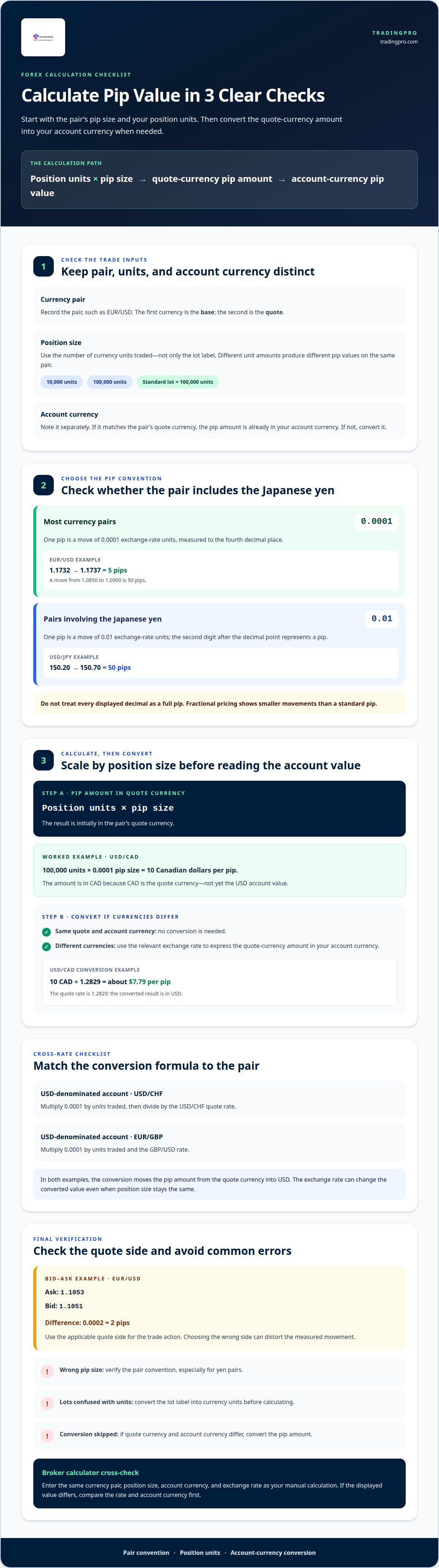
Your account currency determines the final pip value you need to assess a trade. To understand how to calculate pip value on currency pairs accurately, multiply the position size by the pair’s pip size, then convert that amount from the quote currency into your account currency. Most pairs use a pip size of 0.0001; pairs involving the Japanese yen typically use 0.01.
Pip value depends on more than the currency pair. Position size determines how much each pip movement affects the trade, while the exchange rate determines the value after conversion. Identify these inputs before using the result to plan or review a trade.
Learn how to identify the correct pip size, apply the formula to different position sizes, and convert the result into your account currency. The steps below help you calculate pip value before placing a trade.
Key Takeaways
- Identify the pair’s pip size first: most pairs use 0.0001, while pairs involving the Japanese yen typically use 0.01.
- Factor in trade size and the current exchange rate, since both affect the value of each pip.
- Convert pip value from the pair’s quote currency into your account currency to estimate its impact on your position.
- Use lot size to scale your calculation, from micro and mini lots to standard lots.
- Explore TradingPRO’s Rookie, Micro, Pro, and Scalp Accounts to find an account tier that aligns with your trading approach.
Currency pair, position size, and exchange rate inputs
Start with the currency pair, position size, account currency, and pip size. These inputs show how to calculate pip value on currency pairs accurately for a specific trade.
-
Gather Pair, Position, and Account Inputs
Record the currency pair, such as EUR/USD, and identify its base and quote currencies. The base currency comes first; the quote currency comes second. Note your position size in currency units, not only as a lot label. A 10,000-unit position and a 100,000-unit position produce different pip values on the same pair.
Note your account currency separately. If it matches the pair’s quote currency, the pip amount is already in your account currency. If not, you need to convert it. Keeping the pair, units traded, and account currency distinct helps prevent mixing the quote currency with your account denomination.
-
Identify the Pair’s Pip Size
Set the pip size according to the pair before calculating. Most forex pairs use 0.0001 exchange-rate units, measured to the fourth decimal place. For EUR/USD, a move from 1.1732 to 1.1737 represents five pips. Use the standard pip increment, rather than assuming every displayed decimal represents a full pip.
For pairs involving the Japanese yen, use 0.01 exchange-rate units. The second digit after the decimal point represents a pip in these pairs. For example, apply that convention to USD/JPY quotes. Using 0.0001 for a yen pair changes the calculation’s scale and leads to an incorrect pip count.
-
Account for Lot Size and Exchange Rates
Convert the lot label into currency units before calculating. A standard lot represents 100,000 units. For a USD-denominated account trading EUR/USD, multiply 0.0001 by the units traded. The result is in U.S. dollars because USD is the pair’s quote currency. A different position size changes the result proportionally.
When the quote currency differs from your account currency, convert the pip amount using the relevant exchange rate. Because the rate determines the converted value, it can change the result even when your position size stays the same. Keep the conversion inputs clear as you calculate pip value.
Bid and ask prices affect the rate used to open or close a trade. A EUR/USD ask of 1.1053 and bid of 1.1051 produce a 0.0002 spread, or two pips. Use the applicable quote side for the trade action; choosing the wrong side can distort the measured movement.
Common mistakes include using the wrong pip size, confusing lots with currency units, and skipping currency conversion. Don’t count an extra decimal place as a full pip: fractional pricing shows smaller movements than a standard pip.
Converting pip value to account base currency
Pip value is first calculated in the pair’s quote currency. To express it in your account currency, calculate the amount per pip, then convert it using the relevant exchange rate. Brokers may display pip value in your account currency, and that amount can change as the conversion rate changes.
- Calculate the pip amount in the quote currency. Multiply position units by the pair’s pip size. For a 100,000-unit USD/CAD trade, the pip size is 0.0001, so one pip equals 10 Canadian dollars. This initial calculation gives the value in CAD, the quote currency, rather than the USD account currency.
- Choose the conversion direction. If the quote currency is also your account currency, no conversion is needed. When it differs, use a rate that expresses the quote currency against the account currency. For USD/CAD at 1.2829, convert the 10 CAD pip amount into USD by dividing 10 by 1.2829. The result is about $7.79 per pip.
- Apply the right cross-rate formula. For a USD-denominated account trading USD/CHF, multiply 0.0001 by units traded, then divide by the USD/CHF quote rate. For EUR/GBP in a USD account, multiply 0.0001 by units traded and the GBP/USD rate. In both cases, the conversion step moves the amount from the quote currency into USD.
- Convert yen and other quote currencies before interpreting results. The stated example converts that amount to $7.54 per pip. The yen value is the intermediate result; the account-currency value is what lets you assess the position in dollar terms.
- Use matching inputs in a broker calculator. Enter the same currency pair, position size, account currency, and exchange rate used in your manual calculation. A calculator determines pip value from position size and pip size, then converts the result into the selected base currency. If the displayed amount differs, compare the rate and account currency first, rather than changing the pip-size formula. You can use the same inputs when setting up a trading account.
Pip definitions for most currency pairs
A pip is a standard unit for measuring a forex price change. Check the pair’s convention before counting movement, since the pip’s decimal place differs for yen pairs.
-
Define a Pip
Start by identifying the standard price increment used to measure movement in a currency pair. For most pairs, one pip equals 0.0001 exchange-rate units. A EUR/USD move from 1.0850 to 1.0900 is 50 pips, calculated by dividing the 0.0050 price difference by 0.0001.
Use the pip count to describe price movement, not the trade’s outcome by itself. A 50-pip rise benefits a long EUR/USD position, while a short position faces the opposite direction of movement. The pip unit stays consistent; the trader’s position determines whether that movement represents a gain or loss.
-
Distinguish Pip Definitions by Currency Pair
Check whether the pair includes the Japanese yen before counting its pips. For most non-yen pairs, the pip corresponds to a 0.0001 move. In yen pairs, one pip corresponds to 0.01 exchange-rate units. A USD/JPY move from 150.20 to 150.70 equals 50 pips, found by dividing 0.50 by 0.01.
Don’t apply the fourth-decimal convention to a yen pair. Doing so counts the price movement on the wrong scale. A broker may display extra decimal places, but that added precision does not change the pair’s standard pip definition.
- Separate pips from fractional pips. Some quotes display increments smaller than one full pip. A fractional pip, also called a pipette, equals one-tenth of a pip. Many forex brokers show fractional pricing by adding a fifth decimal place. For example, the final digit in a five-decimal quote may represent a pipette, not a full pip.
Identify the pair’s standard pip place first, then treat any extra digit as finer pricing. This separates the quote’s display precision from the unit used to report movement. A change of five pipettes equals half a pip, not five full pips.
- Count the price difference in the correct unit. Subtract the opening quote from the closing quote, then divide the absolute difference by the pair’s pip size. For a standard pair, a 0.0005 change equals five pips. For a yen pair, a 0.05 change also equals five pips.
Use the same convention when comparing price changes across pairs. A raw decimal difference alone can mislead because 0.05 represents different pip counts under the two conventions. Record the pair and its pip unit beside each calculation to keep trading notes consistent.
Pip value by standard, mini, and micro lot
Use the formula and position size to estimate how each pip movement affects the trade. The quote currency and any required conversion determine the final amount in your account currency.
-
Apply the Pip Value Formula
Calculate pip value by multiplying the pip size by the currency units traded. For pairs quoted in U.S. dollars, such as EUR/USD, this gives the pip value directly in dollars: 0.0001 × units traded. For other quote currencies, convert the result into your account currency using the relevant exchange rate.
Multiply the pip value by the number of pips moved to estimate the position’s gross gain or loss. Pip value is an amount per pip, not the trade’s total result. Consider the position’s direction: a favorable move may contribute to profit, while an adverse move may reduce it.
-
Compare Pip Value by Lot Size
Match your position size to its lot category. A micro lot is 1,000 currency units, a mini lot is 10,000 units, and a standard lot is 100,000 units. For pairs with USD as the quote currency, their pip values are $0.10, $1, and $10, respectively.
Scale the calculation proportionally. A larger lot generally means a greater monetary effect for the same pip movement, though the exact value depends on the pair and currency conversion. For a 20-pip move, those amounts become $200, $20, and $2. A 50-pip move corresponds to $500, $50, and $5.
- Check your units before using the result. A lot label can obscure the actual number of currency units in a position. Confirm whether your trade size is expressed in units or lots before multiplying. If you enter 10,000 units as though it were 10,000 lots, the calculation becomes far too large.
Check the quote currency, too. The standard, mini, and micro values above apply to pairs quoted in U.S. dollars. For other pairs, calculate the amount in the quote currency first, then convert it to your account currency. Exchange-rate changes can alter the converted value even if the position size stays the same.
- Use the result to size exposure. Compare the amount per pip with the planned price movement, rather than treating lot size alone as a measure of potential profit. For example, a 10-pip move affects a standard lot more than a micro lot because the position contains more currency units. The same relationship applies when the market moves against the position.
Record the pair, position size, pip value, and account currency together. This makes each estimate easier to interpret and helps distinguish changes caused by position size from changes caused by currency conversion.
What is a Forex Pip and How is it Defined?
Use a pip to measure a standard change in a forex exchange rate. Identify the pair’s convention before counting movement or interpreting a trade result.
- Read the pip as a price movement. A pip measures movement in a currency pair’s exchange rate, not the money gained or lost. For example, buying EUR/USD at 1.1835 and exiting at 1.1901 produces a 66-pip rise. The trade’s result in account currency also depends on position size and conversion.
Keep those measures distinct. The quote movement is expressed in pips; the resulting position gain or loss is expressed as money. A 66-pip move alone doesn’t tell you the cash outcome without the trade’s size and currency details.
- Use the pair’s standard decimal place. For most forex pairs, one pip is 0.0001 exchange-rate units. Count the movement by dividing the quote difference by 0.0001. This definition gives traders a consistent unit for describing price changes, even when different pairs have different exchange-rate levels.
For example, a 0.0066 rise in a standard pair equals 66 pips. Don’t confuse the number of decimal places displayed with the number of pips moved. The pip is a defined increment, while the quote simply shows the exchange rate at a chosen precision.
- Use the yen-pair convention. For currency pairs involving the Japanese yen, one pip is 0.01 exchange-rate units. Apply that unit when measuring a yen pair’s movement. A price change of 0.30 in USD/JPY corresponds to 30 pips under this convention.
Compare the unit, not just the raw decimal change. A 0.30 change represents a different pip count in a pair using 0.0001 as its pip size. Mark the pair’s convention before calculating, especially when reviewing trades across yen and non-yen currencies.
- Separate a pip from a pipette. A fractional pip, or pipette, is one-tenth of a pip. Many forex brokers display fractional pricing by adding a fifth decimal place to quotes. That extra digit shows finer price movement; it does not redefine the standard pip.
Read each quote from the pip place outward. If it includes a pipette digit, treat a change in that digit as one-tenth of a pip. This prevents you from counting a fractional price increment as a full pip when reviewing a trade.
- Apply the direction of the position. A pip count describes movement, while the position determines whether that movement is favorable. In USD/JPY, a short opened at 112.06 and closed at 112.09 loses three pips. If the same short closes at 112.01, it gains five pips.
Record the entry, exit, pair, direction, and pip count together. These details explain why the same price movement can affect buyers and sellers differently. They also help separate the quote’s movement from the position’s monetary result.
TradingPRO
After calculating pip value, position size, and currency conversion, compare those figures with your trading approach. TradingPRO offers Rookie, Micro, Pro, and Scalp Accounts for different trading styles. The right account tier depends on how you plan to trade and apply your calculations.
Use your pip-value calculation to assess potential exposure before choosing an account. A Micro Account may suit traders considering smaller position sizes, while the other tiers offer options for different approaches. Choosing an account does not replace calculating each trade’s pip value in your account currency.
To discuss which TradingPRO account fits your trading approach, contact TradingPRO.
Put Your Trading Process Into Practice
Knowing how to calculate pip value on currency pairs accurately gives you a way to assess exposure before a trade. Make the calculation part of your planning routine, alongside your trade objectives and position decisions. Using the same process for each setup gives you a clearer view of its potential impact.
TradingPRO offers Rookie, Micro, and Pro Accounts for traders considering different account options. Choose an account that aligns with your trading approach, then use your pip-value calculations to plan and review positions. Base each calculation on the inputs that matter for that trade.
For help taking your next step, contact TradingPRO. Build your confidence through informed decisions and keep moving forward with purpose.
Frequently Asked Questions
Why use the Forex Pip Calculator?
A Forex Pip Calculator converts trade details into a pip value in your chosen account currency. It can help you assess how a price movement may affect a position without repeating the calculation manually. Enter the pair, position size, and account currency, then interpret the result alongside your trade plan. It is particularly useful when switching between pairs with different quote currencies or comparing potential position sizes.
How much is a pip worth?
A pip’s monetary value depends on the pair, position size, exchange rate, and account currency. There isn’t one cash value for every trade. For example, a 100,000-unit USD/CAD position at 1.2829 has a pip value of about $7.79 in a USD account. If the position size or conversion rate changes, its value changes too, even if the pair’s pip increment stays the same.
What are pips and how do they work?
Pips describe exchange-rate movement, while pip value translates that movement into money for a specific position. Use pip distances to describe an entry-to-exit move or a planned stop or target. The pip count alone does not include other parts of a trade’s result, such as the spread. The pair’s convention determines how to count each movement.
What is a pip in Forex trading?
A pip is a standardized unit for describing a change in a forex quote. For most pairs, it represents a 0.0001 exchange-rate movement; for Japanese yen pairs, it represents 0.01. That unit measures price change, not dollars, euros, or another cash amount. To estimate the monetary effect in a trade, combine the pip movement with position size and any required currency conversion.
What is a pip?
A pip is a unit for expressing movement in a currency pair’s exchange rate. It is a measure, not a fixed cash amount: the pip count describes how far the quote moved, while pip value shows what that movement means for a particular position. The same pip movement can have different monetary effects on positions of different sizes.
How do you calculate pip value when the account currency is the quote currency?
Multiply the position’s currency units by the pair’s pip size. If your account currency matches the pair’s quote currency, the result is already in your account currency and needs no conversion. Scale the result to match your actual trade size.
How do you calculate pip value when the account currency is the base currency?
First calculate the pip amount in the pair’s quote currency, then convert it to the account’s base currency using the pair’s exchange rate. For a USD-denominated account trading USD/CHF, multiply 0.0001 by units traded, then divide by the USD/CHF quote rate. This conversion matters because the initial pip amount is in CHF, not USD, even though USD comes first in the pair.
How do you convert pip value when the account currency differs from both currencies in the pair?
Calculate the pip amount in the pair’s quote currency, then use a conversion rate connecting that currency to your account currency. For EUR/GBP in a USD account, multiply 0.0001 by units traded and the GBP/USD quote rate to express the value in USD. Keep the conversion direction consistent with the rate you use, and recalculate when that rate changes.


