




- Published on: 2026-11-07 18:17:53
How to build and test a strategy on a rookie trader roadmap

A strategy earns its place through evidence, not confidence. A rookie trader roadmap from month 1 to month 6 moves from market basics to building and backtesting a strategy, then to cautious testing and refinement. Develop the strategy with historical data in month 3, paper trade it in real time for 30 to 60 sessions before going live, and use later months to review and optimize your approach.
It’s tempting to treat a few winning trades as proof that a setup works. A journal, clear entry and exit rules, and consistent risk management provide a stronger basis for decisions. Economic indicators can also help you understand the conditions surrounding a trade.
Follow a practical sequence: shape your strategy, test it against historical and real-time market conditions, and record what each trade teaches you. Learn to use risk orders, assess performance, and avoid common beginner mistakes such as trading without a setup or changing your plan after every loss.
Key Takeaways
- Turn a trading idea into clear entry, exit, and risk rules before putting capital behind it.
- Use historical trades and a consistent journal to spot whether your strategy holds up across different market conditions.
- Read economic and company-specific signals in context so headlines don’t become stand-alone trade triggers.
- Use stop-loss and trailing stop orders as part of a defined plan, and review execution before changing position size.
- Choose a TradingPRO account that fits your stage and trading style, starting with the Rookie Account as you build your process.
Trading strategy development and real-money testing
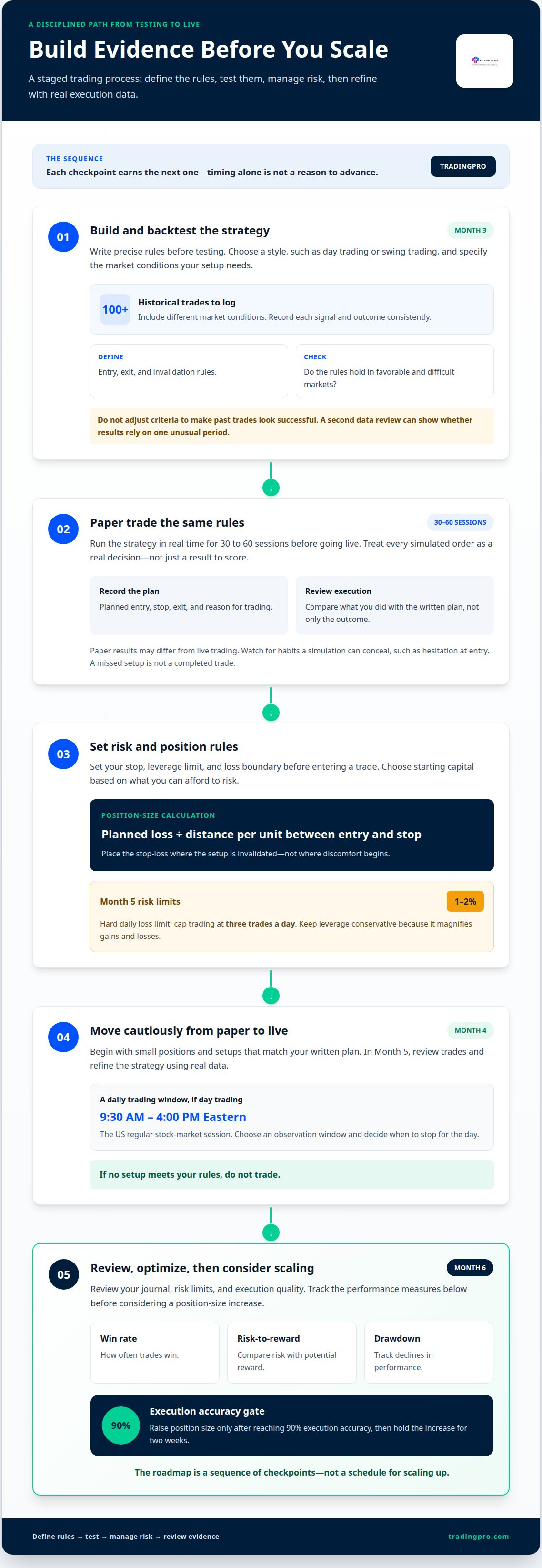
Use month 3 to build and backtest a strategy with historical data. Then paper trade it in real time for 30 to 60 sessions before going live. The rookie trader roadmap month 1 to month 6 provides a staged framework, not a deadline to rush through.
-
Build and Backtest a Trading Strategy
Write precise entry, exit, and invalidation rules before testing. Choose a style, such as day trading or swing trading, and define the market conditions your setup requires. Log at least 100 historical trades across different market conditions. Record each signal and outcome consistently. Check whether the rules hold in both favorable and difficult markets. Don’t adjust criteria to make past trades appear successful. A second pass through your data can reveal whether results depend on one unusual period.
-
Practice with Paper Trading
Run the same rules in a paper account for 30 to 60 sessions. Treat each simulated order as a real decision: note the planned entry, stop, exit, and reason for trading. Compare execution with your written plan, not just the outcome. Paper results can differ from live trading, so watch for habits that simulation may conceal, such as hesitating at entry. Don’t count a missed setup as a completed trade.
-
Set Risk and Position Rules
Choose starting capital based on what you can afford to risk. Calculate position size by dividing the planned loss by the per-unit distance between entry and stop. Place a stop-loss where the setup is invalidated, not where discomfort begins. Keep leverage conservative because it magnifies gains and losses. In month 5, set a hard daily loss limit of 1 to 2 percent and cap trading at three trades a day.
There’s no single starting-capital figure that suits every beginner. Position size depends on your planned loss and the distance to your stop. Set your stop, leverage limit, and daily loss boundary before entering a trade.
-
Move from Paper to Live Trading
Start cautiously in month 4, with small positions and setups that match your written plan. In month 5, review trades and refine the strategy using real data. Month 6 focuses on live trading and optimization. Track win rate, risk-to-reward ratio, and drawdown. Raise position size only after reaching 90% execution accuracy, then hold the increase for two weeks. Treat the rookie trader roadmap month 1 to month 6 as a sequence of checkpoints, not a reason to scale up on schedule.
As you prepare for a controlled live phase, review the account options alongside your trading plan.
- Set a day-trading schedule around the US regular stock-market session, which runs from 9:30 AM to 4:00 PM Eastern time. Choose an observation window and decide when you’ll stop for the day. If no setup meets your rules, don’t trade. In month 6, optimize only after reviewing your journal, risk limits, and execution quality.
Writing, backtesting, and journaling a strategy
Turn your trading rules and test results into a journal you can review. In the United States, short-term trading gains are taxed as ordinary income; the IRS wash sale rule disallows a loss when you rebuy a substantially identical security within 30 days.
-
Write the Strategy Rules
Write each rule in plain language before reviewing another chart. State the required market conditions, entry signal, exit trigger, and what invalidates the setup. For example, specify whether a price level must hold before entry. Keep rules observable so you can classify each trade as compliant or not. Avoid changing them midway through a test; record proposed changes separately.
-
Record Trades and Lessons
Log every trade in a journal, including the setup, planned entry and exit, and reason for acting. Note whether you followed the plan and what you felt before and after the decision. This helps you separate a sound process from a lucky outcome. An early exit may limit a loss, for example, but still break your written exit rule.
- Use one journal format throughout the learning process. For each trade, record the date, instrument, market context, setup name, and outcome. Add a chart or brief description of what you saw when you made the decision. Keep notes factual: “entered before confirmation” is more useful than “bad trade.” This detail reveals repeated execution errors without turning one loss into a new strategy.
- Review your journal on a regular schedule. Group trades by setup and compare rule-following, wins, losses, and risk-to-reward outcomes. Look for patterns across examples, not one dramatic result. If early exits repeatedly cut winning trades short, compare the exit rule with your recorded evidence. Don’t revise a playbook just to erase a losing day; record the proposed change and test it separately.
- Connect each journal review to one practical adjustment. You might add a condition to filter out a recurring weak setup or clarify an ambiguous entry rule. Keep the original version so you can distinguish tested rules from new ideas. On quiet market days, review past trades and refine your playbook instead of forcing an entry. The goal is measurable learning, not more activity.
- Keep trading records organized alongside account statements and transaction history. In the United States, the tax treatment of a sale and a later repurchase can affect how a loss is reported. The IRS wash sale rule concerns substantially identical securities bought within 30 days. Record dates, securities, and transactions accurately; don’t treat a trading journal alone as a substitute for tax records.
When your review habit is established, you can create a trading account as a next step in your learning process.
Fundamental analysis and economic indicators
Build context before choosing a trade. Month 2 focuses on technical analysis basics; month 5 adds fundamental analysis and news trading.
- Start with one asset type you can explain clearly. Stocks represent individual companies, while ETFs track a collection of assets. Options and futures have contract-specific mechanics, and forex involves currency pairs. Choose a market you can study, taking into account your strategy’s holding period and the risks you understand. Avoid switching among all five before you can compare their price behavior consistently.
- Use technical analysis to describe price action, not predict certainty. Begin with a chart’s trend, support and resistance areas, and trading volume. A 100-month simple moving average is one starting indicator for beginners. Treat it as a reference, then check whether price behavior and volume support your interpretation. Don’t add indicators simply because a chart looks more sophisticated.
- Treat chart patterns as setups you can test. For a breakout, define the relevant price level, what counts as confirmation, and where the idea becomes invalid. Then review historical examples and compare similar conditions. A pattern name alone isn’t a strategy. Link the chart signal to a clear decision rule, and don’t treat one successful example as proof.
- Add economic and company context before taking a position. Note relevant economic indicators, scheduled news, and company developments, then ask how each could affect the asset you’re studying. Month 5 is the roadmap’s point for fundamental analysis and news trading. Separate the event itself from your interpretation, and don’t assume every headline creates a tradeable move.
- Compare sectors and industries before narrowing your stock selection. Sector and industry conditions can help explain a stock’s price movement, but they are only part of the picture. For swing or position trading, assess relative strength, institutional flow, and upcoming catalysts. These factors help frame a stock’s context; they don’t replace evaluating the company or defining your entry.
- Combine the signals in a written checklist. Record the broader market condition, relevant sector or industry, chart setup, and any economic event that could change your view. For example, a bullish chart pattern may call for caution if its industry is weakening. Keep the checklist stable while you learn so each decision has a consistent basis for review.
- Choose instruments whose mechanics fit your knowledge and strategy. Start with a market you can follow and explain, then study how its price, trading hours, and contract structure affect your plan. Stocks or ETFs may suit a different approach from options, forex, or futures. Don’t choose an instrument solely because a recent move looks exciting.
Stop-loss and trailing stop orders
Plan exit orders before opening a position. A stop-loss can limit exposure when a setup fails, while a trailing stop can help protect gains as the price moves favorably.
-
Set Stop-Loss Orders
Place a stop-loss at the level where your trade idea no longer holds. If support is central to a long setup, for example, place the stop beyond the point that invalidates your reasoning. Choose the level before entry, then size the position around the planned loss. Don’t move the stop farther away just to avoid accepting a loss.
- Match each stop to the setup, not to your discomfort. A stop placed too close to ordinary price movement may exit a valid trade; one placed too far away can increase the planned loss. Review the chart structure alongside the trade’s invalidation point. Record why you chose the level so your journal can show whether the order followed your rules.
- Keep stop-loss and take-profit orders distinct. A stop-loss defines where you exit if the trade moves against your plan. A take-profit order sets a planned exit when the price reaches a favorable target. For a long position, these levels sit on opposite sides of the entry. Define both before entering, and make sure the target fits your strategy rather than a sudden hope for extra gains.
-
Use Trailing Stop Orders
Use a trailing stop when your plan calls for the exit level to follow favorable price movement. As the price advances, the stop can adjust according to its configured distance or method; if the price reverses, it can trigger an exit. Set the distance to suit the strategy’s normal movement. A tight trail may close the trade early, while a wider one leaves more room.
- Decide how the trailing stop should behave before placing it. A swing-trading plan, for example, may need more room for routine pullbacks than a short-term setup. Check whether the stop follows a fixed distance or a chart-based rule, then apply the same method consistently. Don’t widen a trailing stop after a reversal just to keep a losing position open.
- Review execution after every stopped trade. Note whether the stop matched your original plan, whether the price reached the invalidation point, and whether a take-profit exit would have fit better. Stops are a safety net, not a promise of a specific exit price in every market condition. Keep the order logic consistent, then use evidence from your journal to refine the next version of your plan.
Common reasons new traders fail
Most people who open a day-trading account quit within a year. Treat that risk as a reason to build a repeatable process, not to chase fast results.
- Protect your account before pursuing returns. Poor risk management is described as the first silent killer of trading accounts. It can begin with oversized positions, ignored stops, or repeated trades after losses. Review the potential loss before entry, then ask whether the trade still fits your plan. If the answer depends on hope, skip the setup.
- Stop trading when your setup isn’t present. A quiet session can tempt beginners to invent signals from ordinary price movement. Don’t turn a small fluctuation into a breakout, for example, unless your written conditions are met. Waiting is an active decision. Record why you stayed out, then review whether the market later met your criteria.
- Don’t confuse a winning trade with a sound decision. A profitable entry can still break your rules, while a planned trade can lose. Mark each journal entry as compliant or noncompliant, then assess the process separately from the outcome. This distinction helps prevent a lucky result from becoming a bad habit in your next session.
- Keep your strategy stable long enough to evaluate it. Changing indicators after every loss makes it difficult to learn which rules matter. When you spot a possible flaw, record the change as a new version instead of editing the active plan mid-test. Compare versions using the same criteria, and note the market conditions behind each result.
- Use a daily stop point to interrupt emotional trading. The month-five roadmap sets a hard daily loss limit of 1 to 2 percent and recommends a maximum of three trades a day. Treat these as firm boundaries, not targets. Once the limit is reached, close the session and review decisions later, when pressure no longer drives the next order.
- Measure execution, not just profit. Track win rate, risk-to-reward ratio, and drawdown together; a strong win rate can hide losses that outweigh gains. During month 6, the roadmap calls for at least 90% execution accuracy before raising position size. If your journal shows missed rules, keep the size steady and address the specific execution error first.
- Build a routine that survives slow progress. Use the six-month roadmap to separate learning, testing, cautious live trading, and review. On a slow day, revisit one trade, identify one rule you followed or broke, and update your playbook only when evidence supports it. Start building a more disciplined trading routine by creating your trading account.
TradingPRO: Rookie Account
TradingPRO’s Rookie Account is a practical next step when you’re ready to apply a developing trading plan in an account environment. Choose an account that fits your current experience and intended trading style, rather than expecting it to improve your results.
As your approach evolves, TradingPRO also offers Micro, Pro, and Scalp Accounts. Consider how each account tier fits your plans and which one aligns with your next stage. Keep your strategy rules and risk limits central to the decision.
Have questions about the Rookie Account or other account options? Contact TradingPRO to discuss your next step.
Make your next trading decision deliberate
The next stage isn’t about finding more signals. It’s about building a repeatable decision process and improving it as you learn. Use the rookie trader roadmap from month 1 to month 6 as a framework, then keep adapting your plan to what your journal and execution reveal. Treat each trade as feedback, not a verdict on your potential.
Choose an account that matches your current approach. TradingPRO offers Rookie, Micro, and Pro Accounts, giving you options to consider as your trading develops. Keep your goals, strategy, and risk rules at the center of your decision.
Ready to take a considered next step? Explore registration with TradingPRO and continue building your trading routine with focus and discipline.
Frequently Asked Questions
What should a beginner trader learn in month 1 before risking money?
Learn how orders work, what moves prices, and how to read a basic chart before risking money. Practice identifying trends, support, resistance, and volume using one market watchlist. Write down why a price level matters, for example, then observe whether the price reacts there. Also learn the difference between market and limit orders, and how each can affect trade execution.
What is a realistic month-by-month trading roadmap for months 1 through 6?
A practical six-month plan starts with market basics in month 1, then adds technical analysis in month 2. Month 3 focuses on risk management, psychology, and strategy testing. Month 4 introduces cautious real-market exposure; month 5 adds fundamental analysis and reviews live-trade data. Month 6 is for optimization and diversification. Treat these stages as a progression, not a deadline that guarantees readiness.
How can beginners practice trading with paper trading, and when should they go live?
Practice by placing simulated trades in real time and recording the reasons for each decision. Follow the same entry, exit, and risk rules you intend to use with live trades. The roadmap recommends 30 to 60 sessions before going live. Use that period to identify execution mistakes, such as entering late or skipping a planned exit. Move forward only when your process is consistent.
What trading strategies and technical-analysis basics are appropriate for beginners to learn first?
Start with one straightforward setup, such as a trend continuation or breakout, and define its conditions before testing it. Learn to read price action, volume, support, and resistance without layering on many indicators. A moving average can help frame a trend, but it shouldn’t be a trade signal by itself. Choose a strategy that fits your available screen time and preferred holding period.
What are common beginner trading mistakes, scams, and warning signs to avoid?
Avoid trading out of urgency, copying a signal without understanding its logic, or increasing exposure to recover a loss. Be cautious of claims promising guaranteed profits, pressure to deposit quickly, or requests for account credentials. These are warning signs, not proof of any particular scheme. Keep control of your decisions, use a written plan, and step away when you can’t explain the trade’s risk and exit.
How should a beginner measure progress and decide whether to continue, pause, or change strategy after six months?
Review a sample of trades for rule-following, drawdown, win rate, and risk-to-reward, then compare results across similar setups. Continue testing if your execution is consistent but the strategy still needs clearer evidence. Pause live trading if you repeatedly break risk rules or emotional pressure is driving entries. Change one strategy rule at a time, document why, and test the revised version separately before relying on it.


