




- Published on: 2026-10-24 02:16:15
High watermark in performance fees: How charges are calculated

A manager shouldn’t earn a performance fee twice on the same gains. A high watermark in performance fees sets the previous peak value as the threshold: fees apply only to net gains above it, not to a recovery from losses. For example, at a 25% fee rate, a USD 1,000 profit produces a USD 250 fee, but a later loss can mean the account must regain lost value before another fee is due.
That distinction matters. A performance fee may be calculated as a percentage of profit, but how losses and recoveries are treated determines whether the fee reflects new gains or merely a return to an earlier peak.
Learn how the calculation works across periods, how a high watermark can protect investors as losses are recovered, and where the method has limits. These examples clarify the fee mechanics and show how the watermark is intended to align investor and manager interests.
Key Takeaways
- Use the prior peak as the fee threshold: a manager earns a performance fee on net new gains, not simply on a rebound from losses.
- Follow the calculation across periods to see how profits, losses, and outstanding fees affect what may be charged next.
- For a new investor entering during a fee period, the initial high watermark is generally the value of the initial investment.
- Understand how any stated reset or rolling-window provisions can change the treatment of a drawdown over time.
- Compare the fee method with the account’s profit-and-loss record to understand how it supports alignment between investors and managers.
High-water-mark example calculations
A high-water mark sets the account value that must be exceeded before performance fees can apply to new gains. Follow an account across three periods to see how profits, losses, and fee accounting interact.
Calculating Performance Fees
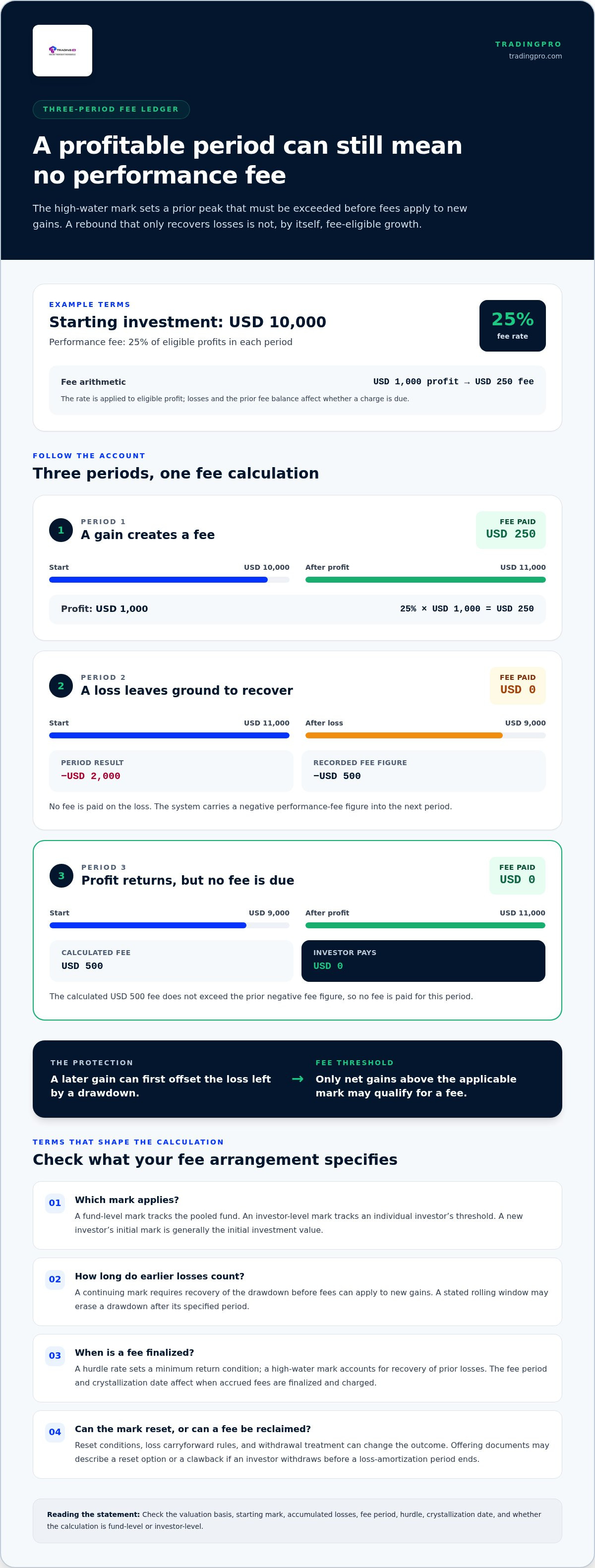
A performance-fee calculation applies the agreed fee rate to eligible profits above the high-water mark. In this example, an investor deposits USD 10,000 on the first day of Period 1, and the performance fee is 25% of profits for each period.
Period 1 starts at USD 10,000 and earns USD 1,000. The USD 250 fee is 25% of that profit. The account then starts Period 2 at USD 11,000 and loses USD 2,000. No fee is paid on the loss; the system records a negative performance-fee figure of USD 500.
Period 3 starts at USD 9,000 and earns USD 2,000. The calculated fee is USD 500, but it doesn't exceed the prior negative fee, so the investor pays no fee for that period. This accounting distinction helps show why a profitable period doesn't always trigger a charge.
Fund-Level and Investor-Level Marks
A fund-level mark tracks the pooled fund’s performance, while an investor-level mark tracks the threshold for an individual investor’s holdings. This distinction matters when investors enter or leave at different times, since their investment values and prior gains may differ.
For a new hedge-fund investor joining during a performance-fee period, the initial high watermark is generally equal to the initial investment value. A fund-wide peak may differ from that investor’s entry value. Investor-level accounting can tie the fee threshold to each investor’s starting point, while fund-level accounting applies the calculation to the pool.
Use the account statement’s valuation basis to identify which mark applies. For example, a fund may recover above its previous pooled peak while a later investor’s holdings have not grown beyond their entry value. The relevant calculation depends on the fee arrangement and the investor’s recorded starting value.
Accounting for Gains, Losses, and Fee Timing
Gains can raise a high-water mark, while losses reduce account value and leave ground to recover. This matters alongside a hurdle rate, which sets a return threshold, and crystallization, which determines when accrued fees are finalized and charged.
The mark and hurdle rate serve different purposes: the mark accounts for recovery of prior losses, while the hurdle rate sets a minimum return condition. Where both apply, performance must meet the relevant terms before a fee crystallizes. The fee period and crystallization date therefore affect when the calculation becomes payable.
Some fee systems measure performance from the first weekend of one month to the first weekend of the next. Another described industry-standard method compares end-of-month profit with the previous month’s profit and charges no performance fee when the comparison is negative. The period, valuation point, hurdle, and fee rate together determine the calculation.
Investor protections against fees on recovered losses
A high-water mark limits performance fees to net increases in asset value. After a decline, later gains first restore lost value; only gains above the applicable threshold may qualify for a fee. This separates new growth from recovery.
Look-back periods determine how long earlier losses remain relevant. With a continuing mark, the manager must recover the drawdown before charging fees on new gains. Some arrangements instead use a rolling window that erases a drawdown after the specified period. This changes how much recovery is needed before fees can apply.
For example, if an account falls below its previous peak, a profitable period may still leave its value under that peak. The gain then offsets the outstanding loss rather than creating fee-eligible growth. In the example calculation, the Period 2 loss produces no investor performance-fee payment, and the Period 3 profit still doesn’t trigger a fee because its calculated USD 500 fee doesn’t exceed the prior negative fee.
Setting the mark matters when an investor joins after a fund has already experienced losses. A new hedge-fund investor entering during a performance-fee period generally starts with a high watermark equal to the initial investment value. This gives the investor an individual reference point rather than automatically assigning the fund’s earlier losses to them. The fund documents explain how entry timing and account valuation affect that starting mark.
Provisions that reset the mark or shorten the loss-recovery window can allow fees after a drawdown, even without full recovery to the earlier peak. A reset to zero may apply if that option is stated in the offering documents before investment. An investor who withdraws before a loss-amortization period ends could also face a clawback, so withdrawal timing and fee terms matter.
Read the offering documents for the mark’s starting value, loss carryforward method, reset conditions, rolling-window length, fee period, crystallization date, and withdrawal treatment. Check whether the calculation is fund-level or investor-level, and how gains are offset against accumulated losses. These terms show when recovered value becomes eligible for a fee and whether a previously withheld amount can later be reclaimed.
Once you understand the fee mechanics, use that clarity to shape your broader trading approach. You can begin account registration when you’re ready to take the next step.
Adding a high watermark mid-period
Adding capital or withdrawing funds changes the account balance, but that movement is not investment performance. A mid-period calculation must distinguish deposits and redemptions from gains and losses. Otherwise, a deposit could appear to create a new peak, or a withdrawal could make an unchanged portfolio appear to have lost value.
A high-water mark does not automatically reset when an investor withdraws or adds capital. The fund’s accounting method and offering documents determine how the mark is adjusted, including whether each contribution is tracked separately or included in a revised investor-level calculation.
For a new investor entering during a performance-fee period, the initial high watermark is generally equal to the initial investment value. This starting point separates the new investor’s results from gains or losses recorded before entry. For existing investors adding capital, the calculation must distinguish the contribution from investment returns, so only eligible gains count toward a higher mark.
Consider a mid-period deposit. It immediately increases account value, but it is not a gain earned by the manager. The accounting method may track the additional capital as a separate tranche with its own starting value, or adjust the investor’s balance and mark together. The governing documents define which approach applies and how fees are allocated.
A withdrawal also requires consistent treatment. Reducing the account balance should not automatically erase a prior loss or create a new performance peak. The calculation must account for the amount withdrawn and the applicable investor-level mark. An investor who leaves before a loss-amortization period ends could face a clawback, making withdrawal timing relevant to the final fee accounting.
Timing adds another layer. Performance fees may be measured from the first weekend of one month to the first weekend of the next, while rolling high-watermark periods may suit funds with monthly or quarterly fee periods. A contribution or withdrawal near a valuation date can affect the balance used for that period, so the documented valuation point and transaction treatment matter.
Before investing, read the offering documents for the mark’s starting value, treatment of subscriptions and withdrawals, valuation dates, and fee crystallization. Identify any reset clause as well: a reset to zero applies only if the option is stated in the offering documents before investment. A separate provision may erase a drawdown after a specified rolling window. These terms show whether a mid-period change adjusts the investor’s calculation or changes the loss-recovery threshold itself.
Advantages for investor-manager alignment
A high-water mark is designed to prevent a hedge-fund manager from charging performance fees more than once on the same gains. It links compensation to value created above the investor’s previous peak, rather than to each profitable period in isolation. For investors, this clarifies the fee basis. For managers, it ties fee eligibility to recovery and continued performance.
Consider a portfolio that rises, falls, and then recovers. Without a continuing mark, a manager could earn a fee on the recovery even if the investor has not regained the earlier account value. With the mark in place, recovery first closes the gap. New fee eligibility begins only after the account exceeds its previous threshold, subject to the fund’s other terms.
This structure can help align incentives in three practical ways:
- Shared focus on net value: The investor’s account value matters, not just whether the latest reporting period ended with a gain.
- Loss recovery remains visible: A manager’s compensation calculation reflects the path from the previous peak through a drawdown and recovery.
- Fee terms become testable: An investor can compare the account’s valuation, prior mark, and fee calculation for the relevant period.
Alignment still depends on the full fee design. A hurdle rate, if included, sets a separate return threshold; crystallization determines when accrued fees are finalized. For example, an account may exceed its previous mark but fail to meet a hurdle, or satisfy both conditions before fees crystallize. Investors need to understand how these conditions interact, rather than treating the watermark as the entire compensation formula.
The arrangement has limits. A mark can reduce repeat charges on recovered gains, but it does not remove investment risk or ensure that a manager’s decisions match every investor’s goals. A rolling loss window or a stated reset can change how prior losses affect future fee eligibility. These provisions shape incentives by determining how long a manager must recover a drawdown before fees can resume.
William N. Goetzmann of Yale School of Management states in an academic paper that high-water-mark provisions limit the value of performance fees. This highlights the trade-off: managers may receive less compensation when recovery takes time, while investors gain protection against being charged twice on the same gains. A clear agreement makes that trade-off visible before investment.
To assess alignment, trace a complete account history: the initial value, any previous peak, the drawdown, the subsequent recovery, hurdle terms, and the crystallization point. Then compare the resulting fee with the fund’s stated method. This shows whether the high watermark in performance fees tracks net new growth or allows a reset that changes the incentive structure.
Performance fees based on percentage of profit and loss
A percentage-based performance fee turns eligible profit into manager compensation, while losses can suspend payment and affect later calculations. The key is identifying which profit qualifies: a profitable period alone does not mean the account has exceeded its previous high-water mark. Read the method as a running calculation, not as a fee applied separately to every gain.
In the example used earlier, the performance fee is 25% of profits for each period. A USD 1,000 gain produces a USD 250 fee before considering the effect of later losses. If the account moves into loss, the system records a negative performance-fee figure and pays no fee to the fund manager. The running position matters because that negative amount can offset a later fee calculation.
Follow the calculation in sequence:
- Identify the account’s profit or loss for the period and the applicable high-water mark.
- Determine whether the gain represents net new value above the mark, rather than recovery of an earlier decline.
- Apply the agreed percentage only to eligible profit, then account for any outstanding negative performance-fee figure.
- Establish when the amount crystallizes and becomes payable under the fee arrangement.
This approach separates the headline percentage from the actual charge. A 25% rate applied to a period’s gross profit can suggest one amount, but losses, previous fee balances, a hurdle rate, and crystallization terms can change what is payable. The high watermark in performance fees therefore affects the profit base, not merely the stated percentage.
There isn’t one rate or high-water-mark term that describes every U.S. fund. The examples here use a 25% fee rate and a separate 5/15 performance-fee arrangement; each fund’s documents define its own rate, calculation base, mark, and timing. Treat those examples as distinct structures, not as a universal market rule.
A fund example shows how the rate and profit base interact: a 5/15 performance fee reduces the investor’s net return by about 1 percentage point. In that example, a 6.4% excess return produces a 0.96% fee calculation. The figures illustrate why investors should distinguish the fee rate from the return eligible for charging.
Compare the account’s profit-and-loss record with its mark, any accumulated negative fee, and the stated crystallization point. That comparison reveals whether a calculation charges on recovered losses or only on net new gains. Register to take your next trading step with a clearer view of how performance and account decisions connect.
For example, a USD 10,000 loss followed by a USD 25,000 profit leaves an overall profit of USD 15,000. The system captures profit and calculates outstanding performance fees after each closed trade, so the sequence of closed trades informs the running balance.
If some profit is captured in open trades, the performance fee paid is the difference between the outstanding fee and the fee captured in those trades. This distinction helps reconcile the calculated amount with the amount actually paid.
TradingPRO: Rookie Account
TradingPRO’s Rookie Account is an option for readers ready to explore trading after learning how performance fees and high-water marks work. A fund’s performance-fee terms are separate from a brokerage account, so do not assume the same fee calculation applies to both.
Consider the Rookie Account as you decide how to approach trading. TradingPRO also offers Micro, Pro, and Scalp Accounts, giving you options to explore as your approach develops. First consider which trading style and account structure fit your goals, then review the relevant terms before deciding.
To learn more about TradingPRO’s account options, visit tradingpro.com.
Make your next move with clarity
Use your understanding of the high watermark in performance fees to ask clearer questions about how investment returns are measured and how compensation relates to performance. Then distinguish that fund-fee arrangement from your own trading decisions: brokerage account options serve a different purpose, so assess each on its own terms.
TradingPRO offers Rookie, Micro, and Pro Accounts. Consider which account fits your approach to trading, and review its terms before deciding. Matching your approach to an account can help you move forward with focus, without confusing a fund’s fee formula with a brokerage account’s structure.
Take the next step at your pace. Explore account registration with TradingPRO and choose a path that supports your trading goals. Build from a clear understanding, make deliberate decisions, and keep moving toward your next milestone.
Frequently Asked Questions
What is a high-water mark in performance fees?
A high-water mark is the highest account value used as a reference when assessing performance fees. It helps distinguish newly generated gains from value the account has already reached. For example, if a portfolio rises above its recorded peak, the amount above that level may qualify for a performance fee, depending on the fund’s terms. Investors can use the mark to understand how account history affects the calculation.
How does a high-water mark affect hedge fund or investment fund fees?
A high watermark in performance fees affects which part of a fund’s return enters its fee calculation. If an account remains below its previous threshold, positive results may still represent recovery rather than chargeable growth. Once it exceeds the threshold, the fund’s fee rate, any hurdle, and crystallization schedule determine how the eligible amount is handled. Reviewing these terms together clarifies when a fee accrues and when it is finalized.
What happens to performance fees after a fund loses money and later recovers?
After a loss, recovery generally goes toward rebuilding account value to its previous high-water mark before fees apply to further gains. The high watermark in performance fees calculation may change if the fund’s documents allow a reset or rolling loss window. For example, an investor considering a withdrawal near a fee date should review any remaining loss-recovery balance and possible clawback terms before interpreting the final account statement.


