




- Published on: 2026-11-25 18:01:25
Emotional reset techniques after a losing trade to regain focus

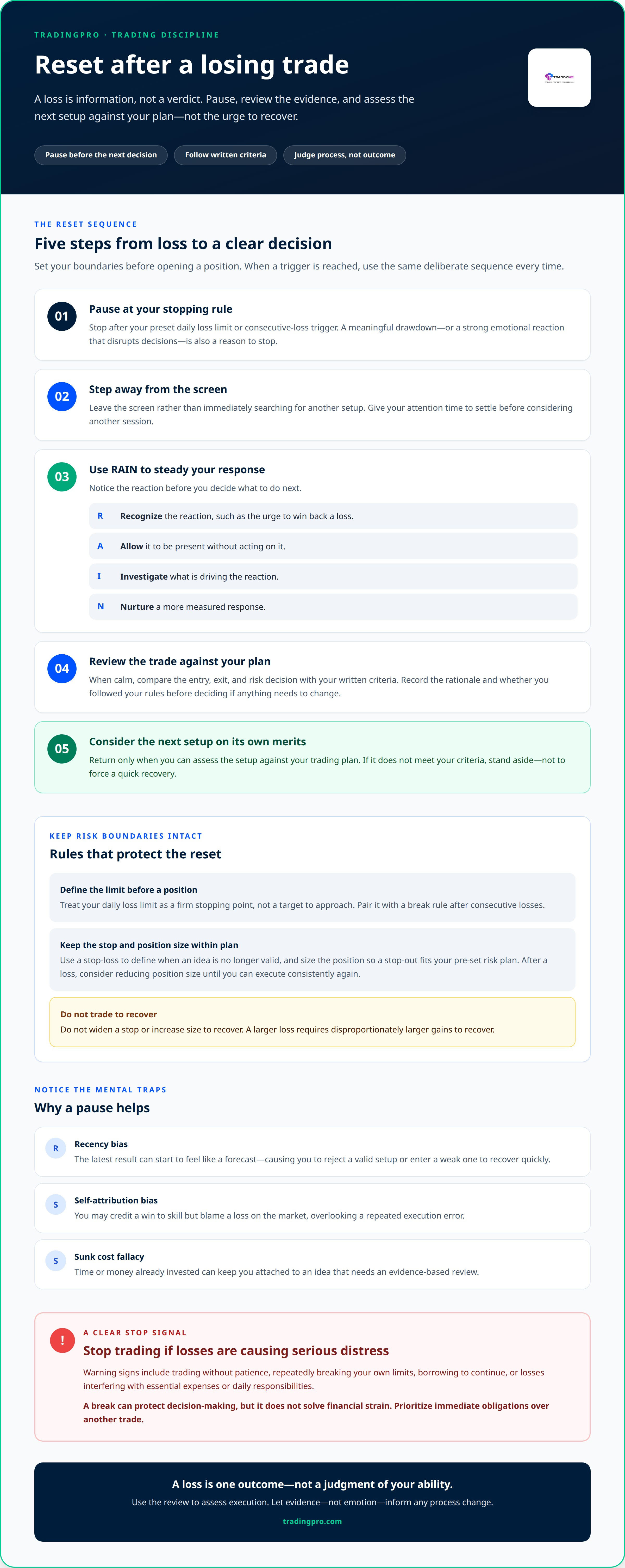
A losing trade is information, not a verdict on your ability. Effective emotional reset techniques after a losing trade begin with a clear rule: pause when a meaningful drawdown or strong emotional reaction disrupts your decisions, then step away from the screen. Return only when you can assess the next setup against your trading plan, not the urge to recover.
It’s natural to feel frustrated or question your strategy after a loss. But reacting to the latest result can lead to rushed entries, hesitation on valid setups, or trades that don’t meet your criteria. A deliberate reset gives you space to separate the outcome from your judgment as a trader.
Learn how loss limits and planned breaks can interrupt reactive decisions, how consistent execution can rebuild confidence, and how reviewing your process can turn a losing trade into useful feedback. The goal isn’t to avoid every loss. It’s to protect your focus and assess the next decision on its own merits.
Key Takeaways
- Set a personal stopping rule for drawdowns and step away when emotion starts steering your decisions.
- Separate a trade’s outcome from your identity so one loss doesn’t dictate how you approach the next setup.
- Rebuild confidence by focusing on consistent execution, not on forcing a quick recovery.
- Review whether you followed your criteria before deciding a losing trade calls for a change.
- Use a journal to spot emotional or situational patterns that may be affecting your trading decisions.
Daily loss limits and mandatory breaks
Set a daily loss limit before opening a position. Treat it as a firm stopping point, not a target to approach. Pair it with a break rule after consecutive losses. These boundaries reduce the need to rely on judgment when frustration starts affecting your decisions. A meaningful drawdown is also a reason to stop, step away from the screen, and let your attention settle before considering another session.
Losses can trigger recency bias: the latest result starts to feel like a forecast. After a losing trade, you might reject a valid setup because you expect another loss, or enter a weak one to recover quickly. Self-attribution bias creates another trap. You may credit a win to skill but blame a loss on the market, overlooking a repeated execution error. The sunk cost fallacy can keep you attached to an idea simply because you’ve invested time or money in it.
To review a losing trade without revenge trading, wait until you’re calm, then compare the entry, exit, and risk decision with your written criteria. Record whether you followed the plan before deciding if anything needs to change.
- Pause: Stop after your preset loss limit or a consecutive-loss trigger.
- Step away: Leave the screen rather than searching immediately for another setup.
- Review: Write down the trade rationale and whether it matched your rules.
These steps keep the review focused on evidence, not recovery. The RAIN method offers another way to pause: Recognize the reaction, Allow it to be present, Investigate what is driving it, and Nurture a more measured response. For example, recognize the urge to win back a loss, then check whether the next setup meets your criteria. If it doesn’t, stand aside.
Use a stop-loss to define when a trade idea is no longer valid, and size the position so a stop-out fits your pre-set risk plan. After a loss, consider reducing position size until you can execute consistently again. Don’t widen a stop or increase size to recover; that can deepen a drawdown, especially because recovering a large loss requires disproportionately larger gains.
Signs that losses are causing serious emotional or financial distress include trading without patience, repeatedly breaking your own limits, borrowing to continue, or finding that losses interfere with essential expenses or daily responsibilities. Stop trading when these signs appear. A break can protect decision-making, but it doesn’t solve financial strain. Prioritize immediate obligations over another trade.
Separating trading outcomes from personal identity
A losing trade describes an outcome, not your character. Keep those judgments separate. “This position closed at a loss” is specific. “I’m a bad trader” turns one result into a claim about your overall ability. That leap can make the next decision harder. You may hesitate on a valid setup or manage an open trade excessively out of fear.
Use a process check to distinguish execution from outcome. Ask whether the setup met your criteria, whether your entry followed your plan, and whether you managed the position as intended. A trade that met your rules and was executed properly remains one result in a series. A loss alone doesn’t prove the process was flawed.
Consider a trader who enters after clear confirmation, uses the planned exit, and still loses. The outcome is negative, but the decision may have been sound. Compare that with a profitable trade entered impulsively and outside the plan. The gain doesn’t make the execution disciplined. Judge each decision by its evidence, not its final result.
Short-term detachment means letting a single outcome stand on its own. Don’t let the last trade rewrite your view of every setup. Recency bias can make a loss feel predictive, leading you to avoid a valid entry or force a recovery trade. Return to the current market evidence and your established criteria instead.
Change the language you use during review. Replace “I failed” with “I moved my exit before the planned condition.” Replace “I’m a natural” after a win with “I followed my entry rules.” These descriptions identify observable actions and make improvement clearer: adjust the decision process when the evidence supports it, not your identity after each result.
To reinforce the distinction, separate your review into two parts:
- Outcome: Record whether the trade won or lost.
- Execution: Note which planned actions you followed or changed.
- Next decision: Identify one process adjustment, only if the review supports it.
Patience and emotional regulation develop through repeated decisions, not a single winning trade. If a loss affects your mood for days, notice how closely your confidence tracks results. Recenter on controllable actions, such as waiting for confirmation and following the exit plan. If a structured trading environment supports your next step, set up your trading access while keeping your process in control.
Building confidence through process
Confidence becomes steadier when it rests on repeatable decisions. A winning trade can feel validating, but it doesn’t prove every choice was sound. A losing trade can feel discouraging, but it doesn’t invalidate a sound plan. Track what you control: setup quality, entry conditions, risk, and execution. That record gives confidence a stronger basis than the latest result.
Start with a written setup definition. Specify the market conditions that must appear before entry. For example, require a trend signal and clear confirmation rather than entering because the price moved quickly. Then define the exit condition before placing the trade. Clear confirmation and structured entries can make outcomes easier to accept, though they don’t eliminate losses.
After a loss, avoid changing several rules at once. First, identify whether you followed your existing criteria. If you did, record the trade as one outcome in a process that can produce both wins and losses. If you deviated, name the exact action, such as entering before confirmation. A precise note points to a useful adjustment without turning frustration into a complete strategy rewrite.
- Before entry: State the setup and confirmation you need.
- During the trade: Follow the planned management and exit conditions.
- After exit: Record the outcome separately from rule adherence.
Position size can affect the emotional pressure a trade carries. If a loss makes you rush, freeze, or abandon your plan, temporarily reduce your size. Use the smaller exposure to practise executing your criteria consistently. The goal isn’t to erase the loss quickly. It’s to make decisions without letting the potential result overwhelm the process.
Build confidence from evidence of execution. Review your notes for repeated examples of waiting for confirmation, respecting exits, and avoiding impulsive entries. A single trade offers limited evidence. A pattern of following your process gives you a more useful basis for evaluating performance. Focus the review on behaviors you can repeat, not a promise of a particular result.
Notice how long a loss affects your mood. If one trade disrupts your confidence for days, results may be carrying too much weight. Return to your written criteria before assessing another setup. Emotional reset techniques after a losing trade work best when they reconnect you with decisions you can control, rather than asking you to feel confident on command.
Temporarily reducing position size after a loss can ease emotional pressure while you rebuild confidence through consistent execution. Keep the smaller size as you practise following the same setup, confirmation, and exit criteria. The aim is steadier decisions, not a quick recovery. When execution becomes consistent, confidence can rest on evidence of how you traded rather than the latest outcome.
If one trade continues to affect your mood for days, your confidence may be too closely tied to results. Give yourself time to return to your written criteria before judging another opportunity. Focus your review on whether you followed the plan and what actions you can repeat. That way, you approach the next decision as part of a process, not as an attempt to repair how the last result felt.
Evaluating execution rather than judging ability
A losing trade needs a review, not a verdict. Start with the plan you had before entry. Check whether the setup qualified, your entry matched its trigger, and your exit followed the rule. Then separate those decisions from the final result. A properly executed trade can lose; a profitable trade can still reveal poor execution.
A trading journal makes this review concrete. Record the setup, entry reason, exit, rule adherence, emotional state, confidence, and external stress. For example, note whether poor sleep or a tense workday affected your patience. Comparing these details across trades can reveal patterns that a chart alone won’t show.
Use a consistent format for every trade. Write what you expected, what happened, and what you controlled. If you entered before confirmation, record that specific deviation. If you followed your plan but the price moved against you, record that too. This helps distinguish a process issue from an ordinary losing outcome.
- Setup: Did the trade meet your written criteria?
- Execution: Did your entry, management, and exit follow the plan?
- State: What emotions, confidence level, or outside pressures were present?
- Adjustment: What single change does the evidence support?
Review your journal for recurring connections, not isolated details. For instance, several entries may show rushed trades after interrupted sleep. Another pattern might show confidence dropping after losses, followed by hesitation on valid setups. These observations can help identify conditions that precede mistakes, but they don’t prove that one factor caused every result.
Before changing a strategy, ask whether the loss came from breaking a rule or from a trade that met your criteria. Change a rule only when your review points to a repeatable weakness. If you followed the process, make that distinction clear in your notes. One losing trade isn’t enough to define your ability or justify rebuilding the entire plan.
Keep your review factual. Replace “I can’t trade” with “I entered before my confirmation appeared.” Replace “the market always traps me” with the specific price action you observed. Clear language narrows the next improvement to something actionable. It also prevents self-judgment from obscuring an execution problem your journal can reveal.
Review your notes at a regular point, rather than changing course in the heat of a loss. Look for repeated deviations, emotional triggers, and decisions that matched your rules. A journal turns those details into a record you can assess. Use it to refine your execution while treating each trade as evidence, not a measure of personal worth.
Treating losses as part of probability
A valid trading setup can still lose. Probability describes a range of possible outcomes, not a promise about the next trade. Even experienced traders have losing trades. The practical task is to follow a defined process across decisions, rather than treating one result as proof of success or failure.
Consider a trader who follows the same entry criteria. One setup reaches its exit condition and loses. A similar setup later wins. The first outcome doesn’t reveal what the next trade will do. It does provide a data point for reviewing how the setup performs under its defined conditions. Keep that distinction clear.
Loss aversion can make a loss feel heavier than an equivalent gain. That reaction may make the loss seem threatening. You might then avoid a later valid setup or take an impulsive trade to erase the discomfort. Recognize the reaction before acting. Return to the current market evidence and your written criteria.
Separate three ideas in your review: the trade’s result, the quality of the decision, and the performance of the broader approach. A losing result can follow sound execution. A winning result can follow a rule break. If several trades show the same avoidable mistake, review that behavior. If execution stayed consistent, don’t treat one outcome as a reason to abandon the process.
Use a simple post-trade routine to keep probability in view:
- Label the result: Record the trade as a win or loss.
- Check the criteria: Note whether the setup qualified.
- Review the action: Identify any change from your plan.
- Wait for fresh evidence: Assess the next setup on its own merits.
This routine also counters recency bias. After a loss, the latest result can seem like a sign that more losses will follow. After a win, confidence may rise beyond what the evidence supports. In either case, assess the next opportunity against the same criteria. Don’t predict from one recent outcome.
Think in terms of a series, not a single trade. A series lets you examine whether your strategy and execution remain aligned, but it doesn’t guarantee a particular result. Keep records consistent, and make adjustments only when repeated evidence supports them. That discipline helps preserve focus without pretending losses can be removed from trading.
Build a trading routine that supports measured decisions and consistent execution. Set up your trading access and keep each decision anchored to your plan.
TradingPRO
TradingPRO offers account options for different trading approaches, giving you a practical next step when you’re ready to apply a consistent process in the markets. Its Rookie, Micro, Pro, and Scalp Accounts provide distinct account tiers. Choose based on your trading needs, not as a way to recover a loss or remove the emotional challenges of trading.
An account choice can support your trading routine, but it can’t make decisions for you or guarantee outcomes. Keep using your loss limits, review process, and planned breaks. To discuss which TradingPRO account may suit your approach, contact TradingPRO.
Make Your Next Decision Deliberate
Your next session is an opportunity to put intention ahead of reaction. Before it begins, write one sentence describing what you’ll do if frustration takes over. Keep it visible beside your trading plan. A prepared response is easier to follow than a decision made under pressure.
Use emotional reset techniques after a losing trade to create space between the result and your next choice. Treat the pause as part of your trading routine, not as a failure to act. Over time, shift your focus from proving yourself to making decisions that reflect your own criteria.
If you’re ready to discuss your trading goals, contact TradingPRO. Keep building a process that supports clear, confident decisions.
Frequently Asked Questions
What are effective emotional reset techniques after a losing trade?
An effective reset interrupts the urge to react before another decision. Close the trading screen, name the feeling, and write one sentence about what triggered it. Then do a neutral task, such as getting water or walking away from your desk. Return only when you can describe a fresh setup without referring to recovering the previous loss. If the urge remains, end the session instead.
How long should traders pause after a loss before trading again?
There’s no fixed pause that suits every loss. Resume only when you can read the market without rushing, follow your entry criteria, and accept the planned exit. For example, if you keep refreshing the chart or scanning for a quick recovery trade, the pause hasn’t done its job. A time-based break can help, but readiness depends on your state, not the clock alone.
What breathing exercises help reduce stress after a losing trade?
Try comfortable, slow breathing while seated away from the trading screen. Let each exhale be unforced, and focus on your breath rather than the price chart. There’s no need to hold your breath or aim for a specific count. If the exercise feels uncomfortable or makes you light-headed, stop and breathe normally. Use it as a pause, not as a signal to trade again.
How can traders distinguish a normal loss from a mistake or broken trading rule?
Compare the trade with the plan you had before entry. A loss may be an ordinary outcome if the setup qualified and you followed your entry, risk, and exit rules. A mistake involves a specific deviation, such as entering before confirmation or moving an exit impulsively. Record the action separately from the result. That distinction helps identify a correctable behavior without treating every loss as proof of failure.
What rules can prevent revenge trading after a loss?
Write your rules before trading, while you’re calm. Set a daily loss limit, define a break trigger after consecutive losses, and prohibit increasing size to recover. Add another gate: require every fresh setup to meet your entry conditions, regardless of the last trade. If you’re trading mainly to erase frustration, stop. A rule works best when it’s clear enough to follow without negotiating with yourself.
When should traders stop trading for the day after a losing trade?
Stop for the day when you reach your preset loss limit, break a key risk rule, or notice that patience has given way to forced entries. A loss that disrupts your focus can also justify ending the session before you reach a limit. Don’t treat the remaining session as a chance to win back losses. Protect the next decision by stepping away while you can still follow your plan.


