




- Published on: 2026-11-23 16:41:46
CFD trading vs spread betting: compare costs, tax and terms

The tax-friendlier option isn’t automatically cheaper or more flexible. In the UK, spread-betting profits are currently free from capital gains tax, while CFD profits are liable to it. CFD trading vs spread betting also differs in position sizing, trading costs and expiry, so tax treatment is only part of the decision.
Both products let you speculate on price movements without owning the underlying asset, and both use leverage, which can magnify losses as well as gains. Compare how margin works and what costs apply to the market and position you’re considering. This guide covers leverage and margin, spreads and commissions, UK capital gains tax treatment, and expiry. Use these factors to decide which structure better fits your trading approach and the risks you’re prepared to manage.
Key Takeaways
- Compare margin requirements and position size together to understand how leverage can amplify both gains and losses.
- Separate the way each product is priced: spreads and commissions can affect the total cost of a trade.
- Check how the rules in your country affect access and tax treatment before choosing a product.
- Consider whether you want a position with a set expiry or one that can remain open, and how that fits your trading plan.
- TradingPRO’s Social Trading / Copy Trading can be a next step if you want to explore copying other traders’ strategies.
Leverage and margin requirements
Leverage lets you control a position larger than the margin you deposit. For CFDs and spread bets, compare the required deposit, potential exposure and rules for your client category.
Margin Requirements
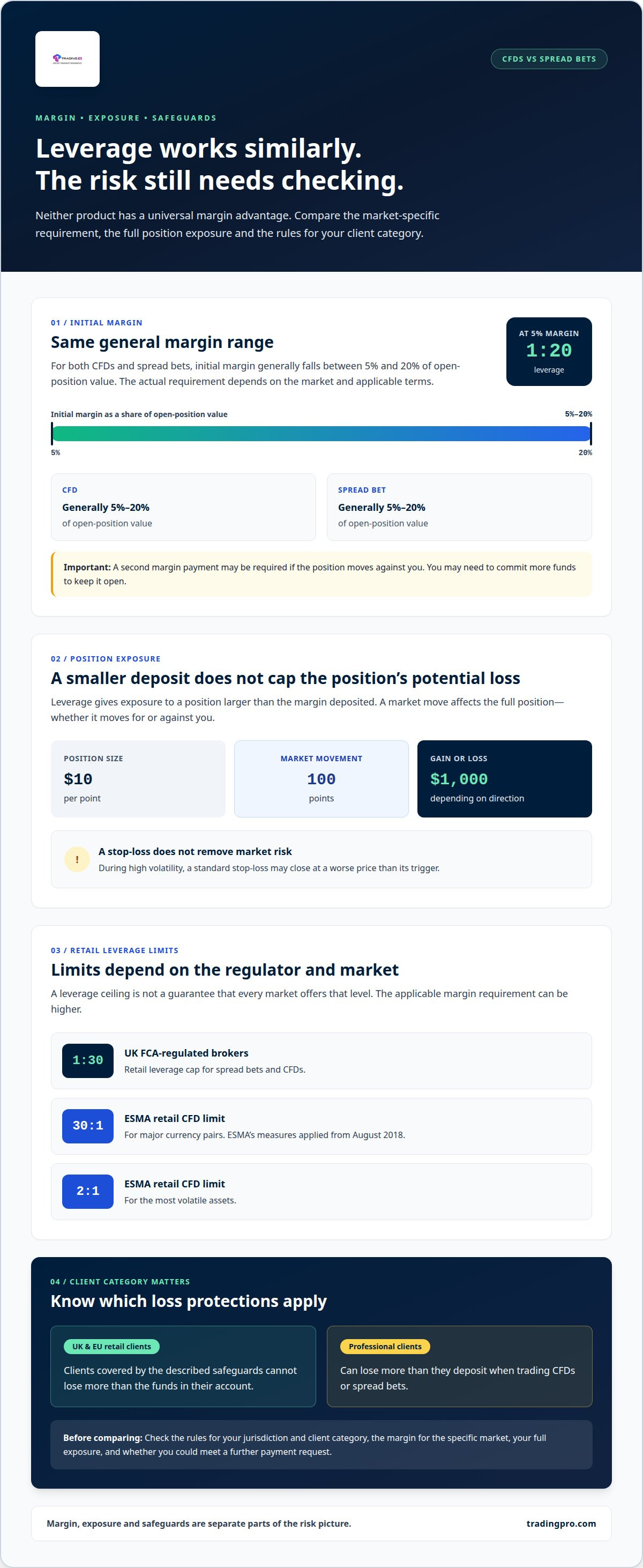
Margin is the amount set aside to open and maintain a leveraged position. Initial margins for CFDs and spread betting generally range from 5% to 20% of open-position value. A 5% margin corresponds to 1:20 leverage: the position’s underlying value is twenty times the margin deposited.
The basic margin mechanism is similar for both products, so neither has a universal margin advantage. The actual requirement depends on the market and applicable terms. You may also need to provide additional margin if a position moves against you, which means committing more funds to keep it open.
| Option | Typical initial margin | Leverage relationship | Possible additional payment |
|---|---|---|---|
| CFD | Generally 5% to 20% of open-position value | A 5% margin equals 1:20 leverage | A second margin payment may be required |
| Spread bet | Generally 5% to 20% of open-position value | A 5% margin equals 1:20 leverage | A second margin payment may be required |
Compare the margin for the specific market and position, rather than choosing by product label alone.
Trading Risk and Leverage-Related Losses
Leverage magnifies exposure to movements in the underlying market. A $10-per-point position would gain or lose $1,000 after a 100-point move. The same calculation applies whether the market moves in your favour or against you; a smaller deposit does not limit the position’s potential loss to that deposit.
Before opening or selling, work out how a plausible adverse move affects the full position. Consider the amount at risk, the margin committed, and whether you could meet a further payment request. A standard stop-loss may close at a worse price than its trigger during high volatility, so it does not remove market risk.
Regulation of Leverage
In the UK, FCA-regulated brokers cap retail leverage on spread bets and CFDs at 1:30. This is a ceiling, not a promise that every market offers that leverage; the relevant margin requirement can be higher. ESMA’s retail CFD limits include 30:1 for major currency pairs and 2:1 for the most volatile assets. Its measures applied from August 2018.
These limits concern retail clients, so client classification matters. Professional clients can lose more than they deposit when trading CFDs or spread bets. By contrast, UK and EU retail clients covered by the described safeguards cannot lose more than the funds in their account. Compare the rules for your jurisdiction and client category before placing a trade.
What Is Spread Betting In Investing?
Spread bets and CFDs are derivatives: they let investors speculate on price movements without owning the underlying asset. Rules and trading costs differ by product and jurisdiction.
Restrictions and FCA Rules
Access depends on location. CFD trading and spread betting are not allowed in the United States, and the U.S. Securities and Exchange Commission prohibits CFD trading there. Spread betting is available only in the UK and Ireland, so U.S. retail investors cannot choose it as an alternative to CFDs.
For UK users, the Financial Conduct Authority’s permanent rules for CFDs, financial spread bets and rolling spot forex took effect in August 2019. These jurisdiction-specific rules matter before comparing products: an instrument available to an investor in the United Kingdom may not be available to one in the United States.
Overnight Financing Charges
Holding a leveraged CFD or spread bet overnight can involve a financing adjustment. This charge reflects the cost of maintaining exposure beyond the trading day. The calculation depends on the instrument, position and applicable terms.
There is no universal rule that one product is always cheaper to hold overnight. Compare the financing basis and how it appears in the account for the same market and direction. Include your expected holding period: a short-lived position and one held through several nights can have different total financing costs.
Markets and Assets Available to Trade
Both products can provide exposure to financial instruments without transferring ownership of the underlying asset. Available markets vary by provider. Examples in these products include share prices and stock indices such as the FTSE 100; some CFD providers list more than 1,500 international stocks.
Start by identifying the specific market you want to trade. Then compare whether a CFD or spread bet tracks it and how the position is quoted. A list of instruments for one product does not establish that every market is available through the other.
UK investors also often consider stamp duty. UK stamp duty on share trades does not apply to spread bets or CFDs because traders do not own the underlying shares. This treatment follows the structure of these derivatives, not a transfer of share ownership.
When choosing between CFDs and spread betting, weigh the instruments you want, access in your jurisdiction, financing terms and how you prefer to measure a position. Both allow speculation on price movements, but their tax treatment and charging structures can differ. Compare the terms that matter most to your trading approach.
UK capital gains tax treatment
In the UK, spread-betting profits are currently free from capital gains tax, while CFD profits are liable to it. This difference follows the products’ tax treatment, not whether the underlying market involves shares. A gain on a CFD can therefore have a different tax result from a gain on a spread bet tracking the same market.
Section 51 of the Taxation of Chargeable Gains Act 1992 provides that betting winnings are not chargeable gains, according to UK legislation. This is the legal basis relevant to betting winnings, but it does not mean every activity called betting receives the same treatment. The UK distinction discussed here is between spread-betting winnings and gains from CFD positions.
For the UK 2026/27 tax year, the annual exempt amount for capital gains tax is £3,000, according to HM Revenue & Customs. For the UK 2026/27 tax year, capital gains above that amount are taxed at 18% or 24%, depending on the taxpayer’s income. These figures make the treatment of CFD gains materially different from the stated UK treatment of spread-betting profits.
CFD losses may be offset against future profits for tax purposes. Spread-betting losses, by contrast, cannot be offset against capital gains. This can matter when comparing results across multiple positions: a profitable CFD trade alongside a losing one may have different tax implications from a winning spread bet alongside a loss.
Tax treatment depends on jurisdiction. Spread betting is available in the UK and Ireland, but UK tax treatment should not be assumed to apply in Ireland. The relevant country’s rules determine how profits and losses are handled. Your country of residence is therefore central to comparing after-tax results, even when both positions track the same market.
In the United States, CFD trading and spread betting are not allowed. The UK tax treatment described above does not establish how U.S. tax rules apply to other financial activity or gains. U.S.-based investors should not use the UK distinction between spread-betting profits and CFD gains as a guide to the tax treatment of other instruments.
To compare the products for a UK tax position, identify whether the trade is a CFD or spread bet, separate gains from losses, and consider the applicable capital gains rules. The key distinction is clear: UK spread-betting profits are currently free from capital gains tax, while CFD profits are liable to it. Tax treatment elsewhere, including Ireland, depends on that jurisdiction’s rules.
Expiry of spread bets and CFD positions
Expiry affects how long a position can remain open and when exposure ends. Spread bets may have fixed time limits ranging from minutes to several years, while most CFD trades can stay open indefinitely. This can shape trade planning, especially if your strategy depends on holding through a specific market movement.
With a fixed-term spread bet, the contract’s expiration date sets its time limit. A position opened for a short-term view may expire before a longer-term market thesis plays out. Review the stated expiry before opening and make sure it matches your intended holding period. Since terms range from minutes to several years, expiry is a feature to compare, not a single standard term.
Most CFDs don’t have a set expiry, so a position can remain open as long as the account and applicable terms allow. Futures and forwards are exceptions: CFD trades based on them can have a defined end date. “Indefinitely” doesn’t mean a trade must stay open forever; it means most CFD positions may have no fixed expiry. Market movements, risk limits and your trading plan still matter.
Currency can affect the practical result when the underlying market and trading account use different currencies. For example, a position linked to an overseas index may produce a result in that market’s currency, while the account balance uses another. The conversion method and related terms can affect the amount shown in the account. Compare these details with the expiry date, particularly if you intend to hold a spread bet or CFD across several trading sessions.
Expiry also affects how you plan for a losing trade. A fixed-term spread bet has a defined time limit, so the market may still be moving when the contract reaches expiry. A CFD without a fixed expiry gives you more flexibility over when to close, but the position remains exposed to price movements while open. Neither structure removes the need to decide what would invalidate your original trade idea.
For a practical comparison, first write down your expected holding period. Then identify whether the spread bet has a fixed expiry, whether the CFD tracks a future or forward, and which currency applies to the position. These differences help you compare like with like. A short-term view may suit a contract with a matching expiry, while a CFD without a fixed date may be more convenient for a longer-term view. The right fit depends on the intended duration and the terms for that instrument.
Financial spread betting basics
A financial spread bet lets you speculate on price movements without buying the underlying asset. You choose a market, a direction and a stake for each point of movement. Your result depends on how far the quoted price moves after you open the position, multiplied by your stake. A rising market can benefit a “buy” position; a falling market can benefit a “sell” position.
For example, a spread bet on the FTSE 100 might use a stake of £5 per point. If the index moves in your chosen direction, each point changes the result by that stake; movement against your position has the opposite effect. The stake is therefore central to the calculation. A larger stake increases the result for each point gained or lost, not the number of points the market moves.
Consider a worked example with a £10-per-point stake and a 50-point rise in the FTSE 100. The position gains £500 before considering the quoted spread. This shows the basic calculation: multiply the number of points moved by the amount staked per point. It also shows why position size matters. The same movement in the opposite direction would produce a loss of the same amount in this example.
The spread is the difference between the bid and offer prices. It affects the price at which a trade can be opened and closed. In one example, an underlying share quote of 1545/1547 becomes 1543.45/1548.55 after a 0.1% spread charge. The wider quote changes the starting point for the trade, so a market must move far enough to overcome that difference before the position shows a net gain.
Costs are another key difference between spread bets and CFDs. Spread-betting companies do not charge fees or commissions, while CFD traders pay a spread and commissions on equities. That doesn’t make every spread bet cost-free: the spread still affects entry and exit prices. Compare the full quoted terms for the same market, direction and position size.
Both products are derivatives, but spread betting expresses exposure as a stake per point rather than a number of contracts or shares. Before opening a bet, identify the market quote, your direction and stake, then calculate how a point movement changes the result. Keep the risk of losing in view: the £10-per-point example produces a £500 loss if the FTSE 100 moves 50 points against the position.
Use the FTSE 100 example to practise the calculation, then start building your trading approach with a clear stake and risk plan.
TradingPRO: Social Trading / Copy Trading
TradingPRO offers Social Trading / Copy Trading for traders interested in replicating other traders’ strategies. After comparing leverage, costs, tax treatment and expiry, this may be a useful next step if you want to explore trading approaches beyond selecting every position independently.
Copying a strategy doesn’t remove market risk or guarantee a particular result. Consider how the approach aligns with your goals, risk tolerance and understanding of the products involved. Keep the differences between CFDs and spread bets in mind, including how each position is sized and taxed in your jurisdiction.
To explore Social Trading / Copy Trading, contact TradingPRO about your next step.
Choose Your Next Trading Step
Turn your comparison into a consistent decision rule. Choose the product structure that fits your approach, then define how you’ll assess each potential position before committing funds. A clear process matters more than choosing a product because one feature seems attractive in isolation.
Your view on CFD trading vs spread betting can also shape the trading environment you want to explore. TradingPRO offers Rookie Account, Micro Account and Pro Account options, alongside Social Trading / Copy Trading. Consider which account option aligns with your goals and experience, and whether following other traders’ strategies fits the way you want to participate.
Take the next step at your own pace. Contact TradingPRO to discuss your options and explore an approach that suits your plans. Build your decision carefully, then move forward with clarity.
Frequently Asked Questions
What is CFD trading?
A CFD is a contract that settles the difference between an asset’s price when a position opens and when it closes. You speculate on price changes without buying the asset itself. For example, a trader might open a CFD position based on a company’s share price, then close it when their view changes. The result depends on the price movement and position size.
What Are CFDs In Investing?
CFDs are derivatives used to take a view on an underlying market without owning its shares or other assets. Investors can open a position based on whether they expect the market to rise or fall. This provides exposure to price movements but no shareholder rights. A CFD position is a contract with a provider, not ownership of the company represented by the share price.
Why Are CFDs So Risky?
CFDs carry risk because leverage can make a relatively small market movement produce a large change in a position’s result. You can lose money if the market moves against your position, and fast price changes can complicate an exit. Before trading, define your exposure and the conditions that would prompt you to close. A stop-loss may not execute at its trigger price during volatile markets.
What is the difference between CFD trading and spread betting?
Both products let you speculate on price movements without owning the underlying asset, but they measure positions differently. A CFD tracks the price difference between opening and closing; a spread bet uses a stake per point of movement. When comparing CFD trading vs spread betting, consider how each position is measured, along with its costs and tax treatment in your jurisdiction.
How do CFD and spread betting profits and losses work?
A CFD’s result reflects the price change between opening and closing, multiplied by the position’s exposure. A spread bet’s result depends on the number of points moved and the stake per point. In either case, an unfavourable market move creates a loss. For a useful comparison, calculate how the same market movement affects each position before choosing its size.
Are spread betting and CFDs legal or available to US residents?
No. CFD trading and spread betting are not allowed in the United States, and the U.S. Securities and Exchange Commission prohibits CFD trading there. Availability elsewhere depends on the country and its rules. Don’t assume that an instrument available in the UK can be accessed by a U.S. resident, or that rules in one country apply in another.
What are the typical fees and costs for CFDs versus spread betting?
Costs vary by market and applicable terms. CFD traders pay a spread, and equity CFDs also involve commissions; spread-betting companies don’t charge fees or commissions, though the spread affects quoted prices. Positions held overnight may also incur a financing adjustment. To compare CFD trading vs spread betting costs, use the same market, direction and holding period.
How do leverage and margin requirements compare for CFDs and spread betting?
Both CFDs and spread bets use margin to open leveraged positions. Initial margins generally range from 5% to 20% of open-position value, and providers may request additional margin after the initial deposit. In the UK, FCA-regulated brokers cap retail leverage at 1:30. The exact margin depends on the market and applicable terms, so compare the position’s exposure as well as its deposit requirement.


