



- Published on: 2026-10-26 11:23:05
CFD Trading Leverage and Its Effect on Exposure and Losses

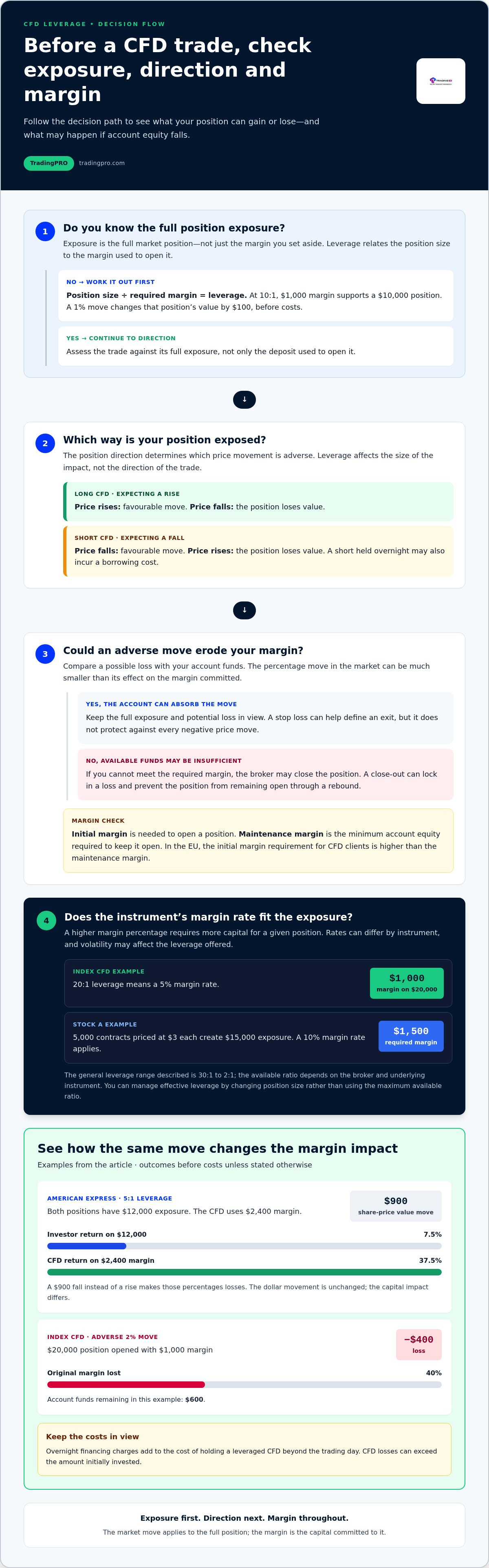
Leverage lets a CFD trader control a larger market position with less upfront capital, called margin. At 10:1 leverage, $1,000 of margin supports a $10,000 position, so a 1% market move changes the position’s value by $100 before costs. Get CFD trading leverage explained through the relationship between exposure and margin, and the effect on gains and losses becomes clear.
CFDs provide exposure to an asset’s price movements without buying the underlying asset. This can make a smaller deposit go further, but it also magnifies the effect of price changes: losses can exceed the amount initially invested. The same mechanics apply whether you take a long position, aiming to benefit from a rise, or a short position, aiming to benefit from a fall. This guide explains CFD trading leverage through practical examples.
Learn how leverage changes exposure, how margin relates to position size, and why the same market move can affect your account in different ways. You’ll also see how profits and losses work on long and short trades, what can happen when you don’t have enough margin, and how to assess risk before opening a position. This guide explains CFD trading leverage in clear terms and connects the key mechanics to real trading decisions.
Key Takeaways
- Assess a CFD trade by its full market exposure, not just the margin set aside to open it.
- Compare margin requirements across instruments to understand how the asset and its terms affect the capital needed.
- Match your long or short position to the market direction you expect, and account for how an adverse move affects your exposure.
- Distinguish CFDs from margin trading and futures by looking at how each product structures exposure and leverage.
- Explore TradingPRO’s Rookie Account as an account option when you’re building familiarity with leveraged trading.
How does leverage affect profits and losses?
Leverage scales a CFD position’s market exposure against the margin used to open it. At 5:1 leverage, a 1% price move changes the position’s value by 5%, before costs.
Amplified Gains and Losses
Leverage magnifies profits and losses because the outcome is based on the full position value, not just the margin deposited. A favourable move can produce a larger return on that margin, while an adverse move can erode it faster. For anyone trading CFDs, the key is to compare the market movement with the total exposure.
Consider the American Express example: an investor pays $12,000 for shares, while a CFD trader uses $2,400 margin for the same $12,000 exposure at 5:1 leverage. A $900 increase equals a 7.5% gain on the investor’s $12,000, but a 37.5% gain on the CFD trader’s $2,400 margin, before costs. If the share value falls by $900 instead, those percentages become losses. The dollar movement is unchanged; the capital impact differs.
Leverage-Related Losses and Risks
Leverage-related risk is the possibility that an adverse price move rapidly erodes margin and account funds. At 10:1 leverage, a 1% adverse move results in a 10% loss on invested capital. A 10% decline could wipe out the initial investment, while CFD trading can also result in losses greater than the amount initially invested.
Position size therefore matters as much as price direction. In one example, a 2% fall in a $20,000 index CFD position opened with $1,000 margin causes a $400 loss, leaving $600 in the account. That loss is 40% of the original margin, even though the index moved only 2%. A stop loss can help define an exit, but it doesn’t protect against every negative price move.
Overnight financing charges add to the cost of holding a leveraged CFD position beyond the trading day.
The trade’s direction determines which price movement causes a loss, but not how leverage works. A long CFD loses when its underlying price falls; a short CFD loses when it rises. A short position held overnight may also incur a borrowing cost. Include these charges when assessing potential profits and losses.
Differences in margin rates across instruments
Margin is the capital required to open and maintain a leveraged CFD position. The margin rate determines how much deposit is required for a given position size, so the same account balance can create different exposure across instruments. An instrument’s margin requirement and price movements together shape the capital needed and the risk involved.
For example, a $20,000 index CFD position at 20:1 leverage requires $1,000 margin. That is 5% of the position value. By contrast, an example using a 10% margin rate requires $1,500 for 5,000 Stock A CFD contracts priced at $3 each. The position value is $15,000, making the required margin 10% of exposure. These examples show why the instrument’s rate matters: a higher margin percentage means more capital is needed for comparable exposure.
Leverage and margin move in opposite directions. Calculate leverage by dividing the total position size by its required margin. A 20% margin rate represents five times leverage, while a lower margin rate supports more exposure per unit of deposit. Providers may set different rates by instrument, including in response to the underlying asset’s volatility. Compare the margin amount with the full position value, not just the cash committed.
Initial margin is the amount needed to open a position; maintenance margin is the minimum account equity required to keep it open. In the EU, CFD clients must meet an initial margin requirement higher than the maintenance margin. If the CFD’s value falls, available funds can approach that lower threshold. Keep enough account equity to absorb adverse movements, and understand that a provider may close a position if you can’t maintain the required margin.
Can CFD losses exceed the initial deposit, and what protections apply? Yes, CFD losses can exceed the amount deposited. The European Securities and Markets Authority has implemented protective measures concerning CFDs, but that does not remove the need to understand margin and close-out risk. If account funds are insufficient to meet the margin requirement, the broker may close the position.
A close-out can lock in losses when a market move reduces account equity below the required level. It may also limit your ability to keep a position open through a rebound. Before opening a trade, calculate the margin against its full position size, then consider how adverse price movements affect available funds. Review the trading account registration once you understand those requirements.
Can I choose how leveraged my position is?
You can manage effective leverage by adjusting your position size, but the available ratio depends on the broker and underlying instrument. The general range offered is 30:1 to 2:1, with volatility influencing the ratio. A higher ratio means less initial margin for the same exposure, while a lower ratio requires more capital.
Separate the leverage available from the leverage you actually use. If your account permits a larger position, you can still open a smaller one. That choice changes your exposure without requiring you to use the maximum ratio. For example, practising with 5:1 or 10:1 leverage is recommended as a way to manage leveraged trades without risking large losses from one trade.
The underlying asset matters because its volatility can affect the offered ratio and the size of price movements. A broker’s general range of 30:1 to 2:1 does not mean every instrument has the same limit. Compare the leverage and margin for the specific CFD before buying or selling. Then size the position around your available capital and the loss you can accept.
Set risk limits before choosing position size
Leverage sets exposure; a risk limit sets how much capital you’re prepared to lose if the trade goes against you. One common guideline is risking 1%-2% of total equity per trade. For a $10,000 account, that equals $100 to $200 of risk on a position. This is a risk-management example, not a guaranteed maximum loss.
Apply the limit to the potential loss at your planned exit, then choose a position size that fits. A 1:2 risk-reward target means the potential reward is at least twice the potential risk. For example, if planned risk is $100, that ratio targets at least $200 potential reward. It doesn’t ensure that the market reaches the target.
Understand stop-loss limitations
A stop loss sets a price at which you intend to close a trade, but it can’t protect against every adverse price move. Fast or discontinuous movements can result in execution at a different price, so the realised loss may exceed the planned risk. This matters with leverage: a small move against a large position can affect account capital quickly.
Before opening a CFD, consider the underlying asset’s volatility, your stop level, and any overnight holding costs. A stop set too close may close the position during normal price fluctuations; a wider stop increases potential losses unless you reduce the position size. CFDs may also be unsuitable for people with low risk tolerance. Choose leverage only when these factors fit your trading plan.
How CFD leverage multiplies market exposure
CFD leverage increases market exposure beyond the amount committed as margin. The calculation is straightforward: divide the total position size by the required margin. This ratio shows how much underlying value your capital controls, not how much you own. A CFD provides price exposure to an asset; it doesn’t transfer ownership of its shares.
The difference between exposure and margin is the essential effect of leverage.
To see the mechanism clearly, separate these amounts:
- Leverage: position size divided by margin, which equals 5:1 in this example.
If Cisco rises, a long position may gain based on its full exposure; if it falls, the same exposure works against the trader. Opening a short CFD reverses the directional aim: falling prices may benefit the position, while rising prices can cause losses. In either case, leverage doesn’t change the underlying price movement. It changes how strongly that movement affects the margin committed.
Exposure also starts with the opening quote, not a theoretical midpoint. For a leveraged position, that opening gap affects the position’s return from the outset.
Use the full position value to assess exposure, then compare it with the deposit and the likely scale of price movements. A smaller margin can control a larger position, but it doesn’t reduce market exposure or cap losses at the margin amount. A CFD position can lose more than initially invested. That’s why position size, direction, spread, and exit plan all matter, whether you’re buying long or selling short.
How does CFD leverage compare with margin trading and futures leverage?
CFDs, margin trading, and futures can all create exposure larger than the cash committed. Their leverage figures aren’t interchangeable, however. Each product defines exposure differently, has its own margin rules, and handles ownership or contract obligations in a distinct way. Before deciding which form of leverage fits your plan, compare the underlying position, collateral requirements, ongoing costs, and how the trade ends.
A CFD is a contract whose value follows an underlying market price. It gives you price exposure without requiring you to buy or sell the underlying asset itself. Margin supports the CFD position, while the trade’s profit or loss reflects price changes across its full exposure. The contract is with the provider, so review its terms, including how positions are valued and closed.
Margin trading generally involves borrowing funds to buy securities, such as shares. The shares are held in the account, and the borrowed amount increases the position beyond the trader’s cash contribution. Borrowing interest and account margin requirements affect the trade. If a share price falls, account equity can decline while the debt remains payable, so both exposure and borrowing obligations matter.
Futures use contracts to buy or sell an underlying asset at a specified future date under standardized terms. Traders post margin as collateral rather than paying the full contract value upfront. The contract’s size, expiry, and settlement method shape exposure. Futures traders may need to monitor their collateral while a position is open.
Look beyond the displayed leverage ratio. A CFD margin rate describes the deposit required relative to position value; futures margin is collateral for a contract, while margin-trading leverage includes borrowed funds. A ratio alone doesn’t reveal financing, contract expiry, ownership rights, or how losses affect available capital. Compare these mechanics for the specific product and underlying market.
For example, when comparing a share CFD with buying shares on margin, consider whether direct share ownership matters to you. A CFD provides price exposure without ownership; margin trading involves buying securities with borrowed funds. A futures contract differs again, with standardized terms and a defined expiry or settlement process. These are structural differences, not simply alternative leverage settings.
Choose by matching the instrument’s structure to your objective, holding period, and ability to manage margin. Check the contract value, collateral rules, financing or borrowing costs, and exit conditions before opening exposure. If you’re ready to put your market plan into practice, create a trading account.
TradingPRO: Rookie Account
After learning how leverage affects exposure, margin, and potential losses, traders can consider TradingPRO’s Rookie Account. Start by defining a position size and risk limit you can manage, then compare your needs with the available account options. The Rookie Account is one option for exploring your trading approach, alongside the Micro Account, Pro Account, and Scalp Account.
Choosing an account doesn’t remove CFD risk or determine the leverage for every position. Keep assessing each trade’s exposure, required margin, and exit plan before opening it. When you’re ready to explore your options, visit tradingpro.com.
Put your trading plan into practice
Turn what you’ve learned into a repeatable decision process. Before opening a CFD position, define your market view, choose exposure that fits your risk plan, and decide how you’ll respond if the price moves against you. Having CFD trading leverage explained in practical terms is a starting point; consistent preparation helps you approach each trade with purpose.
TradingPRO offers Rookie Account, Micro Account, and Pro Account options for different trading approaches. Consider which account aligns with your plans, then review your objectives and risk limits before taking action. Leverage can increase market exposure, but it can’t remove uncertainty or guarantee an outcome. Base your decisions on the position’s potential impact on your capital.
Explore TradingPRO account options and take your next step with a clear plan. Build your understanding, stay disciplined, and move forward with confidence.
Frequently Asked Questions
What is CFD trading and how does it work?
CFD trading lets you trade price movements through a contract with a provider, without owning the underlying asset. You can choose a long position if you expect the price to rise, or a short position if you expect it to fall. When you close the contract, your account reflects the price change, adjusted for applicable trading costs. A share CFD, for example, doesn’t make you a shareholder.
What is leverage in CFD trading?
Leverage in CFD trading lets you control market exposure that exceeds the margin committed to a position. A simple comparison explains CFD trading leverage: compare the position’s market value with its margin requirement. Profit or loss follows the full exposure, not just the margin. This can make your capital go further, but an adverse move can also have a greater effect on your account.
Can leverage help with market fluctuations?
Leverage doesn’t smooth market fluctuations or protect a position from them. It can provide exposure without requiring you to commit the position’s full value upfront, but price changes still affect the full exposure. An unexpected market swing can quickly reduce available account funds on a leveraged trade. To manage fluctuations, focus on position size and the impact of adverse movements, rather than treating leverage as protection from volatility.
How can diversification help manage leverage risk?
Diversification can reduce dependence on a single market or asset, but it doesn’t automatically reduce total leveraged exposure. Positions in different instruments may still respond similarly to the same market event. Review combined exposure across open trades, not just each position on its own. If several CFDs are sensitive to the same underlying factor, they can lose value at the same time. Pair diversification with deliberate position sizing and risk limits.
How can market shifts affect CFD trades?
Market shifts can quickly change a CFD’s value, affecting open profit or loss and the funds available to support positions. An unexpected decline works against a long trade; a sharp rise can hurt a short trade. Fast price changes can also make it harder to exit at the expected level. Reassess exposure when conditions change, especially before holding a position overnight.
What is leverage in CFD trading and how does it work?
Understanding CFD trading leverage starts with the relationship between a position’s total exposure and its margin. This allows a trader to access a position without paying its full value upfront. The provider sets margin requirements, while the trader chooses a position size within those requirements. A higher leverage ratio means less margin relative to exposure, but the underlying market movement still applies to the full position.
How do you calculate CFD leverage and required margin?
Divide the position value by required margin to calculate leverage; divide the position value by the leverage ratio to calculate required margin. For example, a $50,000 CFD position at 10:1 leverage requires $5,000 in margin. Use the same currency for both amounts and apply the instrument’s margin requirement. This calculation identifies the margin needed to open the position, not its maximum possible loss.
What are typical CFD leverage limits for retail traders in the United States?
Retail investors in the United States are prohibited from trading CFDs, so retail CFD leverage limits aren’t an available trading allowance there. Leverage ratios offered by brokers in other markets don’t override that restriction. Distinguish a product’s leverage from whether retail investors can trade it in a particular country. Applicable market rules determine access, not a ratio advertised for another jurisdiction.


