



- Published on: 2026-10-20 10:27:40
Best broker for micro accounts Best Practices and Expert Advice

Smaller trade sizes can make exposure easier to manage, but they don’t remove market risk. The best broker for micro accounts is one whose account terms fit your trading plan and clearly explain costs, funding, and account setup.
Choosing a micro account is about more than finding a low entry point. Understand how position size affects potential gains and losses, what protections apply to your funds, and what opening a live account involves. This guide explains micro trading accounts, outlines practical comparison criteria, and walks through the steps to open an account. Use it to weigh the trade-offs and decide whether a micro account suits your approach.
Key Takeaways
- Understand how micro, mini and standard lot sizes change your market exposure, and why pip value alone doesn’t capture every trading cost.
- Compare regulatory oversight and fund protections for the broker entity serving your country before choosing an account.
- Assess the minimum deposit alongside spreads, commissions and account terms to judge the overall fit, not just the entry amount.
- Use a live-account opening checklist to prepare your application, complete identity checks and select the account settings that suit your approach.
- Explore TradingPRO’s Rookie and Micro Accounts alongside its Pro and Scalp Accounts to identify an account tier aligned with your trading needs.
What Is a Micro Trading Account?
A micro trading account lets you place smaller forex positions than a standard-lot account. Compare position sizes with spreads, commissions, deposit terms, and the rules for the instruments you plan to trade.
Spreads and Trading Commissions
A spread is the difference between an instrument’s buy and sell prices. A commission is a separate trading charge. Since some fee structures emphasize spreads while others list commissions separately, compare the total cost for your planned trading activity.
A two-pip EUR/GBP move on that size represents a $0.20 profit or loss before trading costs. A micro lot is 1% of a standard lot, which represents 100,000 base currency units at 1.00 lot.
Deposits and Commission Charges
When comparing XM, consider its account deposit requirement and trading commissions separately. A deposit funds your account; a commission is a trading cost set by the applicable account terms. The deposit amount alone doesn’t show what frequent trading may cost.
Compare the fee schedule for the account type and instrument you intend to use. Stocks and ETFs may have different commission structures from forex: charges can be calculated per trade or per share, and spreads or other transaction fees may also affect the total. Read how costs are calculated before comparing accounts.
Leverage, Margin, and Trading Risks
In the U.S., there isn’t a single leverage rule that applies simply because an account is called “micro.” Leverage and margin requirements depend on the instrument, account classification, and applicable broker terms. A micro lot changes position size, not the product’s underlying margin rules.
Micro trading still carries market risk. A price move against your position can reduce account equity, and leverage can magnify the effect. Spreads and commissions also reduce results. Smaller trades can help control exposure, but they don’t prevent losses or guarantee that a position can be closed at the expected price.
Use this table to compare position sizes and fees. Stocks and ETFs follow their own charge schedules, rather than forex lot sizing.
| Option | Position or unit size | Cost to compare |
|---|---|---|
| Forex cent lot | 100 base currency units; 0.001 lot | Spread and any commission |
| Forex micro lot | 1,000 base currency units; 0.01 lot | Spread, commission, and pip value |
| Forex standard lot | 100,000 base currency units; 1.00 lot | Spread and commission at larger exposure |
| Stocks and ETFs | Shares or units | Per-trade or per-share commission, spread, and other charges |
Match position size to your exposure plan, then compare the full fee structure for the instruments you intend to trade.
Broker regulation and fund protections
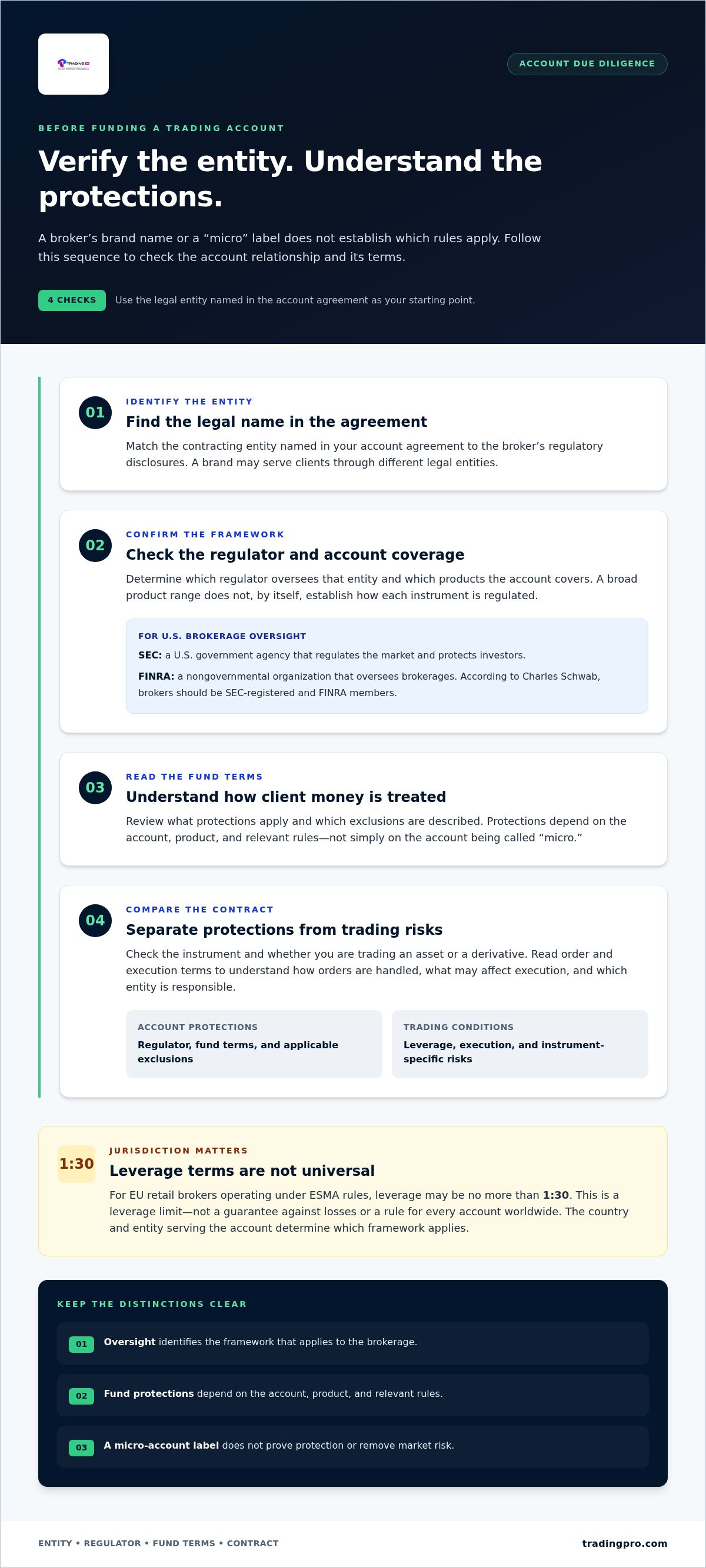
A broker’s brand name alone doesn’t tell you which rules apply to your account. Identify the legal entity in the account agreement, then compare its regulator, available instruments, and terms for handling client funds.
Registration and oversight in the United States
According to Charles Schwab, brokers should be registered with the Securities and Exchange Commission (SEC) and be members of the Financial Industry Regulatory Authority (FINRA). The SEC is a U.S. government agency that regulates the market and protects investors; FINRA is a nongovernmental organization that oversees brokerages.
These roles are distinct. Registration and oversight identify the framework that applies to a brokerage, while fund protections depend on the account, product, and relevant rules. Don’t treat a micro-account label as proof of protection. Review the agreement to identify the contracting entity and available instruments.
Instruments, execution, and the contract
A broker may offer different instruments, but a broad selection doesn’t establish how each one is regulated. A stock transaction and a forex contract can have different terms, risks, and protections. Compare each product description with the legal entity named in the contract, and note whether you’re trading an asset or a derivative.
Execution is another consideration. Read the order and execution terms to understand how orders are handled, what may affect execution, and which entity is responsible. This helps distinguish the broker’s trading service from investor-protection rules. A broker’s stated mission or product range doesn’t replace these contractual details.
Offshore entities and cross-border accounts
An offshore account may be opened under a different legal entity from an account offered in your country. This can affect which regulator oversees the relationship and which complaint channels apply. Compare the entity named in the account agreement with the regulator identified in its disclosures.
For EU retail brokers operating under ESMA rules, leverage may be no more than 1:30. That limit is a leverage rule, not a guarantee against losses or a statement about every account worldwide. Jurisdiction matters: the country where the account is held and the entity serving it determine which framework applies.
Use this sequence before funding an account:
- Identify the entity: Match the agreement’s legal name to the broker’s regulatory disclosures.
- Confirm the framework: Determine which regulator oversees that entity and what products the account covers.
- Read fund terms: Review how client money is treated, what protections apply, and which exclusions are described.
- Compare the contract: Separate protections from leverage, execution, and instrument-specific risks.
A sound comparison weighs oversight and fund terms alongside trading features. Don’t assume an account label or list of instruments settles the question.
Minimum deposits
A micro account’s minimum deposit is only one entry requirement. Compare the funding minimum with the account’s trade-size rules, available instruments, and the cash buffer in your trading plan.
Small Trading Account Deposits
Treat that figure as an entry threshold, not a recommendation for how much to trade with. A small deposit may leave less money available to support open positions and absorb losses.
Before funding, review the account minimum, deposit methods, and any conditions on withdrawals or account use. Distinguish the amount needed to open an account from the balance you plan to keep available while trading. They serve different purposes.
Broker Minimum Deposits and Trade Sizes
A broker’s deposit minimum and minimum trade size are separate limits. The deposit minimum determines how much you must add to open or fund an account; trade-size rules determine the smallest position you can place. A low deposit minimum doesn’t mean every instrument can be traded in equally small amounts.
Compare both requirements for each instrument. A forex account and an account for exchange-listed securities may have different trade units and funding terms. Check whether minimums vary by account type, currency, or payment method, then compare them with your intended position sizes.
Brokerage Account Minimum Deposits
For a brokerage account that trades securities, distinguish the account-opening minimum from the amount required to buy a specific security. The broker’s terms govern account funding, while the instrument’s price and order rules affect the cash needed for a trade. A global exchange listing doesn’t establish a universal deposit threshold.
Look for account-specific requirements in the broker’s disclosures and funding instructions. Confirm the account currency, how deposits are credited, and whether the account supports your chosen instruments. These details help you avoid a mismatch between the balance you plan to provide and the trades you intend to place.
Use this comparison before choosing where to deposit:
- Account minimum: Identify the broker’s opening or funding threshold for the specific account.
- Trade minimum: Find the smallest permitted position for each instrument you plan to use.
- Available balance: Set aside funds for open positions and potential losses, rather than treating the opening minimum as a trading budget.
- Funding terms: Compare accepted deposit methods, account currency, and any stated conditions.
For example, if you’re considering forex and securities, compare their account requirements separately instead of assuming one deposit rule covers both. The useful minimum is the amount that meets the account terms and supports a deliberately sized trading plan.
Broker comparisons
For U.S. residents, a broker’s registration alone doesn’t establish whether it offers micro accounts. To identify the best broker for micro accounts, first confirm that the entity serving U.S. customers accepts your application and supports the instruments you plan to trade.
Compare the legal entity, trading costs, instrument access, and educational resources. Beginners may value clear account guidance, while experienced traders may prioritize execution and order controls. Neither profile makes leverage or a low entry requirement a substitute for understanding risk. When searching for the best broker for micro accounts, focus on these practical differences, not the broker’s label alone.
| Broker option | U.S. oversight to assess | Micro-account comparison focus |
|---|---|---|
| U.S.-registered brokerage | SEC registration and FINRA membership | Account eligibility and available instruments |
| Forex-focused broker | U.S. entity and applicable oversight | Whether micro-size forex positions are offered |
| Multi-asset broker | Regulatory entity for each account | Differences between forex and securities access |
| Offshore broker entity | Jurisdiction and entity named in the contract | Whether its account is available to U.S. residents |
| Broker with educational tools | Registration and membership remain central | Quality of account guidance and learning materials |
Use the table as a screening framework, not as a claim that every category accepts U.S. customers or offers micro trading. “Micro” describes position sizing, but doesn’t establish which instruments an account supports. The legal entity and product terms matter more than the marketing label.
Compare costs by instrument. For forex, assess the spread and any commission; for securities, review the charges and trading conditions. Also compare leverage terms. Retail brokers regulated in the EU under ESMA rules may offer leverage of no more than 1:30, but that rule isn’t a U.S. standard.
Registration and membership are useful screening criteria, not a guarantee against trading losses. The SEC is a U.S. government agency that regulates the market and protects investors; FINRA is a nongovernmental organization that oversees brokerages. Fund protections and complaint processes depend on the account and entity, so distinguish them from general oversight.
Before selecting a broker, compare your needs against five practical questions:
- Entity: Which legal company appears in the account contract?
- Access: Does that entity serve U.S. residents and support your intended instruments?
- Size: Can you place trades at the position size your strategy requires?
- Costs: How do spreads, commissions, and other trading charges apply?
- Support: Are educational materials clear enough to help you understand orders and account terms?
The best broker for micro accounts is the one whose U.S. entity, account access, and trading terms fit your plan. Don’t choose based on a low minimum or leverage figure alone.
Opening a live micro account
Opening a live account involves more than making a minimum deposit. Follow the application in order: select the right legal entity, complete the account details, fund the account, then review the order settings before trading.
Start with the account and entity. Choose an account that supports the instruments you intend to trade. Match the broker’s legal entity to your country of residence, then read the account agreement and product terms. This clarifies which trading conditions and fund-handling rules apply before you submit personal information.
Complete the application accurately. Provide your legal name, residential details, contact information, and any requested financial or trading-experience details. Keep information consistent across the form and supporting documents. If identity or address documents are requested, submit clear copies that match your application. Accurate entries can help prevent avoidable delays during account review.
Set the account currency and fund it. Choose a base currency that suits your planned deposits and withdrawals. Compare the minimum deposit with the amount you intend to risk, rather than treating the minimum as a recommended trading balance. Review the payment method and processing terms, including any currency conversion when your payment currency differs from the account currency.
Check position sizing before placing an order. A forex micro lot represents 1,000 units of the base currency and 0.01 lot. That is 1% of a standard lot. Enter the instrument and position size carefully, then inspect the order preview.
Before your first live trade, use this checklist:
- Confirm the account is approved for the instruments you plan to trade.
- Review the spread, commission, margin details, and order type shown for that instrument.
- Set a position size that fits your available capital and loss limits.
- Check the order direction, quantity, and any stop or limit instructions before submission.
- After execution, review the open position and account balance in the platform.
A live micro account provides smaller position sizing, not protection from losses. For example, a two-pip move in EUR/GBP on a micro lot represents a $0.20 profit or loss before trading costs. Build a repeatable process: check the position, costs, and available capital before each order. If you’re ready to begin the registration process, start your live account registration.
TradingPRO: Rookie Account
TradingPRO’s Rookie Account is a starting point for readers comparing account options and learning how micro trading works. If you’re focused on smaller forex positions, compare it with the Micro Account and consider how each fits your plan. The account name alone doesn’t determine costs, instrument access, or risk, so review the relevant terms before opening an account.
TradingPRO also offers Pro and Scalp accounts, giving you additional tiers to compare as your priorities and approach take shape. Ground your decision in the factors covered here: account requirements, trading costs, fund protections, and live account setup. Explore the Rookie Account and other TradingPRO options to find an account that fits your trading approach.
Make Your Next Move With a Clear Plan
Turn your comparison into a trading plan. Define what you want from a live account, which instruments you intend to trade, and how much capital you can put at risk. Use those priorities to guide your account choice instead of letting a broker’s label make the decision. The best broker for micro accounts is one whose terms and trading environment fit your needs.
TradingPRO offers Rookie, Micro, and Pro accounts, giving you distinct tiers to consider as you set your direction. Choose the account that aligns with your current approach and review its terms before proceeding. A focused decision can help you begin with greater clarity and build your process deliberately.
Start your TradingPRO registration and take the next step toward a more intentional trading setup.
Frequently Asked Questions
Can You Invest With a Small Amount of Money?
Yes, if your account and chosen instrument allow small-unit or fractional orders. First decide how much capital you can afford to risk, then compare account funding rules, order-size limits, and trading costs. For example, a small balance may support fractional share purchases where available, while forex exposure depends on position size and leverage. Starting with less capital doesn’t remove the possibility of loss.
How Much Money Do you Need to Open a Brokerage Account?
The required amount depends on the broker, account type, and instruments you want to trade. Separate the opening minimum from order requirements and the balance available for trading. Before funding, identify the deposit threshold for the specific account and consider how much capital you want to keep available after placing trades.
The Differences Between Various Forex Accounts?
Forex account types can differ in position sizing, pricing, and trading conditions. By common lot definitions, a cent lot represents 100 base currency units at 0.001 lot, a micro lot represents 1,000 units at 0.01 lot, a mini lot represents 10,000 units at 0.10 lot, and a standard lot represents 100,000 units at 1.00 lot. Compare the account’s trading terms, not just its name.
What is a micro account in forex or investing?
A micro account is an account type that allows smaller position sizes, especially in forex trading. “Micro” isn’t a universal label for every investment account, so check the account’s instrument list and contract terms to understand what you can trade and how positions are measured.
What are the minimum deposits and trade sizes for micro accounts?
Deposit minimums and minimum trade sizes are separate requirements. For forex, a micro lot is 0.01 lot, or 1,000 base currency units. Check both requirements before opening an account, then consider whether your available balance can support your planned positions and absorb adverse price movements.
What are the fees, spreads, and commissions for micro accounts?
Trading costs can include a spread and a separate commission. The spread is the difference between buy and sell prices; a commission is an additional trading charge. Compare both for the same instrument and account for your expected trading frequency. A low apparent cost on one trade may not reflect the total cost of repeated entries and exits.
What assets can you trade with a micro account?
The account terms determine which instruments are available; “micro” describes position sizing, not a guaranteed asset selection. Forex accounts can use micro lots for currency-pair trading. Stocks and ETFs may follow separate account and order rules, so don’t assume forex sizing applies to them. Review the instrument list and contract before choosing an account for a particular market.
How do micro accounts compare with standard and cent accounts?
In forex, a cent lot represents 100 base currency units, a micro lot 1,000, and a standard lot 100,000. Forex account labels can indicate different position sizes, so check the account’s contract terms before trading. The larger the unit size, the greater the exposure to a given price movement. Choose the size that matches your risk plan, rather than moving up solely to increase potential returns.


